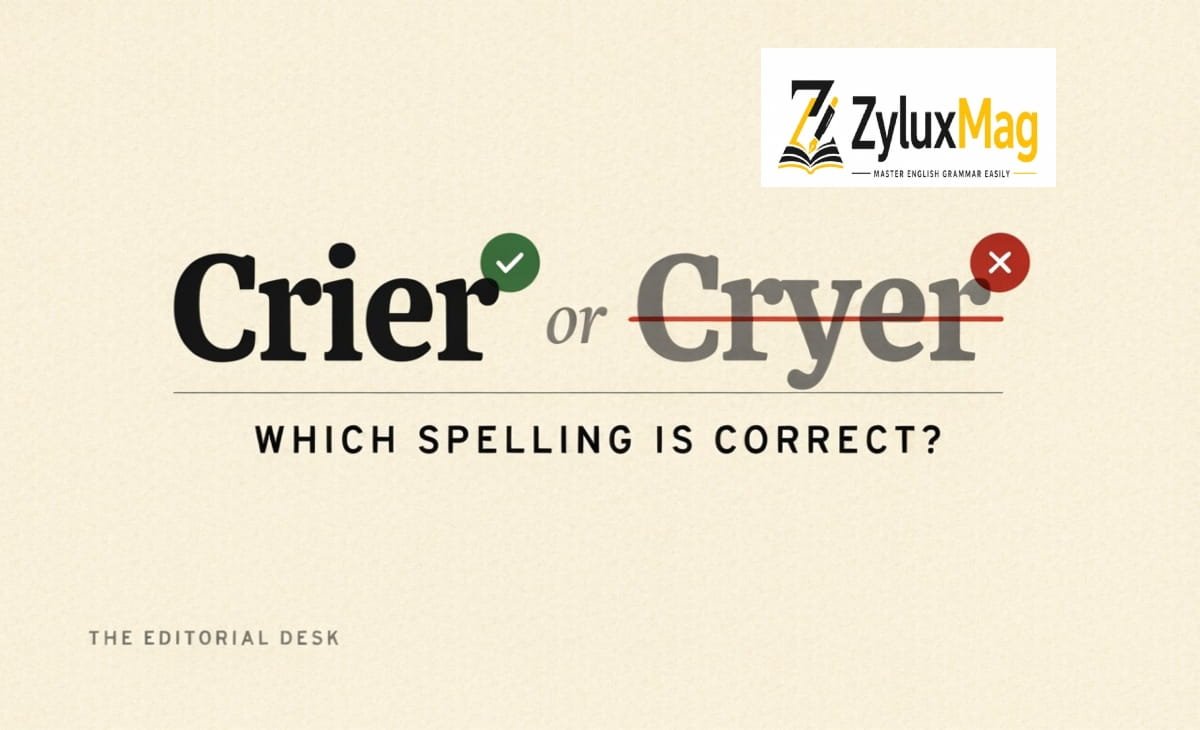
Crier is the correct, standard spelling in modern English. It’s the word used for someone who cries frequently, or for the historical “town crier” who announced public news. Cryer is not a standard word — it’s recognized only as a minor variant spelling, and today it survives mainly as a surname, like the actor Jon Cryer.
If you’re writing a sentence right now, use crier.
In college, I gave a presentation on emotional expression in film and put “the actor is a natural cryer” right on the slide, in size-40 font, for the whole class to see. My professor didn’t even wait — she just said “crier” mid-sentence, like a reflex, and moved on. I wanted to disappear. What got me wasn’t the correction itself, it was realizing I’d never actually questioned the spelling before — I’d just always written it the way it sounded. That one word stuck with me longer than anything else from that class.
What Does “Crier” Mean?
“Crier” has two related meanings, both from the verb cry.
- Someone who cries easily or often.
She’s not usually a crier, but that movie broke her. He’s always been an easy crier.
- Someone who makes public announcements — especially a “town crier.”
Before newspapers, radio, or the internet, towns hired a town crier to walk through the streets and shout out news, laws, and announcements.
The town crier rang his bell in the square before reading the news. He works as a court crier, announcing the judge’s arrival.
Both meanings use the exact same spelling: crier.
Why Do People Write “Cryer” Instead?
Simple reason: “crier” and “cryer” sound identical when spoken. Since English spelling doesn’t always match pronunciation, it’s easy to guess wrong and add “-er” straight onto “cry.”
The Spelling Rule Behind It
When a verb ends in a consonant + y, and you add a suffix like -er, the y changes to i.
- cry → crier
- carry → carrier
- supply → supplier
- apply → applier
This is a regular pattern in English, not an exception. Once you recognize it in “carrier” or “supplier,” “crier” stops looking unusual. Just like confusion between ‘weren’t’ and ‘wasn’t,’ spelling errors such as ‘cryer’ instead of ‘crier’ are common among learners.
Is “Cryer” Ever Correct?
Only as a proper noun — specifically, as a surname.
Jon Cryer starred in Pretty in Pink.
People see this spelling in names often enough that it feels familiar, which is part of why the common noun gets misspelled the same way. But a surname doesn’t change the spelling rule for the everyday word. As a common noun — someone who cries, or someone who makes announcements — only crier is correct.
Crier vs. Cryer: Quick Reference
| Crier | Cryer | |
| Standard spelling | Yes | No — nonstandard variant |
| Meaning: cries often | Correct | Incorrect |
| Meaning: town crier | Correct | Incorrect |
| Valid as a surname | Not typically | Yes (e.g., Jon Cryer) |
| Use in writing | Always | Avoid, except as a name |
Common Mistakes to Avoid
Spelling by sound instead of by rule. Because “crier” and “cryer” sound the same, writers often default to whichever looks more “phonetic.” English spelling rules — not pronunciation — decide this one.
Assuming the surname makes “cryer” correct. Seeing “Cryer” in a name doesn’t make it a valid spelling of the common word. Names don’t have to follow standard spelling rules.
Forgetting the “town crier” meaning. Some writers only know “crier” as “someone who cries” and are thrown off when they see it used for a public announcer. Both meanings are standard.
Plural and Related Forms
The plural of crier is criers.
Two town criers stood in the square.
There’s no difference between American and British English here — crier is the standard spelling in both.