A few years ago, I sent a client report that included the line “please review for any oversite before we submit this.” My manager forwarded the report back with one red word and a note: “Do you mean oversight? Unless we’re pouring concrete right now.”
I remember sitting there staring blankly at my screen, half laughing, half mortified.
It wasn’t the end of the world, but the experience stuck with me – because in business and professional writing, a single letter can really undermine your credibility. That little red highlighting taught me more about “oversight” vs “oversite” than I had ever learned from a grammar book. I’ve triple-checked the spelling ever since.
Quick Answer
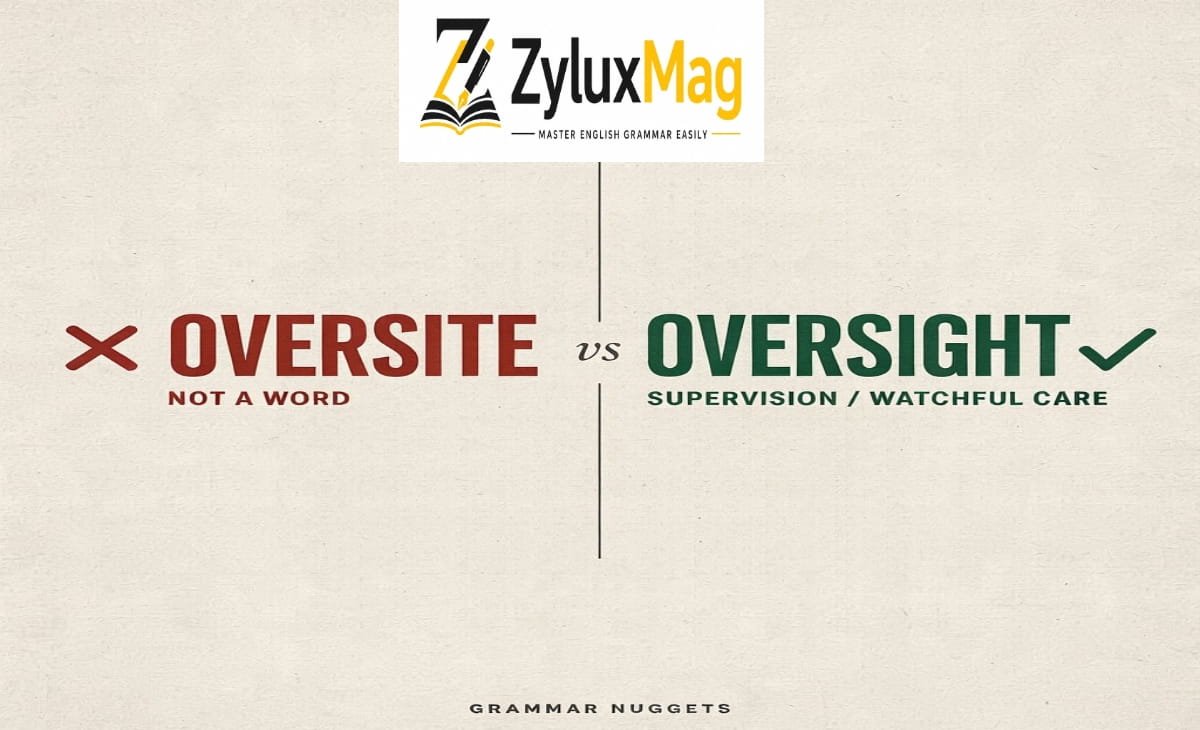
Oversight is what almost everyone needs. It can mean either close scrutiny or the act of accidental omission. Oversite is another real word, but you’ll only need it if you’re working in building construction and referring to a concrete base. Otherwise, use “oversight.”
Why the Confusion?
The mix-up between these two words isn’t accidental. “Oversite” and “oversight” are virtually identical in pronunciation and appear built on the same root. In reality, though, they have separate origins.
“Oversight” comes from the idea of “sight”-or failing to notice something, and by extension, of “watching over” or “managing” something or someone else.
“Oversite” comes from “site”-a physical location. In building and construction contexts, it specifically means a concrete or hardcore floor foundation.
Separating the roots clarifies these definitions: one is about watching; the other is about a physical spot.
What “Oversight” Means
This noun has two distinct, generally unrelated meanings. The correct one to use depends entirely on the context. English reused the word “oversight” for both.
Meaning 1: Supervision or Management
Oversight refers to the act of watching over an activity to ensure it is being handled correctly.
The board provides oversight of financial operations.
Regulatory oversight is more complex in certain industries.
The system requires close oversight from the supervisor.
Meaning 2: An Accidental Mistake or Omission
Oversight refers to an accidental, often unintentional, mistake or omission.
Failure to sign the check was an oversight.
Due to an accounting oversight, the customer was incorrectly billed.
I’m sorry, that missing reference was an oversight.
Coincidentally, the two meanings stand in contrast: one implies carefully seeing and managing, the other a lack of careful seeing (or managing). Nevertheless, contexts usually make clear which sense is meant, and native speakers are not confused about which “oversight” they’re using.
What “Oversite” Means (The Construction Word)
“Oversite” is not a misspelling in construction and related trades (especially in Britain), where it refers to a concrete or hard fill foundation laid directly onto prepared ground, acting as a base for a floor.
Before the main floor, the crew had to pour the oversite.
The oversite will protect the floor from moisture.
Use of this term outside construction is so rare that many major dictionaries, such as Merriam-Webster, do not list “oversite” as an entry. If you’re not writing a technical report on building design, “oversite” is almost certainly the incorrect spelling of “oversight.”
Oversite vs Oversight at a Glance
| Oversight | Oversite | |
| Meaning | Supervision/management, or an accidental mistake | A concrete layer laid over prepared ground |
| Word type | Standard English noun | Niche, technical noun (mainly British) |
| Common context | Business, government, everyday writing | Construction, architecture, building trades |
| Dictionary status | In Merriam-Webster and all major dictionaries | Not in Merriam-Webster; found in British/technical dictionaries |
| Example | An oversight delayed the report. | They poured the oversite before flooring. |
One Simple Trick to Avoid the Mix-up
Let the root words remind you:
“Sight” for “Oversight”: The sense of sight involves seeing. Oversighting involves looking over-or perhaps failing to see confusing homophones like wean and ween.
“Site” for “Oversite”: A site is a place. An oversite is something set down at a building site.
If your sentence doesn’t have something to do with a physical building site, then it needs “oversight.”
Watch Out for These Common Traps:
Treating “oversite” as always wrong. While correct only in construction, don’t assume any mention of it anywhere else is a typo. It could be a British source.
Assuming “oversight” can only be negative. It’s quite positive when discussing strong management or supervision.
Forgetting they’re truly homophones. “Sight” and “site” are homophones, meaning they are spelled differently but sound the same. This is why you need to carefully check your spelling rather than relying on your ear.
Using “oversite” in regular business writing to sound more technical. It doesn’t help; it usually just looks like an error to an editor.
Using either “oversight” or “oversite” as a verb. They are nouns. To indicate supervision, use the verb “oversee.”
Related Word Forms
Oversee (verb): to look over and manage. The project manager overseas all the site engineers.
Overseer (noun): someone who looks over and manages others. The overseer disciplined the slack workers.
Oversights (plural noun): a collection of mistakes or omissions. Despite careful proofreading, oversights can still occur.
Note there isn’t an “oversite” as a verb. Use “oversee.”
Quick Answers to Related Questions
Is “oversite” ever correct?
Yes — but only in construction and building contexts, where it refers to a concrete base layer laid over the ground.
Can “oversight” mean something positive?
Yes. “Oversight” can mean careful supervision (a positive, active meaning) as well as an accidental mistake (a negative, passive meaning). Context decides which one applies.
Are “oversight” and “oversite” pronounced exactly the same?
Yes — “sight” and “site” are true homophones, both pronounced /saɪt/. That’s exactly why the spelling gets mixed up so easily in writing, even though the meanings are completely different.
About the Author
Faizan Babar is a writer and editor at ZyluxMag, focused on making English grammar and vocabulary clear, practical, and genuinely useful for everyday writers. Drawing on years of hands-on experience in professional and freelance writing, he breaks down confusing word pairs like “oversite vs oversight” into simple, real-world guidance — the kind he wishes someone had handed him earlier in his own writing career.