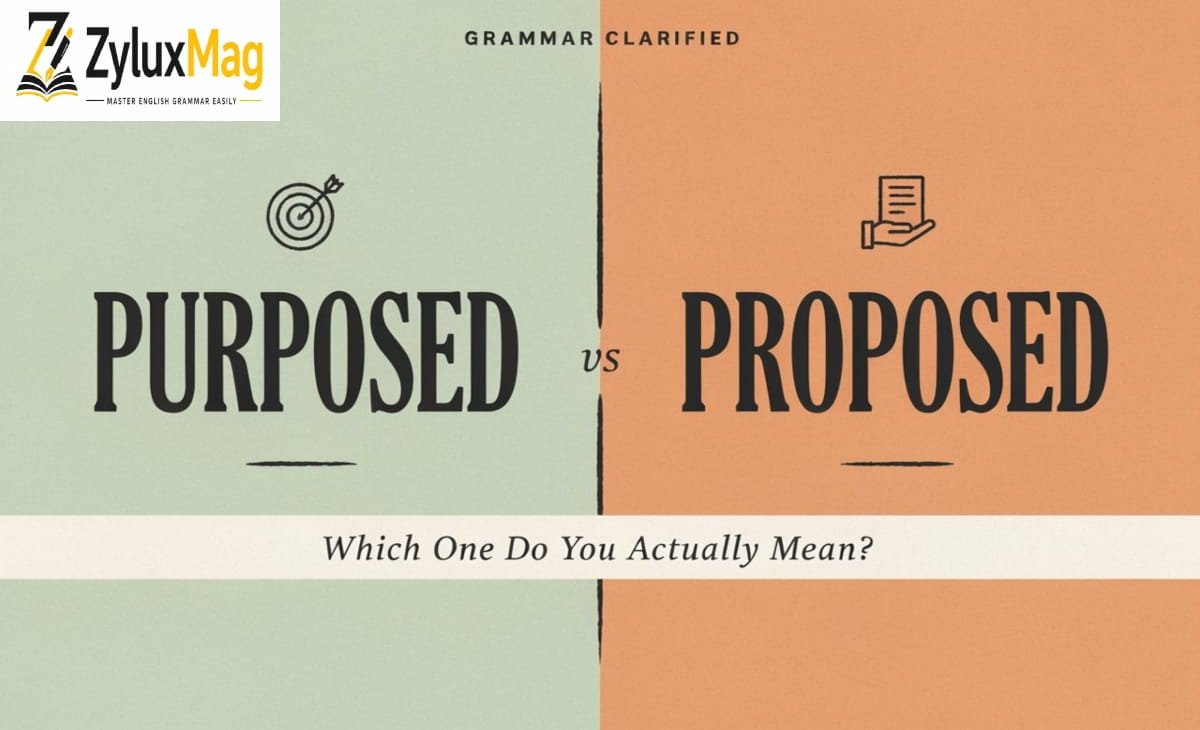
A few years into my first office job, I sent an email to my boss saying I “purposed” a new filing system for our team. She replied two minutes later with just one line: “Did you mean proposed?” I remember staring at my screen, face burning, replaying the email in my head like it was a crime scene. I’d typed it fast, trusted spellcheck, and moved on — except spellcheck doesn’t catch a wrong word that’s spelled right. That tiny mix-up taught me more about careful proofreading than any grammar class ever did.
Quick Answer
Proposed is almost always the word you want. It means to suggest or put forward an idea for other people to consider — “She proposed a new plan.” Purposed is a much rarer, older word meaning to have deliberately intended or resolved to do something on your own — “He purposed to leave at dawn.” If you’re offering something for discussion or approval, use proposed. If you truly mean a fixed, personal intention, purposed is technically correct, but intended or planned will sound more natural in modern writing.
“Proposed” — What It Means and When to Use It
Proposed is the past tense and past participle of the verb propose, which means to suggest, recommend, or put forward an idea, plan, or question for other people to consider, discuss, or approve.
The word comes from the Latin proponere, meaning “to put forward,” and reached English through Old French. That origin is a useful memory hook: whenever you propose something, you’re putting it out in front of others — the outcome isn’t fully in your hands.
Propose covers a wide range of everyday situations:
- Business: “The manager proposed a new schedule for the team.”
- Government/policy: “The senator proposed a change to the tax law.”
- Academic: “The researcher proposed a new theory to explain the results.”
- Marriage: “He proposed to her at sunset.”
In every case, someone is putting an idea forward — it still needs to be reviewed, discussed, or accepted by someone else.
“Purposed” — What It Means and When to Use It
Is “purposed” even a real word?
Yes. It’s a real, dictionary-recognized word — it’s just uncommon in modern English. Purposed is the past tense of the verb purpose, meaning to intend, resolve, or determine to do something. Unlike propose, it doesn’t involve offering an idea to anyone else. It describes a decision someone has already made, privately and firmly, in their own mind.
You’ll mostly encounter this verb in older or literary English:
- “I have not purposed to misrepresent this boy in any way…” — Mark Twain, A Tramp Abroad
- “…they purposed to spend the night.” — Charles Dickens, The Old Curiosity Shop
It also appears frequently in the King James Bible and other older religious texts, which is one of the main places modern readers still run into it. Outside of that kind of formal or archaic tone, purposed is rare in everyday writing today. In a business email or report, “I purposed to finish the project by Friday” is grammatically valid but will read as stiff or old-fashioned — “I intended to finish the project by Friday” is the natural modern choice.
The One Question That Tells You Which Word You Need
Instead of memorizing two definitions, ask yourself one question:
Is this still open for someone else to accept, reject, or discuss — or has it already been decided?
- If it’s still open for others → you need proposed.
- If it’s already settled, and you’re just describing your own resolve → you need purposed (or, better, intended or planned).
This is the actual test behind almost every real sentence you’ll write. A “proposal” waits for a decision. A “purpose” is a decision already made common verb agreement mistakes.
“Purpose-Built” and Other Adjective Traps
There’s one place where purposed is genuinely common and completely correct: as part of a compound adjective.
- “This app is purpose-built for small teams.”
- “The room was purposed for storage.”
- “A purpose-designed workspace.”
Here, purposed (or purpose-built) isn’t describing someone’s private decision — it’s describing what something was made or designed for. This is a different function from the verb usage above (“he purposed to leave”), even though it comes from the same word family. Don’t “correct” this kind of purposed to proposed — that would actually be wrong. “A proposed-built workspace” doesn’t mean anything; the adjective use of purposed stays as it is.
Common Mistakes to Avoid
- Writing “purposed” when you mean “proposed.” This is the single most frequent error behind this confusion — usually a slip while typing, since the two words look and sound alike.
- Assuming “purposed” is a typo or a made-up word. It isn’t. It’s simply rare in modern usage.
- Treating “purpose-built” the same as the verb “purposed to.” They function differently — one describes design intent, the other describes personal resolve.
- Using “purposed” in modern professional writing out of habit or formality. Even when it’s technically correct, intended or planned almost always communicates the same idea more clearly.
Purposed vs Proposed at a Glance
| Proposed | Purposed | |
| Root verb | propose | purpose |
| Meaning | suggested, put forward for others to consider | deliberately intended, already resolved |
| Who decides | others still need to agree | already decided by the speaker |
| Common in modern English? | Yes — everyday word | No — rare, dated or literary |
| Example | “He proposed a new policy.” | “He purposed to leave at dawn.” |
| Related adjective form | proposed change, proposed plan | purpose-built, purposed for storage |
About the Author
Admin is the founder and lead writer at ZyluxMag, where he breaks down tricky English grammar and vocabulary into simple, practical lessons for everyday writers. With years of hands-on experience writing for work, freelance clients, and everything in between, he’s made (and fixed) more grammar slip-ups than he can count — and loves sharing those lessons so readers don’t have to learn them the hard way.