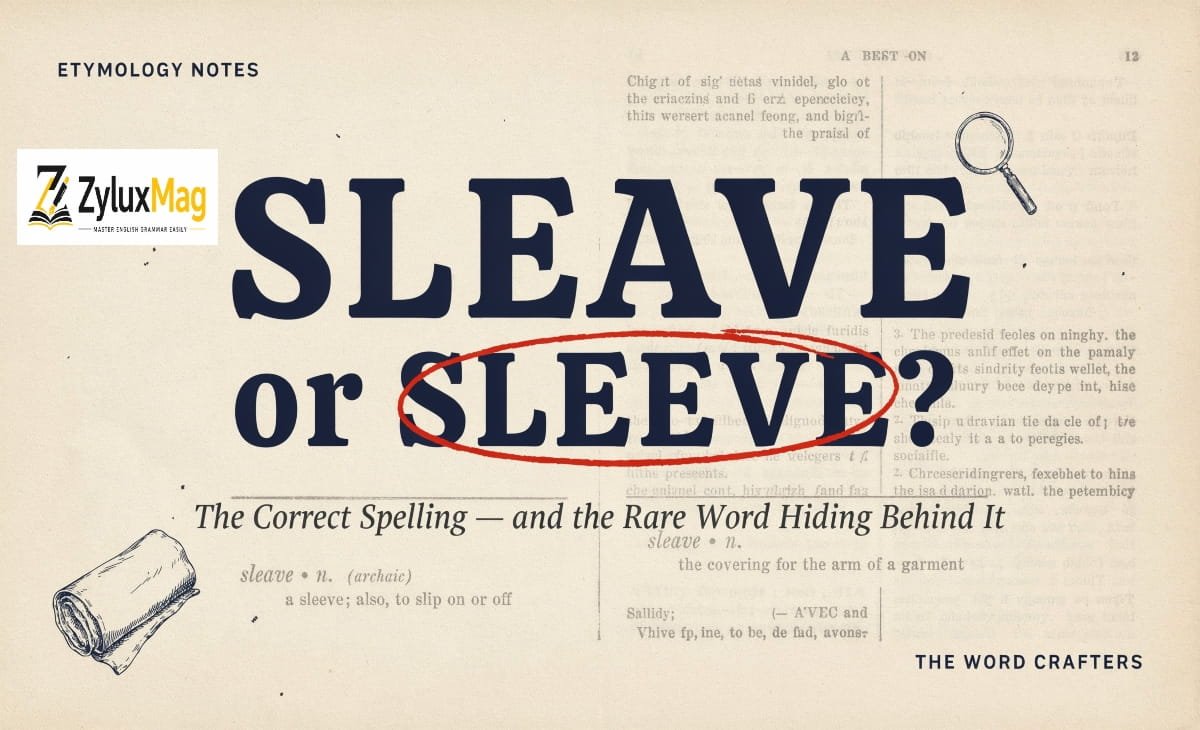
sleave or sleeve is the spelling you want. It’s the part of a garment that covers your arm, and it’s also the correct spelling for record sleeves, mechanical sleeves, and sleeve surgery. “Sleave” is a different word altogether — an old, rarely used term for untwisted silk thread. Unless you’re writing about historical textiles, sleeve is what you need.
“Sleeve” vs. “Sleave”: Quick Definitions
Sleeve (noun) — the part of a garment that covers all or part of the arm. By extension, it also means any tube-like covering or protective case: a record sleeve, a wiring sleeve, a document sleeve.
The jacket has a tear in the left sleeve. He kept the vinyl record in its original sleeve.
Sleave (noun, archaic) — a fine, untwisted silk thread, historically used in weaving and embroidery. It can also function as a verb meaning to separate or untangle threads.
The old text described a sleave of silk used in the embroidery. This kind of confusion is similar to mistakes like crier vs. cryer, where pronunciation leads to incorrect spelling
The two words aren’t different spellings of the same idea. They’re separate words that happen to sound identical.
Why Do People Mix These Up?
Because sleeve and sleave are homophones — they’re pronounced exactly the same way (sliːv), but spelled differently and mean completely different things. That’s the entire source of the confusion. It’s the same kind of mix-up you get with there/their or peak/peek: your ear can’t tell them apart, so your fingers have to guess. Since “sleeve” is overwhelmingly the more common word, most people typing “sleave” have simply meant “sleeve” and mistyped it, or autocorrect has quietly rewritten it wrong.
There’s no British-versus-American split here, either. “Sleeve” is spelled the same way in both — so regional variation isn’t the cause of the confusion.
A few years ago, I was editing a fashion copywriter’s product description and confidently “corrected” her sleeve to sleave, thinking I’d caught a typo. I sent it back with a little note: “Fixed a spelling error for you!” She replied within minutes, politely letting me know sleeve was right all along, and that I’d just introduced a Shakespearean word into a listing for a hoodie. I remember staring at my screen, half laughing, half mortified. That was the moment I realized autocorrect — and my own overconfidence — had been quietly lying to me for years.
“Sleeve” in Context
Clothing
This is the meaning almost everyone is looking for.
She rolled up her sleeves before washing the dishes. This shirt has short sleeves. The tailor shortened the sleeves of the coat.
Beyond Clothing
“Sleeve” shows up in plenty of places that have nothing to do with clothes:
- Records/media: He slid the CD back into its sleeve.
- Medicine: She underwent a sleeve gastrectomy.
- Mechanics/engineering: A protective sleeve covers the exposed cable.
- Idioms: He always has a plan up his sleeve. / She wears her heart on her sleeve.
If you’re ever unsure whether “sleeve” fits a non-clothing sentence, this range is a useful test: if the word describes something that covers, protects, or encases, sleeve is almost certainly correct.
Is “Sleave” Ever Correct to Use?
Rarely, and only in very specific contexts. “Sleave” is a real word — it’s not simply a typo that dictionaries invented after the fact — but it belongs to historical and literary English, not everyday writing. It appears in older texts describing textile work, and famously in Shakespeare’s Macbeth, where sleep is described as untangling the knotted threads of daily care.
Unless you’re transcribing historical material, discussing weaving terminology, or writing literary analysis, you don’t need this word. Modern English simply says “thread” or “silk thread” instead.
Common Mistakes to Avoid
- Typing “sleave” when you mean “sleeve.” This is almost always a simple typo or an autocorrect slip, not a real alternate spelling.
- Assuming “sleave” is the more formal or “correct-looking” version. It isn’t more correct — it’s a different word with a different meaning.
- Writing “sleve.” This isn’t a word at all in either sense; it’s just a misspelling of “sleeve.”
- Expecting a British/American difference. There isn’t one. “Sleeve” is spelled identically everywhere in English.
Quick Rule of Thumb
| Sleeve | Sleave | |
| Meaning | Covers the arm; also protective casings (records, cables, medical procedures) | Untwisted silk thread |
| How common | Everyday, standard English | Rare, archaic, mostly literary |
| When to use it | Clothing, machinery, media, idioms — almost always | Historical or literary writing about textiles only |
If in doubt: use sleeve. It covers (literally) almost every situation you’ll ever write about.