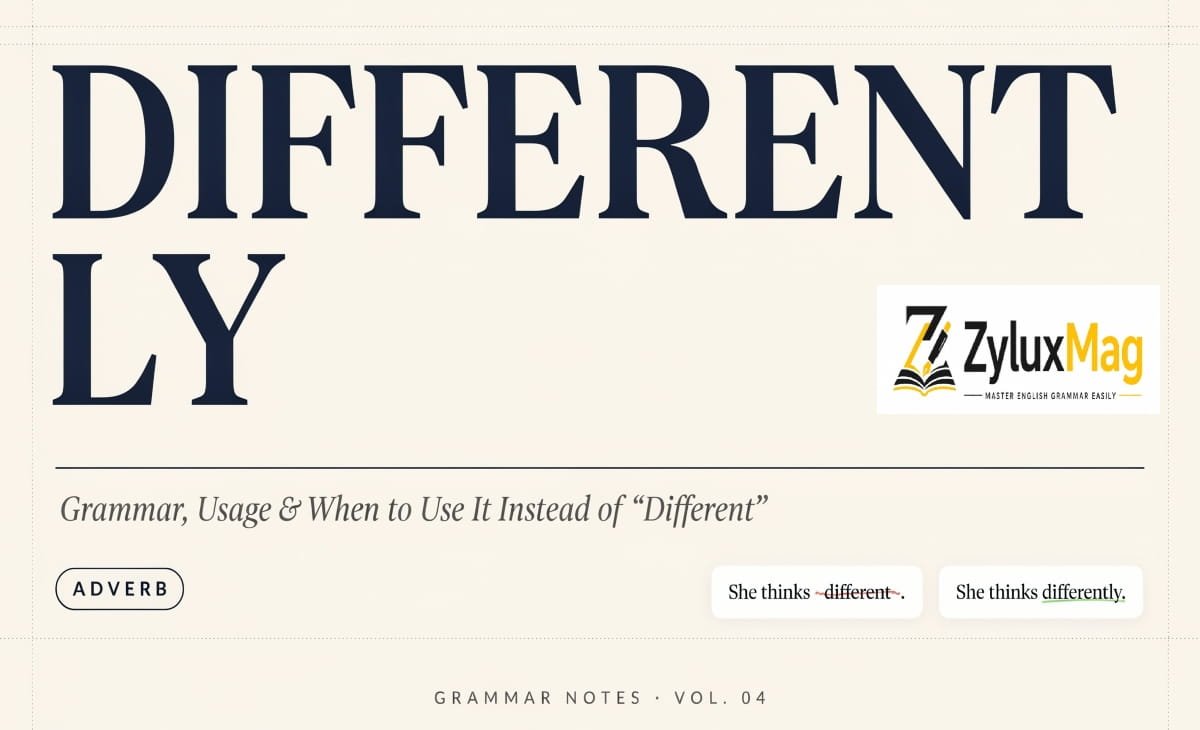
“Differently” is an adverb that means “in a way that is not the same” or “in a different manner.” It describes how an action is done, so it modifies verbs — not nouns. For example: “She solved the problem differently.”
Its close relative, “different,” is an adjective. It describes nouns, not actions: “She used a different method.”
That one distinction — adjective vs. adverb — is behind almost every question people have about this word. Here’s how to get it right every time.
I still remember the exact moment this rule actually stuck for me. During a final-year seminar in college, I stood up and told my professor our group had “approached the data different than the last team.” She didn’t correct me out loud — she just walked to the board, wrote “different vs. differently,” and circled it twice while I kept talking. I finished my slides completely rattled, more worried about that circle than my own findings. Afterward, she explained the adjective-adverb split in about thirty seconds, and it was one of those rules I’d technically “known” since school but never really understood — until I embarrassed myself in front of twenty classmates to finally learn it properly.
“Different” vs. “Differently”: The Core Rule
| Different | Differently | |
| Part of speech | Adjective | Adverb |
| What it describes | A noun (a person, thing, or idea) | An action — how something is done |
| Typical position | Before a noun, or after a linking verb | After an action verb |
| Example | “a different result” | “performed differently” |
| Common pairing | different from / than / to | differently from / than |
The short version: different tells you what kind of thing something is. Differently tells you how something happens.
Quick Test: Ask Yourself This One Question
Before choosing between the two, ask:
Am I describing a thing, or how something is done?
- Describing a thing → use different
- Describing how it’s done → use differently
Example: “The two cakes taste different” (describing the cakes) vs. “She bakes differently than her mother” (describing the action of baking).
When to Use “Differently” (With Examples)
Use “differently” after action verbs — verbs that describe something happening or being done:
- He teaches differently than most professors.
- They responded differently to the news.
- She thinks differently about risk than her colleagues.
- We handled the situation differently this time.
In each case, “differently” is answering the question “how?” — how he teaches, how they responded, how she thinks. English often creates confusion with similar forms, such as later vs. later on, or ‘different’ vs. ‘differently.
When “Different” Is Correct Instead
This is where most of the confusion happens. Even though “different” describes nouns, it’s also correct after certain verbs — and using “differently” there is a common mistake.
The Linking-Verb Exception
Verbs like be, seem, look, sound, taste, feel, and appear are often linking verbs — they connect the subject to a description, rather than showing an action. When a verb is working this way, it takes an adjective (different), not an adverb.
- This cake tastes different. (not “tastes differently”)
- The two designs look different. (not “look differently”)
- Your plan seems different from mine. (not “seems differently”)
A useful way to think about it: these verbs aren’t describing an action being performed differently — they’re describing a state or quality the subject has. The cake isn’t doing anything; it simply is different in taste.
“Feel Different” or “Feel Differently”? The One That Confuses Everyone
This is the trickiest case, because “feel” can work two different ways — and both are grammatically defensible depending on the meaning.
“Feel different” — when “feel” is a linking verb meaning to seem or to be perceived as:
- “I feel different today.” (My mood or state seems different.)
- “This fabric feels different from the other one.” (Its texture seems different when touched.)
“Feel differently” — when “feel” is an action verb meaning to believe or to hold an opinion, and “differently” modifies how that belief is held:
- “I feel differently about this than you do.” (My opinion differs.)
In practice, both are widely used and accepted, and many careful writers avoid the issue entirely by rewording: “I think differently about this” or “This feels different to me.” If you want the safest choice for formal writing, treat “feel” as a linking verb and default to “feel different” unless you specifically mean “hold a different opinion.”
“Differently From,” “Differently Than,” or “Differently To”?
All three exist, but they aren’t equally standard everywhere:
- Differently from — the most widely accepted choice in both American and British English.
- Differently than — common and accepted in American English, especially when followed by a clause (“She sees it differently than I do”).
- Differently to — used in British English, though less common than “differently from.”
If you’re writing for a mixed or international audience, “differently from” is the safest option.
Common Mistakes to Avoid
| Incorrect | Correct | Why |
| He acts different around his boss. | He acts differently around his boss. | “Acts” is an action verb — needs an adverb. |
| This soup tastes differently. | This soup tastes different. | “Tastes” is a linking verb here — needs an adjective. |
| A differently plan was suggested. | A different plan was suggested. | Adverbs can’t describe nouns. |
| The music sounds differently tonight. | The music sounds different tonight. | “Sounds” describes a quality, not an action. |
| She behaves different when she’s nervous. | She behaves differently when she’s nervous. | “Behaves” is an action verb — needs an adverb. |
Is “Differently Abled” Correct?
Yes, grammatically — “differently” is functioning normally as an adverb modifying “abled.” But this isn’t really a grammar question so much as a usage one. “Differently abled” is a term some people use in place of “disabled,” intended to sound more neutral. Others consider it euphemistic or prefer more direct language like “person with a disability.” Its acceptance varies by context, audience, and personal preference, so it’s worth choosing based on who you’re writing for rather than treating it as a strict grammar rule.