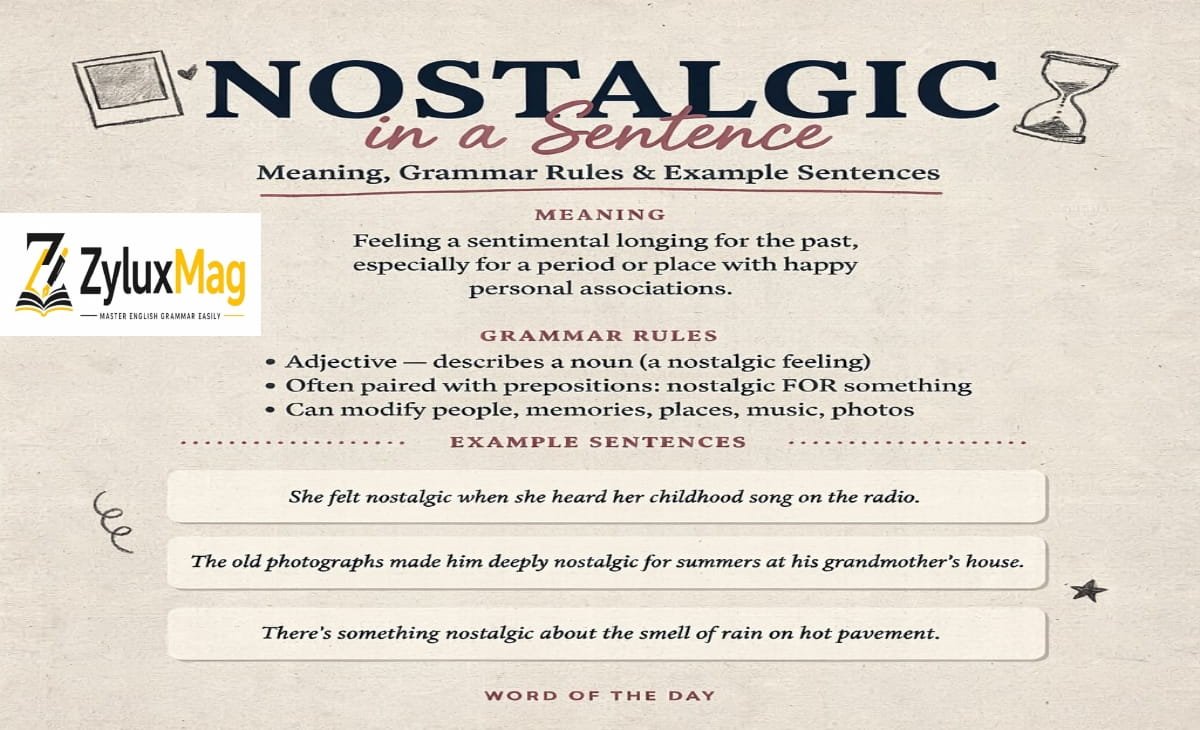
nostalgic is an adjective that describes a wistful, bittersweet longing for the past — happy memories tinged with a sense of loss. For example: “Looking through my old photo albums always makes me feel nostalgic.”
What Does “Nostalgic” Mean?
To be nostalgic is to feel a mix of happiness and mild sadness when you think about the past. It’s not pure joy, and it’s not pure sadness — it’s the specific feeling of missing something good that’s now gone.
That “good but gone” feeling can be triggered by almost anything: a childhood home, an old song, a smell, a photograph, or a person you haven’t seen in years. The important part is the combination of fondness and longing. If you’re just happy, you’re not nostalgic. If you’re just sad, you’re not nostalgic either.
The noun form is nostalgia (“She felt a wave of nostalgia”), and nostalgic is the adjective that describes the feeling itself or the person/thing that causes it.
I still remember the exact moment this rule stuck with me. During a first-year English exam, I wrote “she was nostalgic of her hometown” in an essay answer, fully convinced it sounded fine. My professor circled it in red and wrote just two words in the margin: “for — always for.” No explanation, nothing. I got the paper back, felt a little embarrassed, and went home to actually look it up instead of guessing next time. That one red circle taught me more than any textbook rule ever could — and now I notice this exact mix-up everywhere, from essays to everyday conversation common grammar mistakes.
Grammar Rule: “Nostalgic For” or “Nostalgic About”?
Both are correct, but they’re not always interchangeable. The right choice depends on what you’re pointing to.
When to Use “Nostalgic For”
Use for when you’re naming the actual thing, place, person, or time period you miss. This is the more common and more natural pairing.
- I feel nostalgic for the small town where I grew up.
- He’s nostalgic for the days before smartphones.
- She sounded nostalgic for her university years.
When to Use “Nostalgic About”
Use about when you’re talking more generally about a topic, memory, or experience — often when reflecting or discussing rather than naming one specific thing.
- We got nostalgic about our old school trips.
- I don’t usually get nostalgic about my twenties.
- He was feeling nostalgic about the way things used to be.
| Pattern | Use it when… | Example |
| nostalgic for + noun | Naming a specific place, time, or thing you miss | “nostalgic for my hometown” |
| nostalgic about + noun/topic | Reflecting generally on a memory or experience | “nostalgic about my school days” |
Avoid “nostalgic of” — it’s not standard English and will sound like a mistake to native speakers.
Before or After the Noun? (Sentence Position)
“Nostalgic” can sit in two different places in a sentence, and both are correct:
- After a linking verb (feel, be, seem, sound): “I feel nostalgic.” / “That song sounds nostalgic.”
- Directly before a noun: “It was a nostalgic photo.” / “The film has a nostalgic vibe.”
In the second pattern, “nostalgic” isn’t describing a person’s emotion — it’s describing an object, image, or atmosphere that creates that feeling in someone else. Both uses are equally common, so it helps to notice which one fits your sentence.
“Nostalgic” in a Sentence — Examples by Context
Talking About People and Relationships
- She felt nostalgic thinking about her old college roommates.
- He gets nostalgic whenever he talks about his grandparents.
- Meeting my childhood best friend again made me unexpectedly nostalgic.
Talking About Places and Home
- I feel quite nostalgic for the town where I grew up.
- Walking past my old school always makes me nostalgic.
- They were nostalgic for the countryside after years of city life.
Talking About Objects, Media, and Memories
- It was a nostalgic photo of their wedding day.
- The old arcade game gave the whole room a nostalgic feeling.
- Watching that cartoon again felt deeply nostalgic.
Talking About Feelings and Sensory Triggers
- That song came on the radio and instantly made him nostalgic.
- The smell of fresh bread makes me nostalgic for my grandmother’s kitchen.
- There’s something nostalgic about the sound of rain on a tin roof.
Common Mistakes with “Nostalgic”
Mistake 1: Confusing the adjective with the noun ❌ I have nostalgic for my childhood. ✅ I feel nostalgic about my childhood. (or: I have nostalgia for my childhood.)
“Nostalgic” describes a feeling — it can’t be something you “have.” Only the noun nostalgia works after “have.”
Mistake 2: Using “nostalgic of” ❌ She was nostalgic of her old apartment. ✅ She was nostalgic for her old apartment.
Mistake 3: Assuming nostalgic only means “happy” Nostalgic memories are usually pleasant to recall, but the feeling itself carries a quiet sadness too — the awareness that the moment is gone. A purely happy memory with no sense of loss isn’t quite the same as a nostalgic one.
Mistake 4: Misspelling it as “nostalgetic” The correct spelling is nostalgic — no extra “e” before the ending.
Mistake 5: Thinking “nostalgic” can only describe a person “Nostalgic” can just as easily describe a thing — a photo, a song, a vibe, a design — that causes the feeling in someone else, not just a person who has the feeling.
“Nostalgic” vs. “Sentimental” vs. “Wistful” — What’s the Difference?
These three words overlap, but each has a slightly different focus:
- Nostalgic — specifically about the past. Always involves memory and time.
- Sentimental — about emotional attachment in general, not necessarily tied to the past. A sentimental gift can be about the present, not a memory. (“This bracelet is sentimental to me” doesn’t require nostalgia.)
- Wistful — a quiet, gentle sadness or yearning. It can be about the past, but also about something that never happened or something unattainable. Wistful is softer and vaguer than nostalgic; nostalgic is more clearly tied to specific memories.
In short: all nostalgic feelings are somewhat sentimental and often wistful, but not all sentimental or wistful feelings are nostalgic — only the ones rooted in looking back at the past.
Quick Answers to Common Questions
Is “nostalgic” a noun or an adjective?
It’s an adjective. The related noun is nostalgia (“a wave of nostalgia”), and there’s no commonly used verb form.
Is being nostalgic a good or bad feeling?
Neither, exactly — it’s a mixed feeling. It combines the pleasure of a happy memory with a mild sadness that the moment has passed. Most people experience it as bittersweet rather than clearly good or bad.
Where does the word “nostalgic” come from?
It comes from Greek: nostos, meaning “return home,” and algos, meaning “pain.” The word was originally used to describe homesickness before it broadened to mean longing for the past in general.