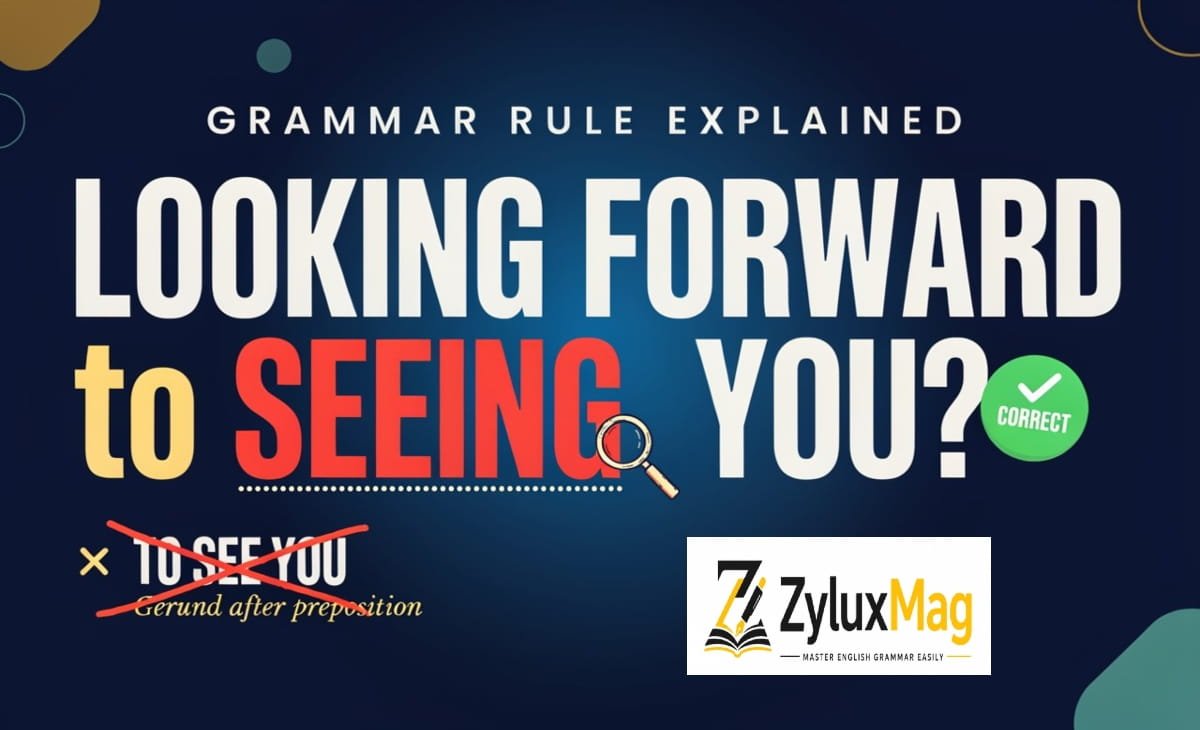
Quick answer: Yes, “looking forward to seeing you” is correct. “Looking forward to see you” is not. The reason comes down to one small word doing a job you might not expect: in this phrase, “to” is a preposition, not part of an infinitive — so it has to be followed by a gerund (the -ing form), not a plain verb.
That’s the whole rule in one sentence. Here’s why it works that way, and how to avoid the mistake for good.
A few years ago, I sent a follow-up email after a job interview I was genuinely excited about. Wanting to sound eager, I wrote, “I am looking forward to see you next week.” I hit send, felt pretty proud of myself, and went on with my day. Two days later, a friend who worked in HR read it over my shoulder and went quiet for a second before saying, “You know that should be ‘seeing,’ right?” I didn’t. I got the job anyway, but I never sent another email without double-checking that one little “to.”
Why “Seeing” and Not “See”?
Most English learners are taught that “to” pairs with a base verb — “to go,” “to eat,” “to see.” That’s true when “to” is part of an infinitive. But “to” has a second job in English: it can also be a preposition, similar to “on,” “at,” or “about.” And prepositions are never followed by a plain verb. They’re followed by a noun, a pronoun, or a gerund.
“Look forward to” is one of those phrases where “to” is a preposition, not an infinitive marker. So the word after it has to act like a noun — and a verb acting like a noun is a gerund.
That’s why it’s:
I’m looking forward to seeing you.
and not:
I’m looking forward to see you.
You’re not choosing “seeing” because it sounds nicer. You’re choosing it because the sentence structure requires it.
Correct vs. Incorrect Examples
| ✅ Correct | ❌ Incorrect |
| I’m looking forward to seeing you at the party. | I’m looking forward to see you at the party. |
| We look forward to hearing from you soon. | We look forward for hearing from you soon. |
| She’s looking forward to meeting the new team. | She’s looking forward meeting the new team. |
| I’m looking forward to the weekend. | I’m looking forward to weekend. |
Notice the last row: the word after “to” doesn’t have to be a verb at all. A noun works just as well, because a noun is also a valid object of a preposition.
A Simple Test You Can Use Every Time
If you’re not sure whether “to” is acting as a preposition or part of an infinitive, try this:
Replace “to” with “toward” and see if the sentence still makes basic sense.
- “I’m looking forward toward seeing you.” → Still makes sense → “to” is a preposition → use the -ing form.
- “I want toward go home.” → Doesn’t make sense → this “to” is part of an infinitive → use the plain verb (“I want to go home”).
This works because prepositions like “toward” behave the same way “to” does in phrases like “look forward to” — they point toward something, and that something is treated as a noun.
Does the Same Rule Apply to Other Phrases?
Yes. Once you recognize this pattern, you’ll start seeing it in other common phrases.
“Looking forward to hearing from you”
This follows the exact same rule and is just as common — especially in emails.
We look forward to hearing from you. ~~We look forward to hear from you.~~
Same structure, same reason: “to” is a preposition, so “hear” becomes “hearing.”
Other verbs that follow the same pattern
Any verb can slot into this structure, as long as it’s in the -ing form:
- looking forward to working with you
- looking forward to starting the new project
- looking forward to visiting your city
The verb changes depending on context. The grammar rule never does common verb agreement mistakes.
“I Look Forward To” vs. “I Am Looking Forward To” — Any Difference?
Both are grammatically correct, and both follow the same gerund rule. The difference is tone, not grammar:
- “I look forward to…” tends to sound slightly more formal or polished — common in professional emails, cover letters, and business correspondence.
- “I am looking forward to…” feels a little warmer and more conversational — natural in personal messages, casual emails, and everyday speech.
Neither is “more correct.” Choose based on how formal the message needs to be.
It’s also fine to drop “I am” entirely in casual writing — “Looking forward to seeing you!” is a common, natural way to close a friendly message or text.
Common Mistakes to Avoid
- Using the plain verb instead of the gerund ❌ “I am looking forward to see you.” ✅ “I am looking forward to seeing you.”
- Using the wrong preposition ❌ “Looking forward for seeing you.” ✅ “Looking forward to seeing you.”
- Dropping “to” altogether ❌ “I look forward seeing you.” ✅ “I look forward to seeing you.”
The root cause behind all three is the same: treating “to” as if it only ever introduces an infinitive. Once you remember that “to” can also be a preposition — and that this is one of those cases — the correct form becomes automatic.