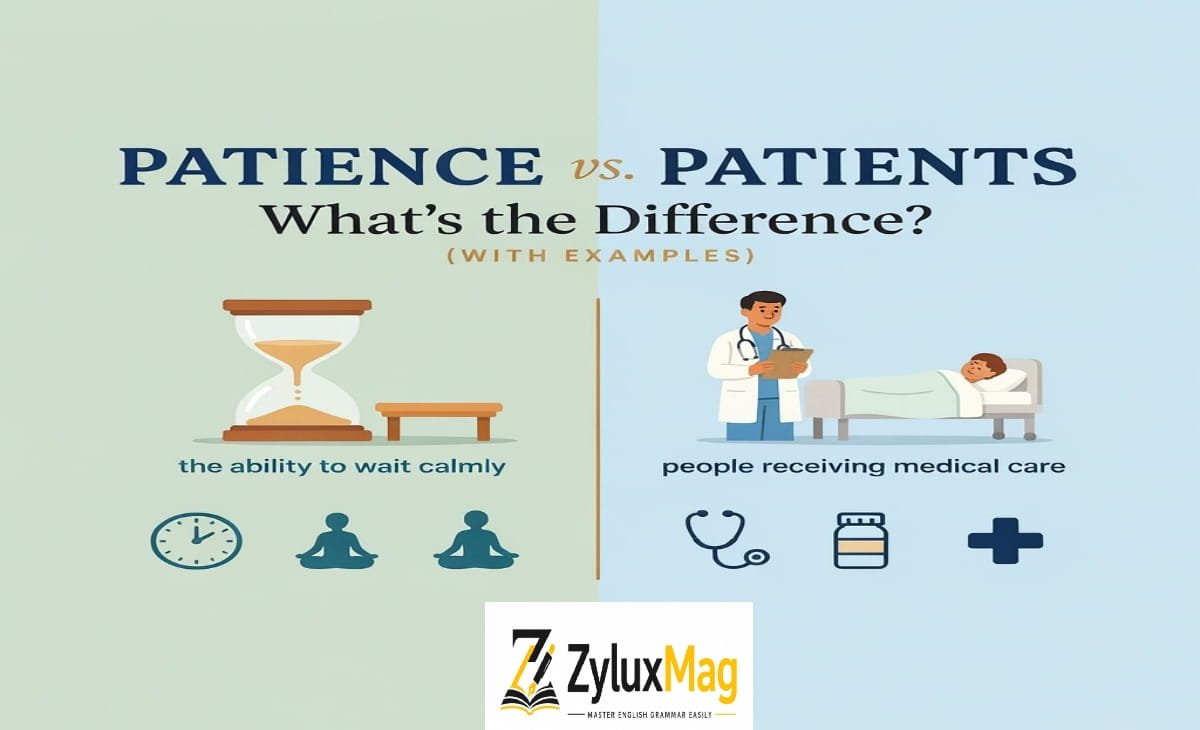
Patience, patients-they sound practically identical, but that’s about all they have in common! One is a crucial trait to cultivate, while the other is a common occurrence in hospitals and clinics. Let’s unravel this common linguistic knot.
What is “Patience”?
Patience is a noun denoting the ability to wait calmly or remain serene when dealing with delays, hardships, or annoyances. It’s about your capacity for endurance without getting flustered. Think of it as an adjective (patient) turned into a quality.
* Her patience was tested when the flight was delayed for hours.
* Learning to play the piano requires a great deal of patience.
* He responded to each of her questions with an unshakeable sense of patience.
Key characteristics of “patience”:
* Uncountable: You never say “patiences.” Just “patience.”
* Singular Verb: Since it’s uncountable, it always takes a singular verb. “Patience is a virtue,” not “Patience are a virtue.”
What are “Patients”?
“Patients” is the plural form of “patient,” referring specifically to individuals who are currently receiving, or who are scheduled to receive, medical care or treatment.
* The clinic saw forty patients today.
* The surgeon would perform three patients a day.
* The patients’ ward was quiet.
Key characteristics of “patients”:
* Plural of Patient: One person being treated is a patient. Two or more are patients.
* Regular Plural: Formed by adding “-s.”
A Memory Slip I’ll Never Live Down
During a college English exam, we had to write a paragraph about a nurse’s daily tasks. I, in my haste and panic, wrote, “She treats twenty patience every shift.” It wasn’t until my professor marked it with a bright red “??”
and no further explanation (which, frankly, was worse than any critique) that the horrified realization dawned on me.
The sound, the letters… It all clicked, but far too late. That single red question mark imprinted the difference between “patience” and “patients” into my brain more effectively than any grammar lesson ever could.
The Root of the Confusion
Why are they so easy to mix up? Both “patience” and “patients” stem from the same origin: the adjective “patient,” which means “able to tolerate delay or difficulty without getting upset.”
From “patient” (the adjective):
* We derived “patience” (the quality of being patient).
From “patient” (now a noun, as in someone who is patient, and by extension, someone who is under medical care):
* We derived the plural “patients.”
So, the adjective “patient” is the central point from which these two distinct words branched out pail vs pale difference.
How to Keep Them Straight
A simple rule of thumb:
* Patience: Think of calm, enduring behavior while waiting or facing challenges.
* Patients: Think of people getting medical treatment (the “T” in “treatment” can be a helpful visual cue for “patients”).
In essence:
* Is the sentence about enduring hardship or waiting calmly? You need patience.
* Is the sentence about individuals being cared for medically? You need patients.
Common Pitfalls to Avoid
* Using “patients” when you mean the quality of being patient: “He has no patients with faulty technology.” (Should be patience)
* Pluralizing “patience”: “Her patiences grew thin.” (Should be patience)
* Forgetting the apostrophe in possessives: “The patient’s bedside table was tidy.” (Should be patient’s or patients’ depending on context)
Quick Check
Fill in the blank with patience, patients, patient’s, or patients’:
- The therapist showed remarkable __________ with her clients.
- The hospital’s __________ ward was recently renovated.
- I read the __________ file before the appointment. (one person)
- The __________ complaints were reviewed by the manager. (more than one person)
- Waiting in traffic requires a lot of __________.
Answers: 1. patience 2. patients 3. patient’s 4. patients’ 5. patience
About the Author
Faizan Babar is the founder and lead writer at ZyluxMag, where he simplifies complex English grammar and vocabulary into easy-to-understand, practical lessons. With a background enriched by his own experiences in writing, including the hilarious missteps in word usage along the way, he focuses on making grammar accessible and memorable for everyone.