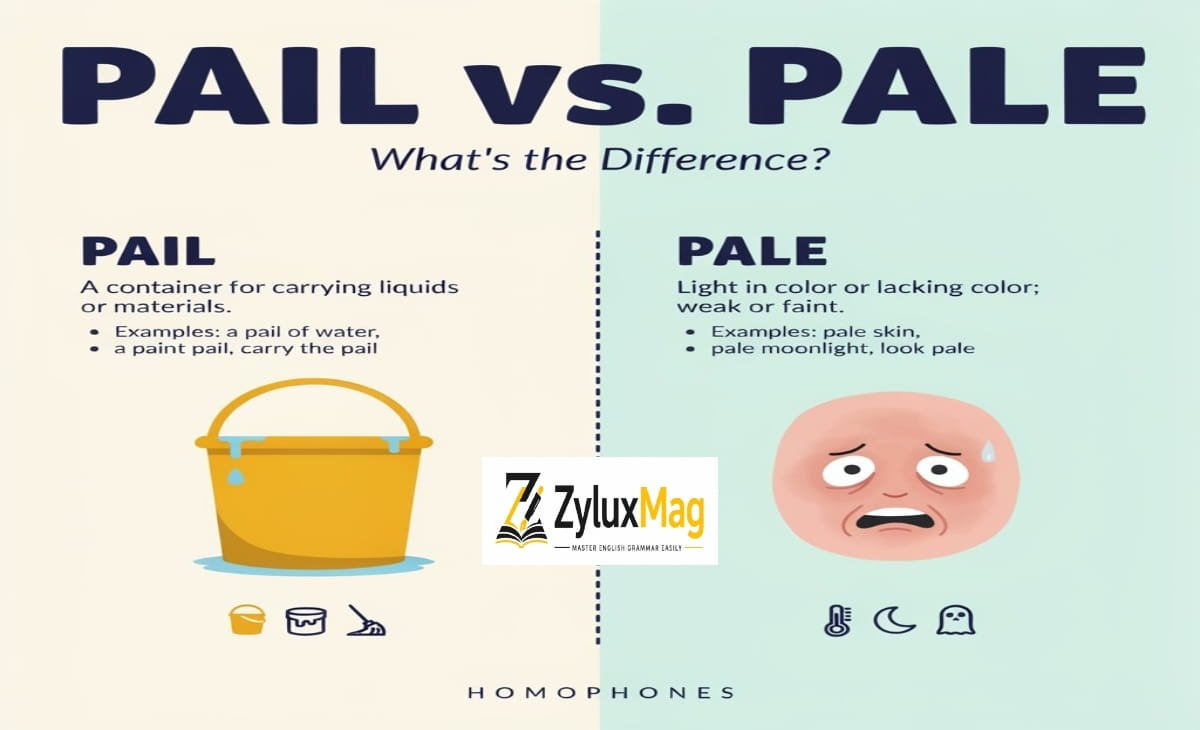
A pail is simply a bucket, whereas pale is an adjective or verb indicating a light color or fade. If there’s something holding liquid, you need to use pail. For faded colors and similar phenomena, pale is the appropriate word.
The above is the condensed version of the explanation. Further details and context are given in the following sections.
Pail vs. Pale at a Glance
| Word | Part of Speech | Meaning | Example |
| pail | noun | a bucket or container, usually with a handle | She carried a pail of water. |
| pale | adjective | light in color; lacking strong color | His skin looked pale. |
| pale | verb | to lose color or seem less important by comparison | Her worries paled next to his. |
| pale | noun (less common) | a boundary stake or fence post | His behavior was beyond the pale. |
Both words are pronounced the same way — /peɪl/ — which is exactly why they get mixed up. They’re homophones: same sound, different spelling, different meaning.
A stake or fence post used to mark boundaries, generally referenced in the expression “beyond the pale”.
The offender’s behavior was well beyond the pale.
These two words sound identical (/pel/) hence the confusion in their use and spelling. They belong to the category of homophones where the same sound leads to confusion in spelling and context.
What Do We Mean By Pail?
A pail is basically a bucket like container that is typically open at the top and often features a handle. Its fundamental role is to hold water, so any container that performs such a function is a pail. It’s invariably used as a noun.
They carried a pail of water back from the river.
She emptied the pail of sand onto the foundation.
He had a pail of paint waiting by the fence.
While pail is understood universally, ‘bucket’ is a more commonly used word, especially in British English. ‘Pail’ can sometimes sound antiquated, especially in American English, though it’s still perfectly acceptable.
What Do We Mean By Pale?
Pale performs several roles as it can function as an adjective, a verb, or even a noun in certain phrases.
Pale As an Adjective
‘Pale’ serves as a very common adjective describing a faint or light color and sometimes also a complexion that lacks natural color.
The doctor noticed that his skin had become noticeably pale.
She was wearing a lovely pale yellow blouse.
The faded fabric of the old couch had a rather pale shade.
Pale As a Verb
“Pale” also works as a verb which implies something is losing its brightness or appearing somewhat less important compared to something else.
The moon was barely visible as dawn began to pale.
The competition among students paled as it became clear she would win regardless.
My anxieties for the exam paled once I knew how little there was to know.
Many users fail to recognize the verb form and associate ‘pale’ only with color.
Pale As a Noun: The “Beyond the Pale” Phenomenon
Occasionally, ‘pale’ is employed as a noun in the phrase “beyond the pale”. Here, it signifies something that falls outside accepted limits or behavior.
The businessman’s remark was certainly beyond the pale of professional conduct.
This specific context of “pale” is not related to color but rather to a boundary. Historically, it referred to a boundary marker or fence that delineated a territorial zone belonging to a specific group crier or cryer spelling.
Common Mistakes Regarding Pail and Pale
- Using “pail” instead of “pale.” The same sounds of both the words can lead to confusion in text messages or casual emails. Correct it by knowing that any color or tone uses pale: the color of the dress was pale, not pail; his skin looked pale, not pail.
2. Misunderstanding the functions of “pale.” People sometimes consider ‘pale’ only as an adjective when describing color. Remember that it also works as a verb (“pale with fear”, “fade away”) and a noun in some specific idiom (“beyond the pale”).
3. Believing “pale” refers to complexion color. In “beyond the pale,” it denotes a limit or boundary and has no bearing on any coloration: the remark was not referring to somebody’s skin tone.
4. Treating “pail” and “bucket” as interchangeable in every context. Although mostly they are the same, there may be some nuances: ‘pail’ is considered slightly archaic and American more than ‘bucket,’ which is the more common word globally.
How to Remember the Difference?
The basic memory hook is quite simple.
A pail holds something. Think pail, plastic or metal container.
A pale describes a color or fades something away. Think of its adjective use.
If it can hold water, use a pail. If you’re talking about color/fade, use pale.
A Mixture I Still Recall
A few years back, I had a job writing product descriptions for an exclusive set of kitchen utensils whose theme name was the “beach bucket” collection. I used the term ‘pail’ nearly a dozen times in my writing but later accidentally wrote “turned pail in dismay” when I was talking about customer reactions. The error passed on to the client but was noticed by the editor minutes before the material went live.
He just asked if I meant “turned a bucket of dismay.”
Even thinking about it gives me a pang. Ever since, I have been rechecking my spelling on these words vigilantly.
About the Author
Faizan Babar is an Editor at ZyluxMag where he mainly writes on topics such as English grammar, vocabulary and common writing errors. Over his professional experience writing for various clients worldwide, Faizan has had to overcome and fix many of these common mistakes and loves sharing what he’s learned so that all readers too don’t have to learn the hard way.