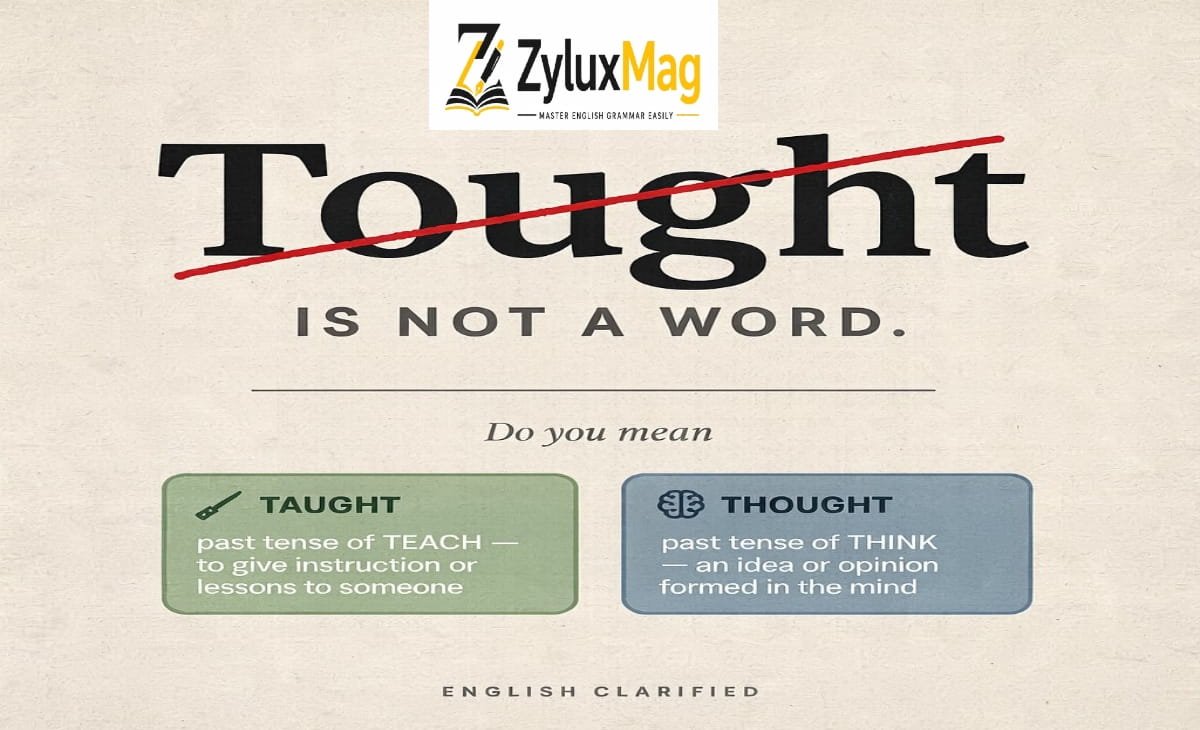
Tought is not a correct English word — it’s a common misspelling. You almost certainly meant either “taught” (the past tense of teach) or “thought” (the past tense of think, or a noun meaning an idea).
Years ago, I was finishing up a freelance article on a tight deadline, half-asleep and running on coffee fumes. I typed “she tought me everything I know” in the client email and hit send before my brain caught up with my fingers. Ten minutes later, the client replied with just one line: “Did you mean taught?” I wanted to disappear into my chair. That tiny red-flag moment stuck with me longer than any grammar lesson ever had — because nothing teaches you a rule faster than embarrassing yourself in front of someone who’s paying you to know better.
If you’ve just typed “tought” and paused, you’re in good company. Here’s exactly how to tell which word you meant — and why this mix-up happens to even careful writers.
“Taught” vs. “Thought” — Which One Did You Mean?
Both words look and sound similar enough to blur together, especially when you’re typing fast. But they come from two completely different verbs and mean two completely different things.
Use “Taught” When You Mean Teaching
“Taught” is the past tense and past participle of the verb teach. It always relates to instruction — someone showing or explaining something to someone else.
- “My grandmother taught me how to bake bread.”
- “He has taught English for ten years.”
If your sentence involves a teacher, a lesson, or a skill being passed on, “taught” is your word.
Use “Thought” When You Mean Thinking
“Thought” is the past tense and past participle of the verb think. But unlike “taught,” it also works as a noun, meaning an idea or a mental impression.
- “I thought you were coming later.” (verb — a past action of thinking)
- “That’s an interesting thought.” (noun — the idea itself)
This dual role is worth remembering: “taught” only ever functions as a verb form, but “thought” can be both a verb and a noun depending on the sentence.
Why “Tought” Feels Like It Should Be a Word
If “tought” isn’t real, why does it feel so natural to type? Blame English’s irregular verb family.
Words like bought, caught, fought, sought, and brought all share the same “-ought” pattern with a silent “gh.” Your brain has learned this pattern so well that it starts applying it automatically — even to words that don’t actually belong to that exact spelling. “Taught” and “thought” both end in this same silent-letter sound, so it’s an easy, understandable slip to smash them together into “tought.”
In short: “tought” isn’t a random typo. It’s your brain pattern-matching against a real and very common rule in English — it just applied the rule slightly wrong.
Quick Self-Check: Taught or Thought?
Next time you hesitate, ask yourself one question: is this about teaching, or about thinking?
| If you mean… | Use… |
| An act of teaching | taught |
| An idea or the act of thinking | thought |
If a person is involved in showing someone how to do something, go with “taught.” If it’s happening inside someone’s head, go with “thought.”
Other Words People Confuse With “Tought”
Once you’re aware of this pattern, a few related mix-ups become easy to catch too:
- Taut — means tight or tense (a taut rope), not related to teaching or thinking at all.
- Though — means “despite the fact that” (a conjunction).
- Through — means moving from one side to the other, or completing something.
- Teached — a common learner error; the correct past tense of “teach” is always “taught,” never “teached.”
Common Mistakes to Avoid
- Writing “tought” instead of “taught” in a teaching context — the most frequent version of this error.
- Writing “tought” instead of “thought” in a thinking or idea context — the second most common.
- Using “teached” instead of “taught” — this is also incorrect. “Teach” is an irregular verb, so it never takes the regular “-ed” ending.
- Assuming spellcheck will always catch “tought” — sometimes it won’t flag it, or it may autocorrect to the wrong one entirely.
Simple Way to Remember the Difference
Here’s a quick mental shortcut: “taught” has “teach” hiding inside its meaning — both relate to instruction. “Thought” relates to “think” — both involve your mind. If you can silently swap in “teach” or “think” and the sentence still makes sense, you’ve picked the right word.