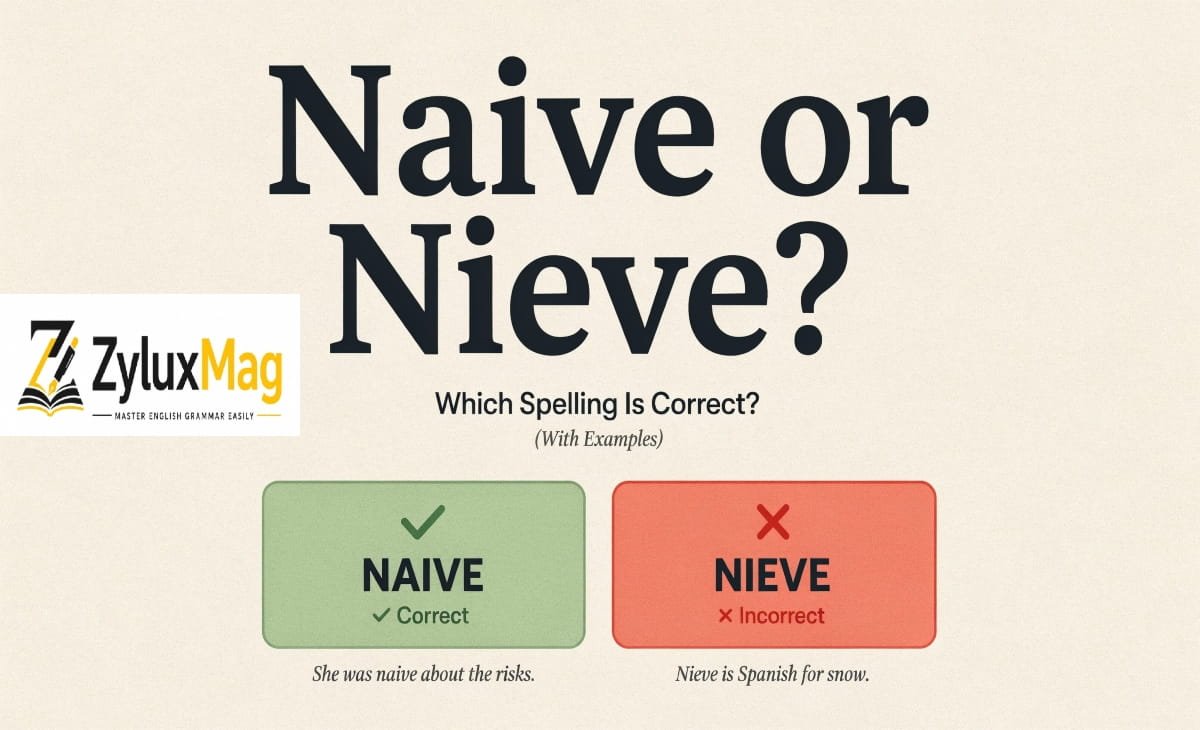
The correct English spelling is naive (or naïve, with the accent mark). “Nieve” is not an English word — it’s Spanish for “snow.” If you’re describing someone as inexperienced, overly trusting, or lacking worldly knowledge, the word you want is naive.
What Does “Naive” Actually Mean?
Naive is an adjective used to describe a person, belief, or decision that lacks experience, judgment, or awareness of how things really work. It often carries a sense of innocence or misplaced trust — someone who takes things at face value without questioning them.
Importantly, naive does not mean stupid. A naive person can be highly intelligent but simply inexperienced in a particular situation. The word points to a gap in experience or awareness, not a lack of intelligence.
- She was naive to think the contract had no hidden terms.
- His naive trust in strangers eventually got him into trouble.
A Mistake I Actually Made
I once sent a client feedback on their draft and wrote, “Assuming the reader is nieve about the topic, we should explain more.” Ten minutes later, my client — bless her — replied with just one line: “Did you mean naive? Also, that’s kind of ironic.” I stared at my screen, mortified. I’d been writing professionally for years and still typed the Spanish word for snow into a client email. I fixed it, laughed it off, but I also went and actually looked up why I kept doing that. Turns out I wasn’t alone — and that one embarrassing email taught me more than any grammar book ever did.
Why “Nieve” Isn’t Correct in English
“Nieve” shows up so often in searches because it sounds like it could be a valid alternate spelling of “naive.” It isn’t. English dictionaries don’t recognize “nieve” as a word, and using it in place of “naive” is simply a spelling mistake — not a stylistic choice or regional variation.
“Nieve” Is a Real Word — Just Not in English
“Nieve” does exist as a real word, just not in English. In Spanish, nieve means snow. This is likely where the confusion comes from: many people learning English (or bilingual in Spanish) recognize “nieve” visually and assume it’s connected to “naive” because the two words sound similar when spoken quickly. They aren’t related at all — different languages, different meanings, and no shared origin.
Naive vs Naïve: Do You Need the Diaeresis?
Both naive and naïve are correct in English. The two dots above the “i” — called a diaeresis — come from the word’s original French form, naïf (masculine) or naïve (feminine). The diaeresis signals that the “a” and “i” are pronounced as two separate sounds, not blended together.
In modern English, the diaeresis is optional. “Naïve” appears more often in formal, literary, or academic writing, while “naive” (without the accent) is the more common choice in everyday writing, digital content, and casual contexts. Neither version is “more correct” than the other — it’s simply a matter of style.
This is also not a British vs. American English difference. Both varieties of English accept naive and naïve equally; the choice comes down to personal or house style, not regional spelling rules.
“Naive” in a Sentence
- It would be naive to assume the deal comes with no risk.
- I was naive about how competitive the job market really is.
- Her naive optimism didn’t survive the company’s first difficult quarter.
- Don’t be naive — read the fine print before you sign anything.
The word also appears in technical and academic writing with a more neutral meaning. A “naive algorithm” or “naive approach,” for example, simply refers to the simplest possible method for solving a problem — not necessarily a wrong or foolish one, just one that hasn’t been optimized.
- The naive approach solves the problem correctly, but a more efficient method exists.
Related Words: Naively, Naivety, and Naïveté
- Naively (adverb): He naively believed the offer was too good to be true — and it was.
- Naivety (noun, more common in British English): Her naivety made her an easy target for the scam.
- Naïveté (noun, from French, common in American English): His naïveté about office politics cost him the promotion.
All three forms follow the same spelling logic as “naive” — no “ie” combination, and the accent marks remain optional.
A Simple Trick to Never Misspell It Again
Think of the word’s French root: naïf/naïve. French keeps its “a” front and center, and English kept it too. If you remember that naive comes from French — not from words like believe, relieve, or retrieve — you’ll stop reaching for that “-ieve” pattern out of habit.
A quick mental check: naive has “a” before “i,” just like “naive” starts like “native” — same first three letters, easy to recall.
Common Mistakes to Avoid
- Writing “nieve” instead of “naive.” This is the single most common error tied to this word, usually caused by phonetic guessing or overlap with the Spanish word for snow.
- Assuming naive means “unintelligent.” It refers to inexperience or misplaced trust, not low intelligence.
- Treating this as a British vs. American spelling issue. It isn’t — both varieties of English use naive and naïve interchangeably.
- Overapplying the “-ieve” pattern from words like believe or relieve. Naive doesn’t follow that pattern because it comes from French, not the same root as those words.
- Assuming the diaeresis is required. It’s optional in modern English; both naive and naïve are correct.
Quick Recap
| Form | Valid in English? | Meaning |
| naive | ✅ Yes | Lacking experience or overly trusting |
| naïve | ✅ Yes (accented variant) | Same meaning, traditional French spelling |
| nieve | ❌ No | Spanish word for “snow” — not English |
If you remember nothing else: naive is correct, nieve is not, and the two words come from entirely different languages.
Frequently Asked Questions
Is “naive” the same as “naïve”?
Yes. They have identical meanings — “naïve” simply keeps the traditional French accent mark, while “naive” is the more common modern spelling.
Does naive mean stupid?
No. Naive means lacking experience or awareness, often paired with excessive trust. It says nothing about a person’s intelligence.
How do you pronounce “naive”?
It’s pronounced nye-EEV, with stress on the second syllable — the “a” and “i” are spoken as separate sounds, not blended.
Is “nieve” ever correct in English text?
Only as a foreign word (for example, referencing snow in Spanish) or as a proper noun, such as a name. It is never a correct substitute for “naive.”