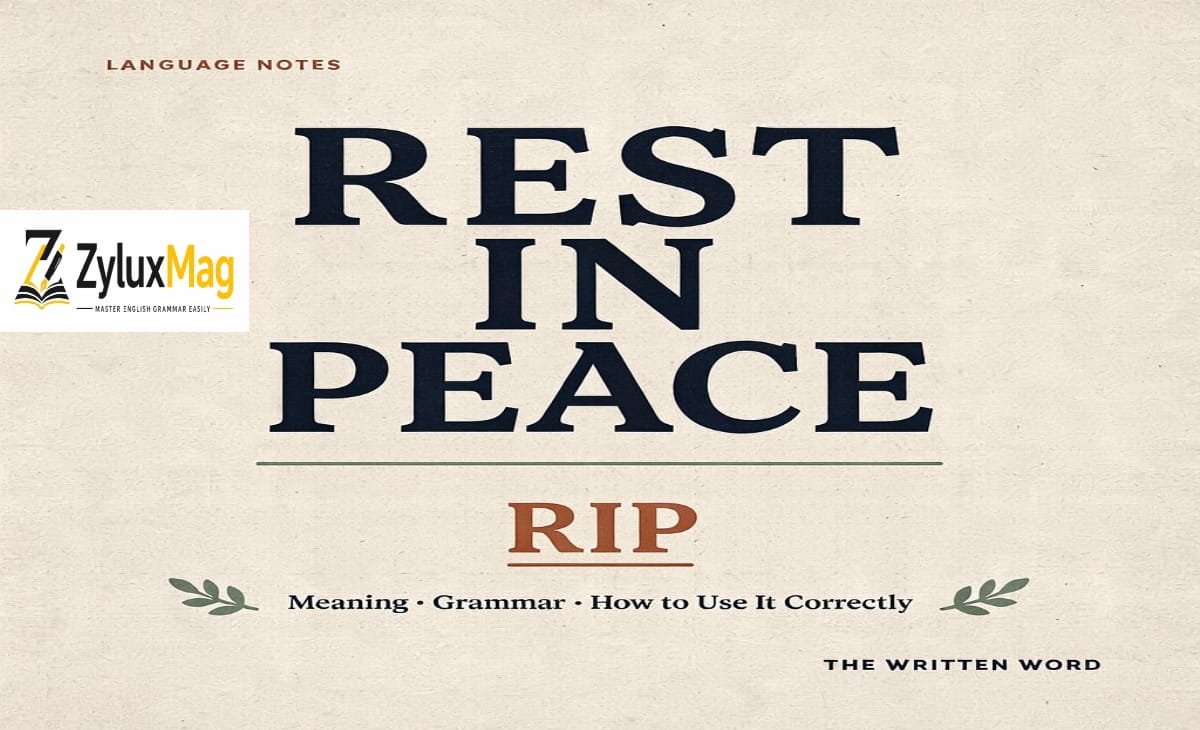
“Rest in peace” is a phrase used to express the hope that someone who has died is now free from pain or trouble. It’s commonly abbreviated as RIP or R.I.P., and you’ll see it on gravestones, in obituaries, and in condolence messages. The phrase comes from the Latin requiescat in pace, meaning “may he/she rest in peace.”
That’s the short version. Here’s everything else worth knowing about where it comes from, how it’s punctuated, and — the part most people get wrong without realizing it — the grammar behind it.
Where “Rest in Peace” Comes From
The phrase traces back to the Latin requiescat in pace, which began appearing on Christian gravestones as early as the 8th century and became common across Western Christian burial traditions. Catholic funeral services still sometimes use the original Latin. Over time, the English translation “rest in peace” took its place on headstones and in obituaries, and the abbreviation R.I.P. followed.
Today the phrase is used far beyond religious or funeral contexts. It shows up in everyday condolence messages, on social media, and even — informally and often humorously — for things that have nothing to do with death (“RIP my phone screen”). The core meaning stays the same: something has ended, and there’s a wish for peace attached to it.
RIP or R.I.P.? Getting the Abbreviation Right
Both forms are used, and neither is officially “wrong,” but they belong in different contexts.
| Form | Best used for | Notes |
| RIP | Texting, social media, casual writing | No periods; increasingly the default, especially in British English |
| R.I.P. | Formal writing, print, headstones, obituaries | Traditional form, with a period after each letter |
| R.I.P | — | Inconsistent (missing the final period) — best avoided |
When to Use Periods
If you’re writing formally — an obituary, a printed card, a headstone inscription — R.I.P. with periods after each letter is the safer, more traditional choice. If you’re texting a friend or posting online, RIP without periods is completely standard and won’t look wrong.
The one form to avoid is the mixed version, R.I.P (periods after the first two letters but not the last). It’s inconsistent, and while some style discussions allow dropping a final period before a full stop ends the sentence, using it as a standalone abbreviation looks like a typo rather than a style choice.
Capitalization: RIP vs Rip
Keep the abbreviation capitalized — RIP, not “rip.” This isn’t just a style preference: lowercase “rip” is a completely different word (a tear, as in “rip a piece of paper”), so capitalization is what keeps the abbreviation readable at a glance.
The full phrase “rest in peace” has no single fixed capitalization rule. All of these are used correctly, depending on context:
- rest in peace — normal sentence case, most common in running text
- Rest in Peace — title case, often used for emphasis on cards or headers
- REST IN PEACE — full caps, sometimes used on headstones for visual weight
Choose based on where it appears. In a sentence, lowercase is standard. On a card, sign, or heading, title case or full caps are both acceptable stylistic choices.
The Grammar Behind “Rest in Peace” (Why It’s Not “Rests”)
A few years ago, I was ghostwriting an obituary for a client — my first one, and I was nervous about getting the tone right. I typed “rests in peace” without thinking twice and sent the draft, feeling pretty good about it. The client wrote back gently pointing out it should just be “rest.” I remember staring at the screen thinking, wait, isn’t “he” singular? Shouldn’t it take an -s? That one correction sent me down a rabbit hole into subjunctive grammar, and I’ve never made that mistake again.
This is the part most explanations skip, and it’s the most useful thing to actually understand.
“Rest in peace” looks like a simple imperative — a command, like “Sit down” or “Come here.” But it isn’t really addressed to the person in the way a command is. It’s a shortened version of a wish: “(May he/she) rest in peace.”
The word “may” plus a subject and a base-form verb is a pattern called the subjunctive (or more specifically, an optative — a verb form used to express a wish). You’ll recognize the same pattern in other set phrases:
- (May) God bless you.
- (May) Long live the king.
- (Long) may it last.
In each case, the verb stays in its base form — “bless,” “live,” “last” — no matter the subject. It doesn’t become “blesses,” “lives,” or “lasts,” because in a normal sentence you’d expect a third-person singular subject to take an -s ending (“He blesses,” “The king lives”). The subjunctive breaks that rule on purpose: it’s a wish, not a statement of fact, so it doesn’t follow the usual subject-verb agreement.
That’s exactly why “rest in peace” is correct and “rests in peace” is not — even though “he” or “she” is singular and would normally take “rests” in an ordinary sentence. The word “may” is implied but not spoken, and the verb keeps its uninflected form to match that implied wish.
How to Punctuate It in a Sentence
As a standalone phrase, “Rest in peace” is a complete sentence and takes a period or exclamation point:
- Rest in peace.
- Rest in peace!
Using a Comma Before a Name
When the phrase is followed by a name, you’re directly addressing that person — grammatically called direct address — and direct address always takes a comma:
- ✅ Rest in peace, Grandma.
- ✅ Rest in peace, David.
- ❌ Rest in peace Grandma. (missing comma)
This isn’t a rule specific to this phrase — it’s the same comma rule that applies any time you name the person you’re speaking to (“Thanks, Sam,” “Come here, Max”). “Rest in peace” just happens to be one of the most common places people forget it.
“Rest in Peace” in Real Use: Example Sentences
The right tone depends heavily on where you’re using the phrase.
Formal (Obituaries, Cards, Headstones)
- Rest in peace, beloved father and friend.
- He passed peacefully at home, surrounded by family. Rest in peace.
- In loving memory — rest in peace.
Everyday and Text Messages
- So sorry for your loss. Sending love — resting in peace now, free from pain.
- Just heard the news. RIP, he was such a kind man.
- Thinking of your family today. Rest in peace to your grandmother.
Casual and Humorous Use
Outside of actual loss, RIP is often used loosely and lightly for things that have simply ended or failed:
- RIP my diet, I just ordered pizza.
- RIP to my phone battery, it’s been a long day.
- That show got cancelled — RIP.
This casual use is common and widely understood, but it’s worth reading the room: in a message of condolence, keep the tone sincere and avoid this lighter register entirely.
Common Mistakes to Avoid
- “Rest in piece” — a spelling mix-up with “peace.” “Piece” means a part of something; “peace” means calm or the absence of conflict. Only “peace” is correct here.
- “Rests in peace” — incorrect verb form. As explained above, the phrase is a subjunctive wish, so the verb stays as “rest,” regardless of the subject.
- “R.I.P” with a missing final period — inconsistent punctuation. Use either “RIP” (no periods) or “R.I.P.” (a period after each letter).
- Missing the comma before a name — “Rest in peace, Grandma” needs that comma; “Rest in peace Grandma” doesn’t read correctly as a direct address.
- Assuming RIP only applies to people — it’s now widely used, especially online, for objects, plans, or situations that have “ended,” and this casual use is normal, not incorrect. It’s simply a different register from formal condolences.