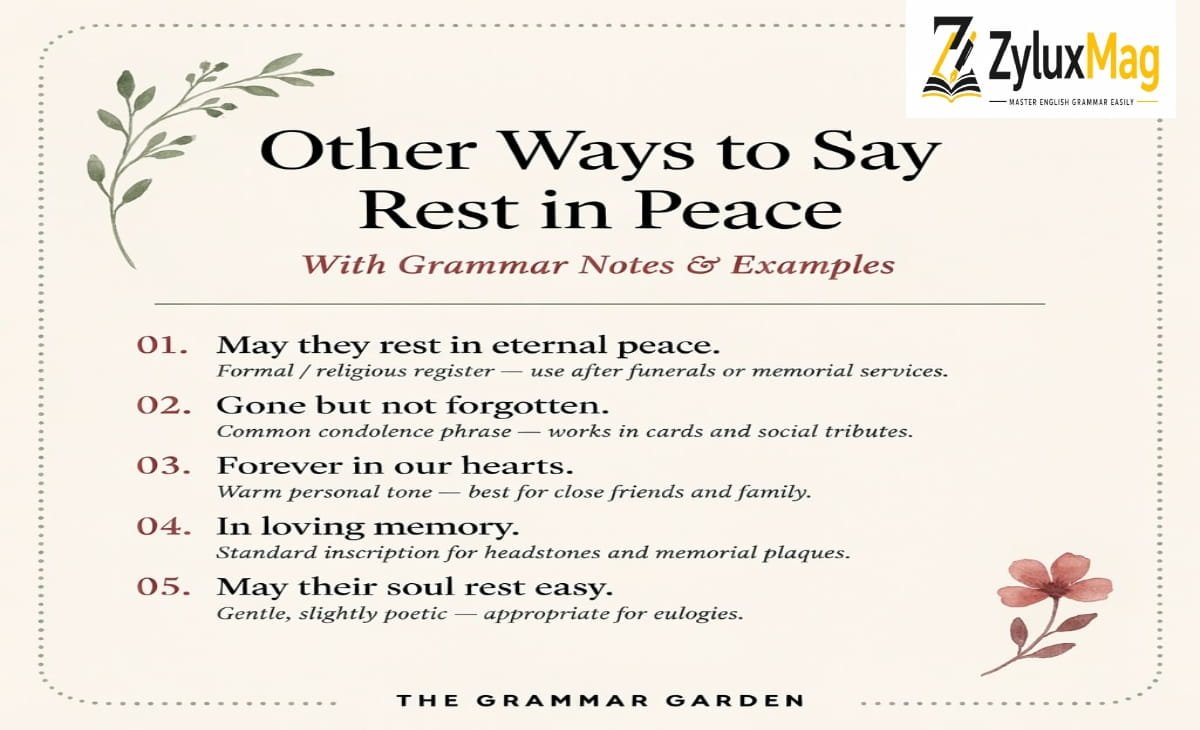
Common alternatives to “rest in peace” include “rest easy,” “may they Other Ways to Say Rest in Peace,” “gone but never forgotten,” “rest in eternal love,” and “forever in our hearts.” The right choice depends on two things: whether your message should be religious or secular, and whether you’re writing to close family or in a more formal setting.
Here’s a quick snapshot before we get into detail:
- Religious: “May their soul rest in peace”
- Secular: “Forever in our hearts”
- Casual: “Rest easy, friend”
- Formal: “Our thoughts are with the family”
- Poetic: “Resting among the stars”
Now let’s look at where this phrase comes from, when each alternative fits, and a few grammar points worth getting right.
A few years ago, a coworker lost her father, and I wanted to write something in her card that felt personal, not just another “RIP” scribbled at the bottom. I spent way too long staring at that blank space, terrified of sounding cold or, worse, saying something that clashed with her family’s beliefs since I honestly didn’t know if they were religious. I ended up writing “thinking of you and your family” instead, and she later told me it meant more than she expected. That’s when it hit me: the right words in a moment like that aren’t about sounding poetic, they’re about actually fitting the person you’re writing to.
What Does “Rest in Peace” Actually Mean?
“Rest in peace” is a wish for the deceased — a hope that their soul is now at ease, free from suffering. It’s most often used on tombstones, in obituaries, in sympathy cards, and increasingly in text messages and social media posts.
Where the Phrase Comes From
The phrase has roots in Latin funeral inscriptions, particularly requiescat in pace (“may he/she rest in peace”), which is where the abbreviation R.I.P. originally came from. It became closely associated with Christian, and especially Catholic, burial traditions, though today it’s used far more broadly by people of many backgrounds and beliefs.
Why It’s “Rest in Peace,” Not “Rests in Peace”
This trips up a lot of writers. “Rest in peace” is not a simple statement about what someone is currently doing — it’s a wish, with the word “may” left out but implied:
- (May) she rest in peace. ✅
- ~~She rests in peace.~~ ❌ (This sounds like a factual statement, not a wish, and isn’t the standard idiom.)
This is called the subjunctive mood — a special verb form used for wishes, hopes, and things that aren’t simply factual. That’s why the verb stays in its base form (“rest”) no matter who you’re talking about:
- May he rest in peace.
- May they rest in peace.
- May your grandmother rest in peace.
You’ll never inflect it to “rests” or “rested,” even for a single person or in past contexts.
Is “Rest in Peace” Religious? Can Anyone Use It?
“Rest in peace” originated in Christian tradition, but in modern use it’s largely become a general expression of respect and condolence, not a strictly religious one. Most people say it without thinking of it as a prayer.
That said, if you know the deceased or their common English expressions family holds a different faith — or no religious faith at all — it’s more thoughtful to choose a secular alternative like “forever in our hearts” or “may their memory be a comfort,” rather than assuming a phrase with religious origins fits every situation.
How to Choose the Right Alternative
Instead of scrolling through a long list hoping something feels right, ask yourself three quick questions:
- Religious or secular? Does the message need to reflect a specific faith, or should it stay neutral?
- Close relationship or more distant one? Was this someone you loved deeply, or someone you’re offering condolences to more formally (a colleague’s parent, a public figure)?
- Spoken/text or written/formal? Is this a quick text to a friend, or something going in a card, obituary, or official message?
Your answers point you toward one of the categories below.
Religious and Spiritual Alternatives
| Phrase | Tone | Best Used For |
| May their soul rest in peace | Reverent | Traditional condolence messages |
| Rest in God’s loving arms | Comforting | Christian families |
| Sleep in heavenly peace | Gentle | Cards, obituaries |
| Rest with the angels | Tender | Messages for children or loved ones |
| May they find eternal peace | Solemn | Formal religious tributes |
Non-Religious and Secular Alternatives
| Phrase | Tone | Best Used For |
| Forever in our hearts | Warm | General sympathy messages |
| Gone but never forgotten | Heartfelt | Obituaries, memorials |
| May their memory be a comfort | Gentle | Messages to grieving families |
| At peace now | Simple | Short, sincere notes |
| Their memory lives on | Reflective | Tributes, eulogies |
Casual and Personal Alternatives
| Phrase | Tone | Best Used For |
| Rest easy, friend | Warm, informal | Texts, social media posts |
| Fly high | Affectionate | Close friends, younger people |
| Until we meet again | Hopeful | Personal messages |
| Sending you love and peace | Supportive | Messages to the grieving, not the deceased |
| You’ll be missed every day | Simple, direct | Casual tributes |
Formal and Professional Alternatives
| Phrase | Tone | Best Used For |
| Our thoughts are with the family | Respectful | Workplace condolences |
| We honor their memory and contributions | Formal | Company announcements, obituaries |
| May they be at peace | Neutral | General formal use |
| We extend our deepest sympathies | Formal | Professional or public messages |
| Their legacy will be remembered | Dignified | Tributes to colleagues or public figures |
Poetic and Literary Alternatives
| Phrase | Tone | Best Used For |
| Resting among the stars | Imaginative | Messages for children, nature lovers |
| Gone to rest beneath the trees | Peaceful | Memorials with a natural theme |
| Resting in eternal light | Lyrical | Cards, engravings |
| Carried gently into peace | Soft | Personal tributes |
| Now at one with the quiet | Reflective | Poetic eulogies |
“Rest in Power” — Why It’s Not a Direct Substitute
“Rest in power” is sometimes treated as just another synonym for “rest in peace,” but it carries a more specific meaning. It’s typically used to honor someone whose life involved resilience, activism, or social impact — often someone from a marginalized community, or a public figure connected to a cause. The phrase has become closely associated with movements for racial and social justice.
Because of this context, “rest in power” isn’t a neutral, all-purpose alternative. Using it for someone with no connection to that context can feel mismatched or, to some readers, inappropriate. When in doubt, choose a different phrase from the categories above.
Common Mistakes to Avoid
- Using “rest in peace” without considering the family’s beliefs. If you’re unsure of someone’s faith, a secular phrase is the safer, more respectful choice.
- Writing “rests in peace” or “rested in peace.” The idiom stays in its base subjunctive form — “rest” — regardless of tense or subject.
- Treating “rest in power” as interchangeable with “rest in peace.” It carries specific cultural weight and isn’t a generic substitute.
- Choosing something too casual for a formal setting. “RIP” in a text to a close friend is fine; the same phrasing in a company-wide email is not.
- Choosing something too formal for someone you loved deeply. A distant, professional phrase can feel cold when a personal or poetic one would be more genuine.