I once sent a client a project update saying our brands’ identities were Entwined vs Intertwined after a rebrand collab — trying to sound poetic, honestly. She wrote back, half-joking, “Are we getting married or launching a product?” I panicked, reread the email, and realized I’d made a simple business partnership sound like a wedding vow. I swapped it for “intertwined” and the whole tone shifted — suddenly it read professional, not romantic. That one word swap taught me more about connotation than any grammar book ever did. Now I pause before every “entwined” and ask myself: am I describing hands, or a business deal?
Quick Answer
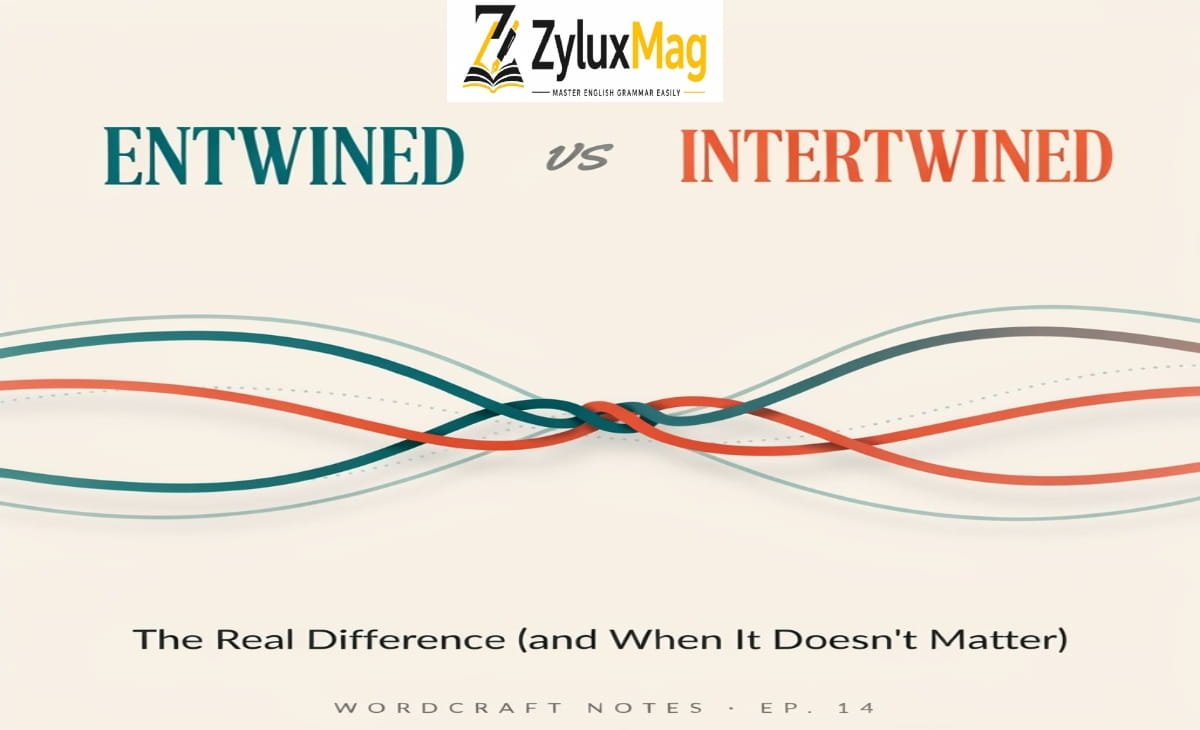
Entwined and intertwined both mean twisted or linked together, and dictionaries list them as synonyms — so using either one is grammatically correct. The difference between them is a matter of tendency, not rule: Entwined vs Intertwined leans toward physical or intimate closeness (fingers, vines, two fates), while intertwined leans toward complex, mutual connection between multiple things (stories, systems, histories). In most sentences, you can swap one for the other without being wrong.
What Each Word Means
Entwined
Entwined is the past tense and past participle of entwine, meaning to twist one thing around another, or to twist two things together. Merriam-Webster defines it simply as “to twine together or around.”
The word works both literally and figuratively:
- Literal: The snake entwined itself around the branch.
- Figurative: Their fingers were entwined as they walked.
- Figurative (relationships): His legacy remains entwined with hers.
Even in its figurative uses, entwined tends to keep a sense of closeness between two specific things — often something personal, physical, or emotional.
Intertwined
Intertwined is the past tense and past participle of intertwine, meaning to unite by twining one thing with another. The prefix inter- (“between” or “among”) reinforces the idea of mutual, back-and-forth connection rather than one thing simply wrapping around another.
- Literal: The branches are intertwined and grow into a solid wall.
- Figurative: Economics and politics are deeply intertwined.
- Figurative (systems or stories): The two timelines are intertwined throughout the novel.
Intertwined is more often used for abstract or multi-part connections — ideas, systems, histories, plots — where several elements are woven together in a complex way.
The Real Difference — Tone, Not Grammar
Here’s the part most explanations get wrong: there is no grammar rule that separates these two words. Major dictionaries, including Merriam-Webster, list intertwine as a direct synonym of entwine. Neither word is more “correct” than the other, and neither is restricted to a specific sentence structure.
What actually differs is tone and typical context:
| Entwined | Intertwined | |
| Typical feel | Intimate, physical, personal | Complex, structural, analytical |
| Common subjects | Hands, fingers, vines, two people | Ideas, systems, stories, histories |
| Number of elements | Often two | Often multiple, or treated as a system |
| Common register | Poetic, romantic, descriptive | Neutral, journalistic, academic |
Think of it this way: entwined paints a picture of something wrapping closely around something else. Intertwined describes a web of connection that’s hard to pull apart. Both images overlap — which is exactly why the words overlap too.
Which One Should You Use? (Quick Test)
When you’re stuck between the two, ask yourself:
- Is this physical, intimate, or about just two things? → Entwined will usually sound more natural. Their hands were entwined.
- Is this abstract, systemic, or about multiple elements? → Intertwined will usually sound more natural. Their careers have become intertwined over the years.
- Does either one sound fine? → They’re interchangeable here. Choose based on rhythm or formality, not correctness. Their lives were entwined. / Their lives were intertwined. Both work — the first feels slightly more personal, the second slightly more analytical subtle usage differences like differently.
Entwined vs Intertwined in Real Sentences
| Sentence | Word used | Literal or figurative | Why it fits |
| He entwined his fingers with hers. | Entwined | Figurative | Two specific things, physical closeness |
| The vines were entwined around the trellis. | Entwined | Literal | One thing wrapping around another |
| His legacy remains forever entwined with hers. | Entwined | Figurative | Personal, single relationship |
| Economic frustration and politics have become increasingly intertwined. | Intertwined | Figurative | Multiple abstract forces |
| The two timelines are intertwined throughout the novel. | Intertwined | Figurative | Complex, structural connection |
| The branches are intertwined and form a solid wall. | Intertwined | Literal | Multiple strands mutually twisted |
Common Mistakes and Misconceptions
Treating the tone difference as a strict grammar rule. Some guides claim entwined is “only” for emotion and intertwined is “only” for logic. That’s an overstatement. Dictionaries cross-list the two words as synonyms, so this is a stylistic tendency you can lean on — not a rule you can break.
Assuming intertwined always needs more than two subjects. Intertwined often describes multiple or complex elements, but nothing in the grammar requires it. “Their fates are intertwined” is perfectly correct even with just two people involved.
Misspelling the words. Both are single words, with no hyphen: entwined, not en-twined; intertwined, not inter-twined. Watch also for the double “e” in *entwine” (one “e” after the “tw,” not two).
Assuming “intwine” is a typo. It isn’t. Merriam-Webster lists intwine as a recognized variant spelling of entwine. It’s rare and slightly old-fashioned, so entwine is the safer choice in modern writing, but intwine isn’t an error if you encounter it in older texts.
Overusing either word in plain, technical writing. Both words carry a literary or emotive quality. In a business report or technical document, “connected,” “linked,” or “related” often communicates the same idea more directly.
A Few Edge Cases Worth Knowing
Is “intwine” a real word?
Yes. It’s an accepted, though uncommon, variant spelling of entwine. You’ll mostly see it in older or more formal literary writing. For everyday and professional writing, stick with entwine.
Is one more formal than the other?
Intertwined appears more often in journalism, academic writing, and analysis, which gives it a slightly more neutral, formal feel. Entwined shows up more in poetry, fiction, and descriptive or romantic writing. Neither is “incorrect” in formal contexts, but this pattern can guide your choice.
Can you always swap them?
In most sentences, yes — grammatically, the swap will always work. The only time it’s worth pausing is when you want to control tone precisely: choose entwined for a closer, more personal image, and intertwined when you want to emphasize complexity or multiple parts working together.
About the Author
Admin is the founder and lead writer at ZyluxMag, where grammar and vocabulary are broken down in plain, practical language for everyday writers. With years of hands-on experience writing client emails, marketing copy, and content across freelance projects, Admin has learned firsthand how a single word choice can change the tone of an entire message — and shares those real lessons here so readers don’t have to make the same mistakes.