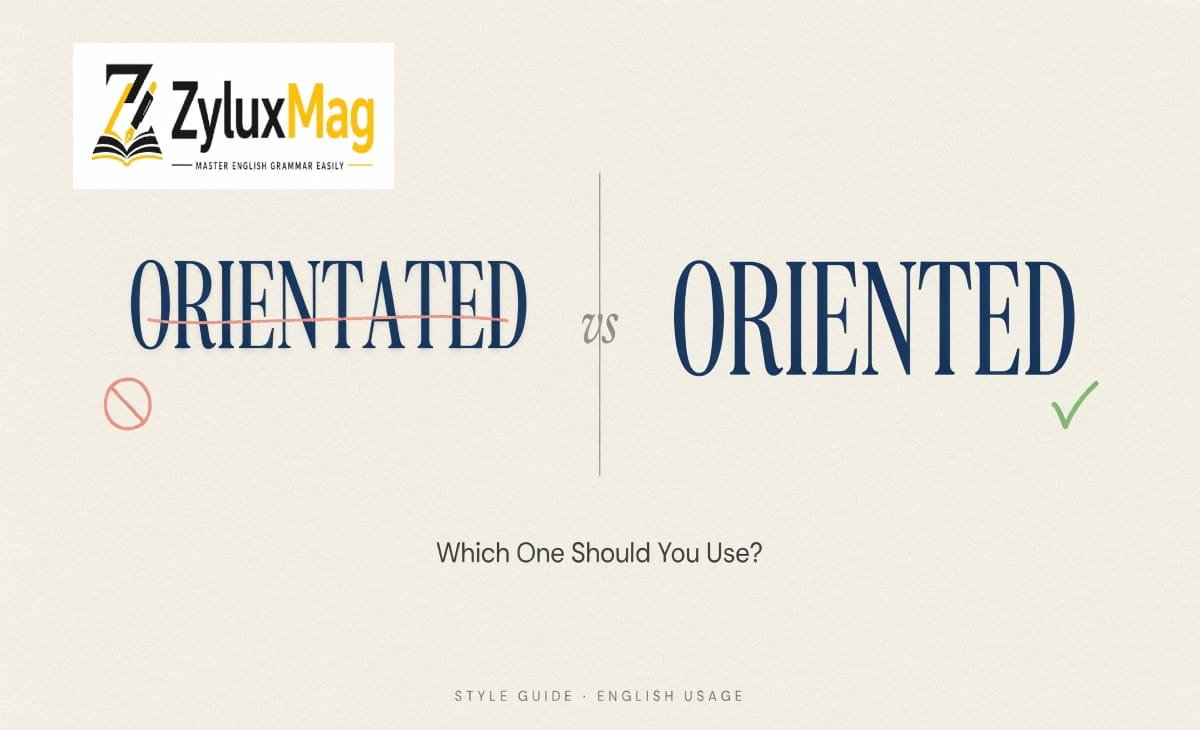
Orientated vs Oriented mean exactly the same thing. “Oriented” is the standard form in American English, while “orientated” is common and accepted in British English. Neither one is wrong — the right choice depends on your audience, not on correctness.
If you just needed the quick answer, that’s it. If you want to know why two spellings exist, and how to handle tricky cases like “goal-oriented” vs “goal-orientated,” read on.
A Mistake That Taught Me This the Hard Way
In my final year of college, a professor circled “orientated” in red on my draft and wrote “??” next to it — like I’d invented the word on the spot. I actually argued with him about it after class, half-convinced I was being marked down for nothing. Turned out we were both right, just working from different sides of the Atlantic in our heads. That’s the moment it really clicked for me: this isn’t a right-or-wrong rule you memorize once and forget. It’s a word that quietly reveals which English you were taught — and nobody warns you about that until someone circles it in red.
Do Orientated vs Oriented” Mean Different Things?
No. Despite looking like separate words, they carry the exact same meaning:
- To align or position something in relation to a direction or fixed point. The house is oriented toward the morning sun. The house is orientated toward the morning sun.
- To familiarize yourself with a new place or situation. It took her a day to get oriented in the new office. It took her a day to get orientated in the new office.
Both sentences in each pair are grammatically correct and mean the same thing. There is no shade of meaning that “orientated” captures and “oriented” misses, or the reverse. The difference is entirely regional, not semantic.
Where “Orientated” Actually Came From
A common belief is that Orientated vs Oriented is the “proper” past tense of the noun orientation, and that “oriented” is some kind of shortcut. That gets the history backwards.
The verb “orient” came first, entering English in the early 18th century. “Orientate” appeared later, formed by back-formation from the noun orientation — essentially, someone built a new verb by working backward from the noun, rather than the noun coming from the verb “orientate.” This is a normal pattern in English (similar things happen with words like administrate alongside administer), but it means “orientate” is the newer, added form — not the more “correct” one.
So grammatically, “oriented” is the more direct participle of the original verb “orient.” “Orientated” isn’t incorrect — it just took the long way around.
American English vs British English: The Real Rule
When to Use “Oriented”
Use “oriented” if you’re writing for:
- A US audience
- A style guide like AP or Chicago (both favor “oriented”)
- Academic or scientific writing, where “oriented” is the dominant form regardless of region
- An international or mixed audience, since “oriented” is understood everywhere and never looks out of place
Example: The company is customer-oriented, with support teams available around the clock.
When to Use “Orientated”
Use “orientated” if you’re writing for:
- A UK, Australian, or Commonwealth audience
- A British house style that specifically prefers it
Example: New students attend an orientated session before the term begins.
One thing worth knowing: even in the UK, “oriented” is increasingly common, especially in formal and international writing. The US/UK divide is a strong leaning, not a hard rule — so if you use “oriented” everywhere, you won’t be wrong anywhere.
What About “Goal-Oriented,” “Customer-Orientated,” etc.?
This is where most people actually run into this question — not while writing the verb “orient” on its own, but while writing a compound adjective in a resume, business description, or course listing.
The same regional pattern applies:
| American English | British English |
| goal-oriented | goal-orientated |
| customer-oriented | customer-orientated |
| results-oriented | results-orientated |
| career-oriented | career-orientated |
In practice:
- She is a results-oriented manager with five years of team leadership experience. (US style)
- The course is student-orientated, with small group tutorials each week. (UK style)
If you’re writing a CV, marketing copy, or a course description for a US company or American readers, “oriented” is the safer and more expected choice. For UK-based writing, “orientated” fits naturally, though “oriented” won’t be flagged as wrong there either.
Common Mistakes to Avoid
Thinking “orientated” is simply a typo or an error. It isn’t. It’s a real, dictionary-recognized word that’s standard in British English — not a misspelling of “oriented.”
Assuming “orientated” must be more correct because it matches “orientation.” This is the reverse of what actually happened historically. “Oriented” comes directly from the original verb “orient”; “orientated” was built afterward from the noun. Neither history makes one spelling more “correct” today — but the “orientated must be right because it matches the noun” logic doesn’t hold up.
Mixing both spellings in the same piece of writing. Even though both forms are acceptable, switching between “oriented” and “orientated” within a single document, webpage, or resume looks inconsistent and unpolished. Pick one and use it throughout.
Forgetting the pattern extends to related words. The same US/UK split applies to the antonym pair: disoriented (American) and disorientated (British) follow the identical rule.
Quick Reference: Which Word to Pick
| Your Situation | Use |
| Writing for a US audience, or following AP/Chicago style | Oriented |
| Writing for a UK or Australian audience, or British house style | Orientated (oriented also works) |
| Audience is international or unclear | Oriented |
| Academic or scientific writing (any region) | Oriented |
Whichever you choose, the most important rule is simple: pick one spelling and stay consistent throughout your writing.