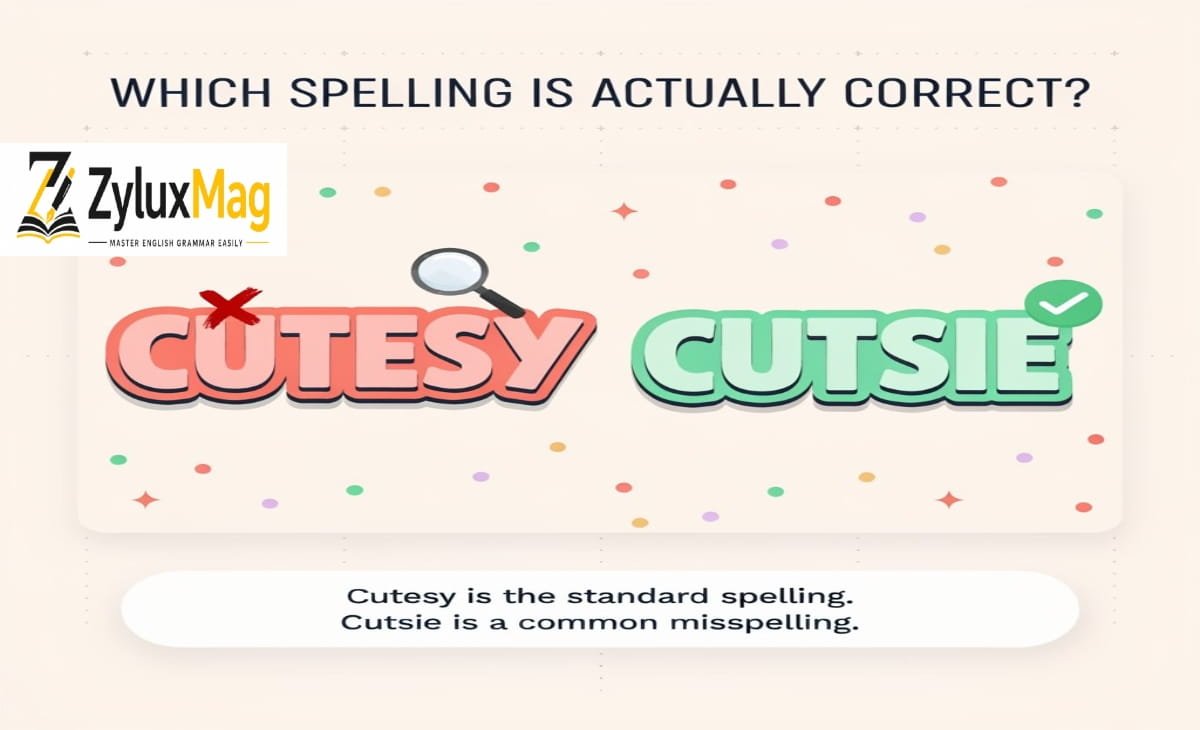
Cutesy is the correct and standard spelling. “Cutsie” is a common misspelling with no dictionary support — it most likely comes from writing the word the way it sounds rather than the way it’s spelled.
It means something that’s self-consciously or excessively cute — often in a way that feels a little forced or overdone.
A quick confession: I actually learned this one the hard way. A few years back, I was pitching a lifestyle brand for a copywriting gig, and I described their packaging as having a “cutsie, handmade feel” in the email. Confident. Typo-free, I thought. The client wrote back — kindly, but pointedly — asking if I meant “cutesy.” I froze, Googled it under the table like a student caught cheating, and yep: I’d been spelling it wrong for years, probably in every text and caption before that. I got the gig anyway, but I never trusted my spelling on that word again without double-checking — which is exactly why this word earned its own article.
What “Cutesy” Actually Means
Cutesy is an adjective, and its meaning is more specific than people usually assume. It doesn’t just mean “cute.” It means cute on purpose, and often a bit too much so spellings like sleave vs sleeve.
Major dictionaries describe it as:
- Merriam-Webster: self-consciously or excessively cute
- Cambridge Dictionary: artificially attractive and pleasant, especially in a childish way
- Britannica Dictionary: trying too hard to be appealing; too cute in an annoying way
Notice the pattern: every definition includes a hint of criticism. Cutesy isn’t neutral. It usually suggests that something is trying to charm you, and that the effort is a little obvious — like a greeting card with kittens peeking out from behind flowers, or baby talk that goes on a bit too long.
Where “Cutesy” Comes From
Cutesy is built from the word cute, plus the suffix -sy, the same ending you see in folksy. That suffix tends to add a playful or slightly exaggerated feel to a word, which fits: cutesy takes “cute” and pushes it just past sincere into performative.
The word has been in use since at least 1914, so it’s not new slang — it’s simply informal by nature, the way chummy or touchy-feely are.
Is “Cutesie” Different From “Cutsie”?
This is the part most guides get wrong, and it’s worth being precise about, because there are actually three spellings floating around, not two:
| Spelling | Status |
| cutesy | Correct — the standard spelling everywhere |
| cutesie | A recognized minor variant in some dictionaries (e.g., Random House), but far less common |
| cutsie | Not a real spelling — this is the letter-transposition error people are usually asking about |
The confusion happens because cutesy is pronounced “KYOOT-see,” and when people try to spell it from memory, the e and s get swapped, producing “cutsie.” That version doesn’t follow the word’s actual structure (cute + -sy) and isn’t listed as standard in any major dictionary.
So if you’ve seen “cutesie” somewhere and assumed it was just another misspelling of “cutsie,” it’s actually the reverse: cutesie is the rarer accepted form, and cutsie is the one to avoid.
“Cutesy” vs. “Cute” vs. “Adorable” vs. “Twee”
These words often get used interchangeably, but they carry different tones. Swapping one for another can quietly change how a sentence sounds.
| Word | Tone | Example |
| Cute | Neutral to positive, sincere | The puppy is cute. |
| Cutesy | Slightly negative, “trying too hard” | The greeting card was almost too cutesy. |
| Adorable | Strongly positive, sincere | Her laugh is adorable. |
| Twee | Negative, overly quaint or precious | The café’s decor felt twee. |
The key distinction: cute and adorable are compliments. Cutesy is a description with an edge to it — it can be affectionate, but it can just as easily be a polite way of saying “that’s a bit much.”
How to Use “Cutesy” in a Sentence
- ✅ Her handwriting has a cutesy, bubbly style.
- ✅ The ad’s cutesy slogan felt a little try-hard.
- ✅ He always uses a cutesy nickname for his dog.
- ✅ This card is cutesier than the one we sent last year.
- ❌ That cutsie little café on Main Street. — should be cutesy
Because cutesy leans informal, it fits casual writing, marketing copy, reviews, and conversation far more naturally than academic or highly formal writing. If you’re writing a formal report, a more neutral word like charming or sentimental often fits better — not because cutesy is spelled wrong, but because its tone is casual by design.
Common Mistakes to Avoid
- Writing “cutsie” instead of “cutesy.” This is the main error. Remember the word is built from cute + -sy — keep the e from “cute” in place, and the spelling falls into order: c-u-t-e-s-y.
- Treating “cutesy” as a plain synonym for “cute.” “Cute” is a straightforward compliment. “Cutesy” usually implies the cuteness is deliberate, exaggerated, or a little much. Using them interchangeably can send the wrong message — calling someone’s serious design choice “cutesy” may come across as a mild dig, not a compliment.
- Using “cutesy” in formal writing without noticing the tone shift. Even spelled correctly, “cutesy” is an informal, faintly judgmental word. It’s a fine, natural choice in a blog post or casual review — less so in a cover letter or academic paper.
Quick Answers to Related Questions
How do you pronounce “cutesy”?
It’s pronounced KYOOT-see (/ˈkyoot-si/) — two syllables, stressing the first.
Is “cutesy” formal or informal?
Informal. It’s common in everyday writing, marketing, and conversation, but it’s usually avoided in formal or academic contexts.
What are the other forms of “cutesy”?
As an adjective, it takes comparative and superlative forms just like other short adjectives ending in -y: cutesy → cutesier → cutesiest, following the same y-to-i pattern as happy → happier → happiest.
Written by Admin Admin writes about English grammar, spelling, and everyday word choices for ZyluxMag, drawing on years of hands-on writing and editing experience to clear up the mix-ups that trip up even confident writers.