I still cringe thinking about this one Sale vs Sell. Back in college, I stood up to present a marketing project and confidently told the room, “We plan to sale this product to a younger audience.” A classmate snorted, and my professor just raised an eyebrow. I laughed it off at the time, but afterward I went home and actually looked up why “sale” felt so wrong there – turns out I’d been treating a noun like a verb my whole life. That small, humiliating moment stuck with me longer than any grammar worksheet ever did.
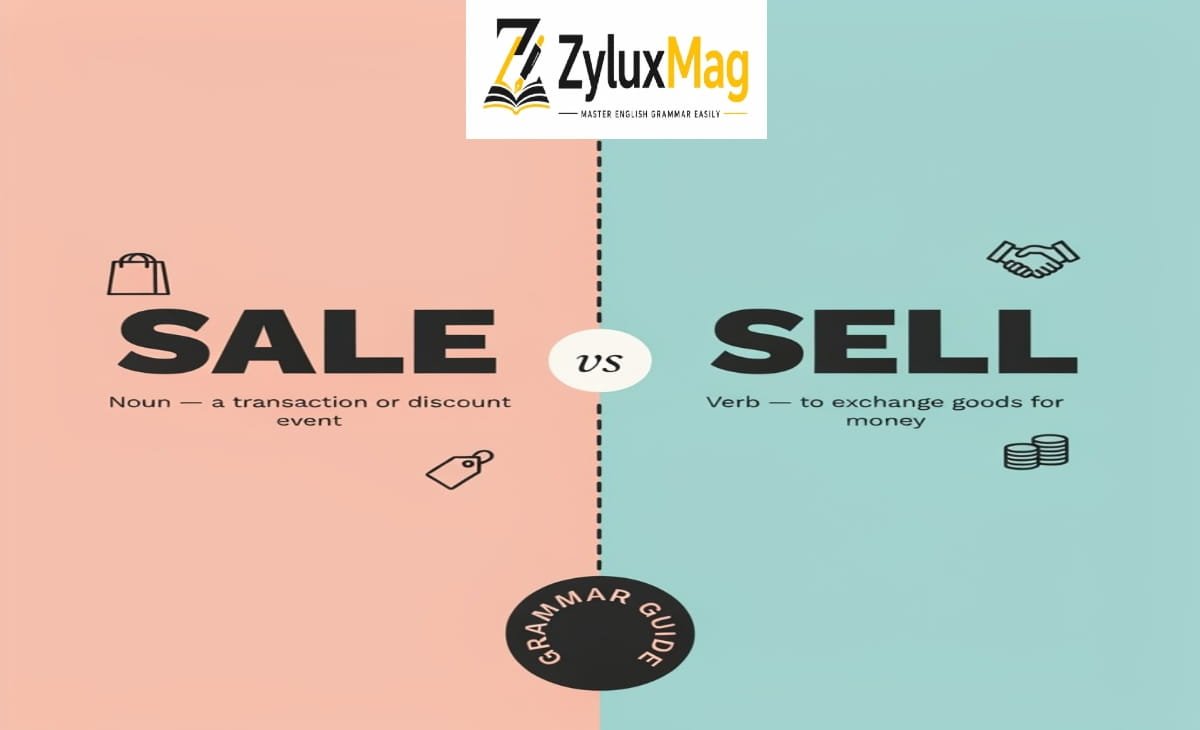
“Sale” is a noun – it names a thing or event, like a sale or something that’s for sale. “Sell” is a verb – it names the action of exchanging something for money. A simple test: if you can put “a” or “the” in front of it, use sale. If you’re describing what someone does, use sell.
“Sale” – The Noun
Sale refers to the act of selling something, or an event where things are being sold at reduced prices. It’s a thing you can count, refer to, or point to – never an action you perform.
The bakery had a big sale on bread this morning.
We watched the sale of the old house from across the street.
Is this bike still available, or has the sale already gone through?
Fixed Phrases With “Sale”
Certain phrases always use sale, never sell. These trip people up more than any grammar rule, because they show up constantly in everyday writing – signs, listings, and ads.
For sale – “This apartment is for sale.”
on sale – “These shoes are on sale until Friday.”
point of sale – “The system tracks every point of sale.”
clearance sale – “The store is running a clearance sale.”
garage sale / yard sale – “We’re having a garage sale on Saturday.”
None of these ever take “sell.” If you see “for sell” or “on sell,” it’s incorrect – no exceptions.
“Sell” – The Verb
Sell means to give something to someone in exchange for money. It describes an action, so it changes form depending on who’s doing it and when.
I sell vintage furniture at weekend markets.
She sells insurance for a living.
They sold their car last month.
We are selling the house next spring.
How “Sell” Changes Form
Sell is an irregular verb — its past tense doesn’t follow the normal “-ed” pattern understanding correct word forms in English.
| Form | Word |
| Base | sell |
| Third person singular | sells |
| Present participle | selling |
| Past simple | sold |
| Past participle | sold |
There’s no such word as “selled.” The past tense of sell is always sold — the same form for both simple past and past participle (“She sold it yesterday” / “She has sold three houses this year”).
This is also where sales comes in as a related noun: “sales” refers to the broader activity or figures (“Sales were strong this quarter,” “the sales department”), while sells is simply the verb form used with he/she/it (“He sells cars”). Don’t mix them up:
Sale vs. Sell at a Glance
| Sale | Sell | |
| Part of speech | Noun | Verb |
| Meaning | A thing/event | An action |
| Example | “It’s on sale.” | “I sell candles.” |
| Related forms | sales (noun) | sells, selling, sold |
| Memory cue | Sale rhymes with tale — a thing | Sell rhymes with tell — an action |
Common Mistakes to Avoid
“This car is for sell.” “This car is for sale.”
“Everything in the store is on sell.” “Everything in the store is on sale.”
“He selled his laptop last week.” “He sold his laptop last week.”
“I will sale this next week.” “I will sell this next week.”
“He sale a lot of products.” “He sells a lot of products.”
A quick way to catch these mistakes yourself: if the word follows “for,” “on,” or “a/the,” it should almost always be sale. If it follows a subject doing something (“I,” “she,” “they”), it should be sell in one of its verb forms.
One more mix-up worth watching for: sale and sail sound identical but mean completely different things. A boat sails; a store has a sale. Autocorrect won’t always catch this one, so it’s worth a second glance before you hit publish.
The Exception: When “Sell” Acts Like a Noun
Just when the rule seems perfectly clean, English adds one wrinkle: sell can occasionally act as an informal noun, especially in business or persuasion contexts.
That pitch was a hard sell. (meaning: difficult to convince someone of)
The offer is a pretty soft sell – no pressure at all.
There’s also best-seller – a product, especially a book, that sells in very high numbers. It’s built from sell, not sale, even though it describes something related to sales success. “Best-sale” and “best-saler” are both incorrect.
These uses are informal and limited to a handful of set expressions – they don’t change the core rule. In everyday writing, sale is still the noun and sell is still the verb.
About the Author
Faizan Babar is a writer at ZyluxMag, where he covers English grammar, vocabulary, and everyday language tips for learners and writers alike. He believes the best way to understand a grammar rule is to have gotten it wrong at least once in real life – and he’s had plenty of those moments himself. When he’s not writing, he’s usually reading about language quirks or helping friends fix their emails before they hit send.