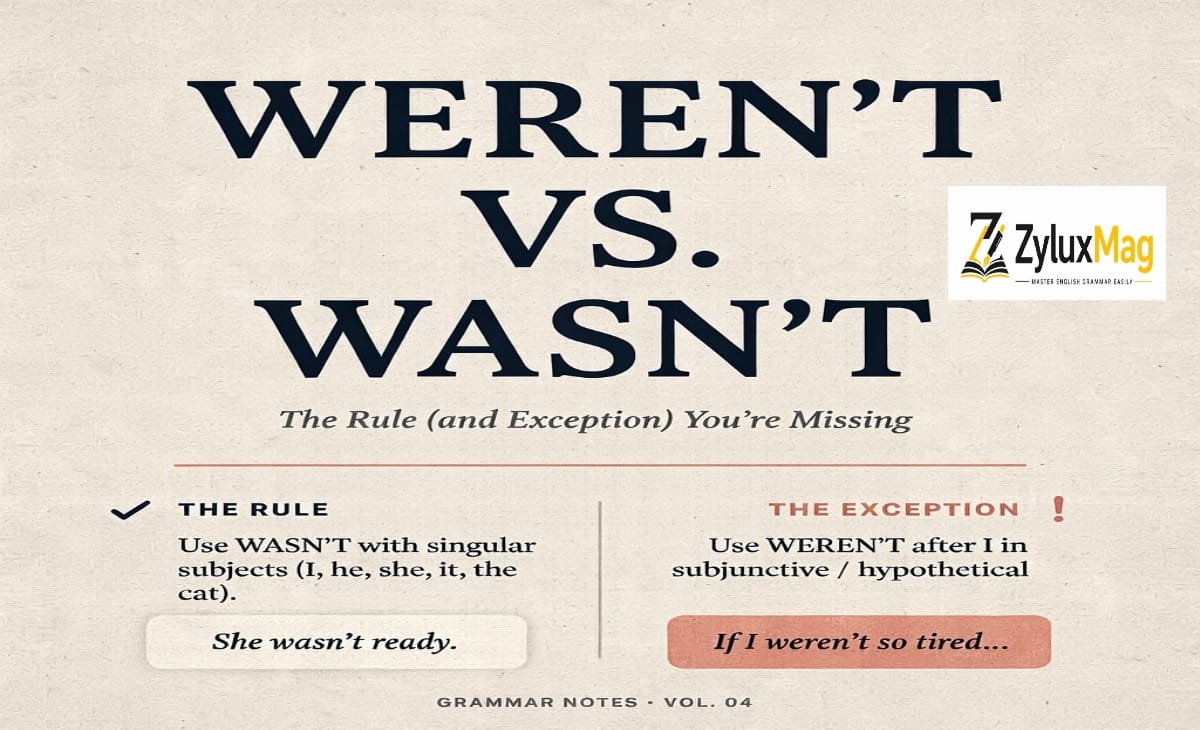
“Weren’t” is the contraction of “were not.” Use it with plural subjects — we, you, they — and with plural nouns: “They weren’t ready.” It’s also correct with singular subjects (I, he, she, it) in hypothetical or wishful statements, like “If I weren’t so tired…” This is called the subjunctive mood, and it’s the exception most people never learn.
What “Weren’t” Means
“Weren’t” combines “were” and “not” into one word. The apostrophe replaces the missing “o” in “not”:
were + not → weren’t
It’s the negative past-tense form of “to be,” used wherever “were” would normally appear.
The Basic Rule — When “Weren’t” Is Correct
With Plural Subjects (we, you, they)
In standard past tense, “were” pairs with we, you, and they — and “weren’t” follows the same pattern.
- We weren’t late.
- You weren’t listening.
- They weren’t at the meeting.
Note that “you” always takes “were,” even when you’re talking about one person: “You weren’t home yesterday” is correct whether “you” means one friend or a group.
With Plural Nouns
Any plural noun works the same way.
- The kids weren’t listening.
- My parents weren’t happy about it.
- The results weren’t accurate.
For singular subjects (I, he, she, it) describing a real past fact, English uses wasn’t, not “weren’t”:
- I wasn’t there. ✅ (not “I weren’t there”)
- He wasn’t ready. ✅ (not “He weren’t ready”)
The Exception Nobody Tells You — “Weren’t” With I, He, She, It
Here’s the part most explanations skip: “weren’t” can go with singular subjects — but only in a specific situation.
What the Subjunctive Mood Is (in Plain English)
The subjunctive mood is used for things that aren’t real: wishes, hypotheticals, and unreal conditions — usually after words like if or wish. In this mood, English uses “were” for every subject, including I, he, she, and it — not “was.”
That means the negative form is also “weren’t,” even for a singular subject.
Examples
- If I weren’t so busy, I’d help you move.
- I wish she weren’t so far away.
- If he weren’t the manager, he probably wouldn’t have said anything.
- If it weren’t for the rain, we’d be at the beach right now.
Compare the same subject in two different moods:
- I wasn’t there yesterday. (a real fact about the past)
- If I weren’t there, no one would notice. (a hypothetical situation)
The difference isn’t the subject — it’s whether the sentence describes something real or something imagined.
“Weren’t” vs. “Wasn’t” — Quick Comparison
| Subject | Real Past Fact | Hypothetical / Wish |
| I | I wasn’t ready | If I weren’t ready… |
| He / She / It | He wasn’t home | If she weren’t home… |
| We / You / They | We weren’t invited | If they weren’t invited… |
Notice that “weren’t” is the same for every subject in the hypothetical column — that’s the subjunctive at work.
The 3-Second Self-Check
When you’re not sure which word to use, ask one question:
Is this a real fact, or an imagined situation?
- Real fact → match the subject normally: singular takes “wasn’t,” plural takes “weren’t.”
- Hypothetical, wish, or “if” statement → use “weren’t,” even for I/he/she/it.
If you can mentally add “but it’s not true” or “but this isn’t real” after the sentence, you’re likely in subjunctive territory, and “weren’t” is correct.
How to Spell It Correctly
The apostrophe goes before the n, replacing the missing “o” from “not”:
- ✅ weren’t
- ❌ were’nt
A simple way to remember it: read the word as “were” + “n’t,” not “were’n” + “t.”
“Weren’t” in Questions and Tag Questions
“Weren’t” is common in both direct questions and tag questions.
Direct questions:
- Weren’t you supposed to call me?
- Weren’t they at the party too?
Tag questions (short questions added to confirm something):
- You were there, weren’t you?
- The lights weren’t on, were they?
In tag questions, the tag simply mirrors the subject and verb from the main clause in negative form.
Common Mistakes to Avoid
- Using “wasn’t” in a subjunctive sentence.
“If I wasn’t so tired, I’d go” is extremely common in casual speech, and many people don’t consider it wrong. But in standard and formal English, “weren’t” is the traditionally correct form: “If I weren’t so tired, I’d go.” - Misspelling the apostrophe position.
“Were’nt” is a common typo. The correct spelling is “weren’t.” - Assuming “weren’t” can never follow I, he, she, or it.
It can — but only in hypothetical, wishful, or unreal statements, not in simple past-tense facts. - Confusing “weren’t” with “aren’t.”
“Weren’t” is past tense (“They weren’t home yesterday”). “Aren’t” is present tense (“They aren’t home right now”). Mixing up the tense is a common error for learners translating from languages with fewer tense distinctions.
“Weren’t” vs. “Were Not” — Does Formality Matter?
Both forms are grammatically identical — “weren’t” is simply the contracted, more casual version of “were not.” The difference is about tone, not correctness.
- Casual / everyday writing: “They weren’t happy about it.”
- Formal / academic writing: “They were not satisfied with the outcome.”
Many style guides for academic, legal, or professional writing recommend avoiding contractions altogether, so “were not” is generally the safer choice in formal documents, reports, and essays. In conversation, emails, and everyday writing, “weren’t” is completely standard and natural.