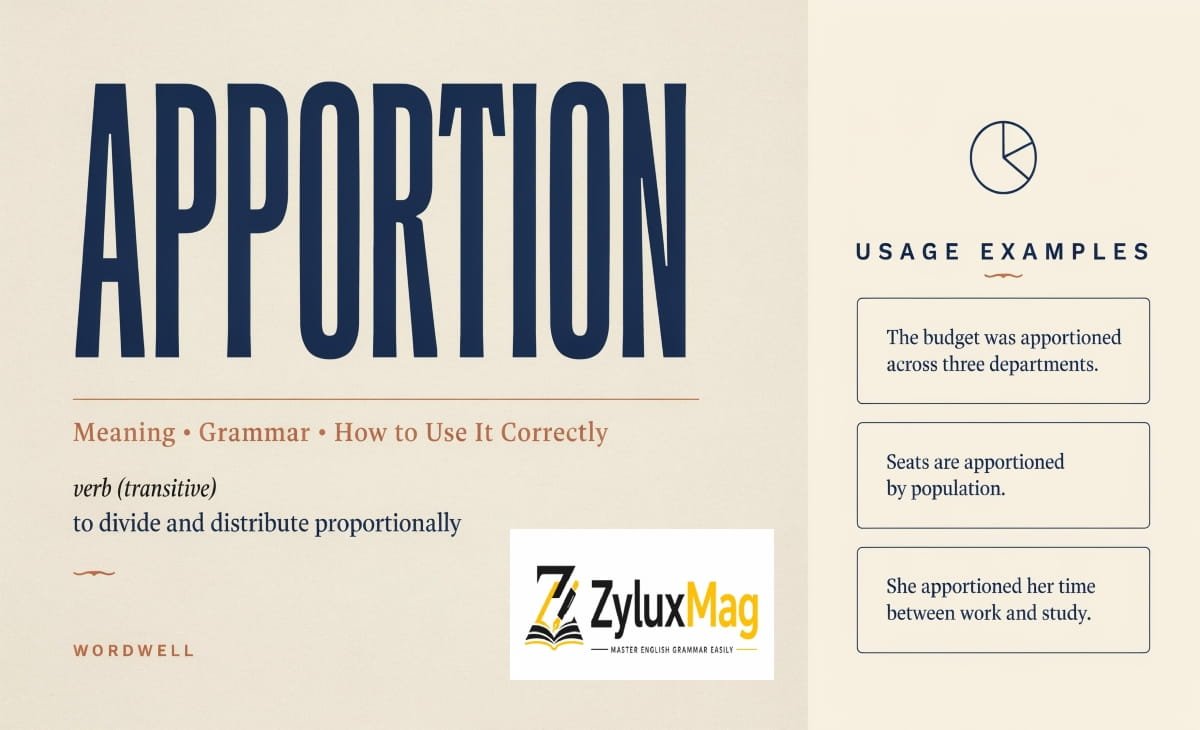
Apportion means to divide something and give out a fair or proportional share of it to each person or group — for example, apportioning costs, blame, seats, or resources among the people involved. It’s a formal verb, most often seen in legal, financial, and political writing.
If you’ve come across this word in a contract, a news article, or a textbook and want to know exactly how to use it, this guide covers everything: word forms, sentence patterns, related words, and the mistakes people make most often.
A few years ago, I was drafting an invoice email for a client with three business partners, and I wrote that the fee would be “apportioned between all three of them.” My editor at the time — a retired legal secretary — sent it back with one line: “between is for two, dear.” I remember staring at the screen, half-embarrassed, half-annoyed that nobody had ever taught me this in school. I fixed it to “among,” hit send, and never made that mistake again. It’s a tiny word, but getting it wrong in front of a client felt like showing up to a meeting with your shirt inside out.
Word Forms of “Apportion”
“Apportion” is a regular transitive verb — it always needs a direct object (you apportion something). Here are its forms:
| Form | Word | Example |
| Base verb | apportion | They apportion the budget every quarter. |
| Present (3rd person) | apportions | The manager apportions tasks fairly. |
| Past tense / past participle | apportioned | Funds were apportioned last year. |
| Present participle | apportioning | The committee is apportioning the seats now. |
| Noun | apportionment | The apportionment of costs took weeks to finalize. |
A quick spelling note: it’s apportion, with a double “p” and a single “n” before the ending. Common misspellings include apportian, aportion, and apportionn.
How to Use “Apportion” in a Sentence
The trickiest part of using this word correctly is choosing the right preposition. The rule is straightforward once you see it laid out:
| Preposition | When to use it | Example |
| among | Three or more people/parties | The judge apportioned blame among the three drivers involved in the crash. |
| between | Exactly two people/parties | The bill was apportioned between the two roommates. |
| to | Naming who receives a share | The charity apportions a fixed amount to each regional office. |
Apportion … Among
Use “among” when you’re dividing something across three or more people, groups, or things. Like other formal English terms such as sans, the word ‘apportion’ is commonly used in structured or professional writing.
- The estate was apportioned among the four siblings.
- Responsibility for the delay was apportioned among several departments.
Apportion … Between
Use “between” specifically when only two parties are involved.
- The rent is apportioned between the two tenants based on room size.
- Liability was apportioned between the driver and the manufacturer.
Apportion … To
Use “to” when the sentence focuses on the recipient rather than the group being divided among.
- A fixed budget is apportioned to each department.
- Water rights are apportioned to farms along the river.
Is “Apportion” Formal or Informal?
Apportion is a formal word. You’ll find it in legal documents, government reports, financial statements, and academic writing — but it would sound stiff in casual conversation. If you’re talking with friends about splitting a bill, “we split it” or “we divided it up” sounds far more natural than “we apportioned it.”
Save “apportion” for writing where precision and a formal tone matter: contracts, reports, policy documents, or academic essays. Some words, like frescade, appear less frequently, while others like ‘apportion’ are common in legal and financial contexts.
“Apportion” vs. “Proportion” — What’s the Difference?
These two words look and sound similar, but they aren’t interchangeable.
| Word | Part of speech | Meaning | Example |
| Apportion | Verb | To divide something and distribute it in shares | They apportioned the profits among the partners. |
| Proportion | Mainly a noun (also used as a verb in formal writing) | A part, share, or ratio in relation to a whole | A large proportion of the budget goes to salaries. |
The simplest way to remember it: apportion is an action (you do something to divide it up), while proportion is usually a description of how big one part is compared to the whole. You apportion money; you talk about the proportion of money that went somewhere.
“Apportion” vs. “Allocate,” “Distribute,” and “Allot”
These words overlap in meaning but carry different shades of emphasis:
- Apportion — dividing something in proportional or fair shares, often based on a formula, rule, or set of criteria. Strongly associated with formal, official contexts.
- Allocate — assigning something for a specific purpose or to a specific recipient. The emphasis is on purpose, not necessarily proportion. “The company allocated funds for marketing.”
- Distribute — the most general and neutral term, simply meaning to give out or spread something among people. “Volunteers distributed food to the shelter.”
- Allot — assigning a fixed, specific portion to someone, often with a sense of limitation. “Each speaker was allotted five minutes.”
In practice, “apportion” is the most formal and rule-based of the four — it usually implies that the division follows some proportional logic (population size, level of responsibility, contract terms), not just a simple handout.
Does “Apportion” Mean Equal Shares?
No — and this is a common misconception. Apportion means proportional or fair, not necessarily equal.
If a company apportions costs among three departments based on their size, the largest department might pay significantly more than the smallest. That’s still “apportioning” correctly, because the division follows a proportional rule — it just isn’t a 50/50 or three-way equal split.
Compare:
- The inheritance was apportioned equally among the children. (equal, but stated explicitly)
- Blame was apportioned according to each driver’s degree of fault. (proportional, not equal)
If you mean an equal split specifically, say so — “apportion” alone doesn’t guarantee it.
“Apportion” in Real Use: Legal, Political, and Everyday Contexts
You’ll most often meet this word in these settings:
- Legal: Liability in the accident was apportioned 70–30 in the plaintiff’s favor.
- Political: Congressional seats are apportioned to states based on population.
- Financial/business: Overhead costs are apportioned across departments according to headcount.
- Everyday (less common, but valid): She apportioned the leftover pizza among her roommates.
The word shows up constantly in U.S. political and legal contexts specifically — “apportionment” is the formal term for how congressional representatives and tax burdens are divided among states based on population.
Common Mistakes to Avoid
- Using “between” for three or more parties. “Apportioned between the five workers” should be “apportioned among the five workers.”
- Confusing apportion with proportion. “The company will proportion the funds” is incorrect in standard usage — it should be “apportion the funds.”
- Assuming it always means equal shares. It means proportional, which can be unequal.
- Using it in casual speech. “Let’s apportion the pizza” is grammatically fine but sounds unnaturally formal — “split” or “divide up” fits better in everyday conversation.
- Misspelling it. Watch for the double “p” and single “n”: ap-portion, not “apportionn” or “aportion.”