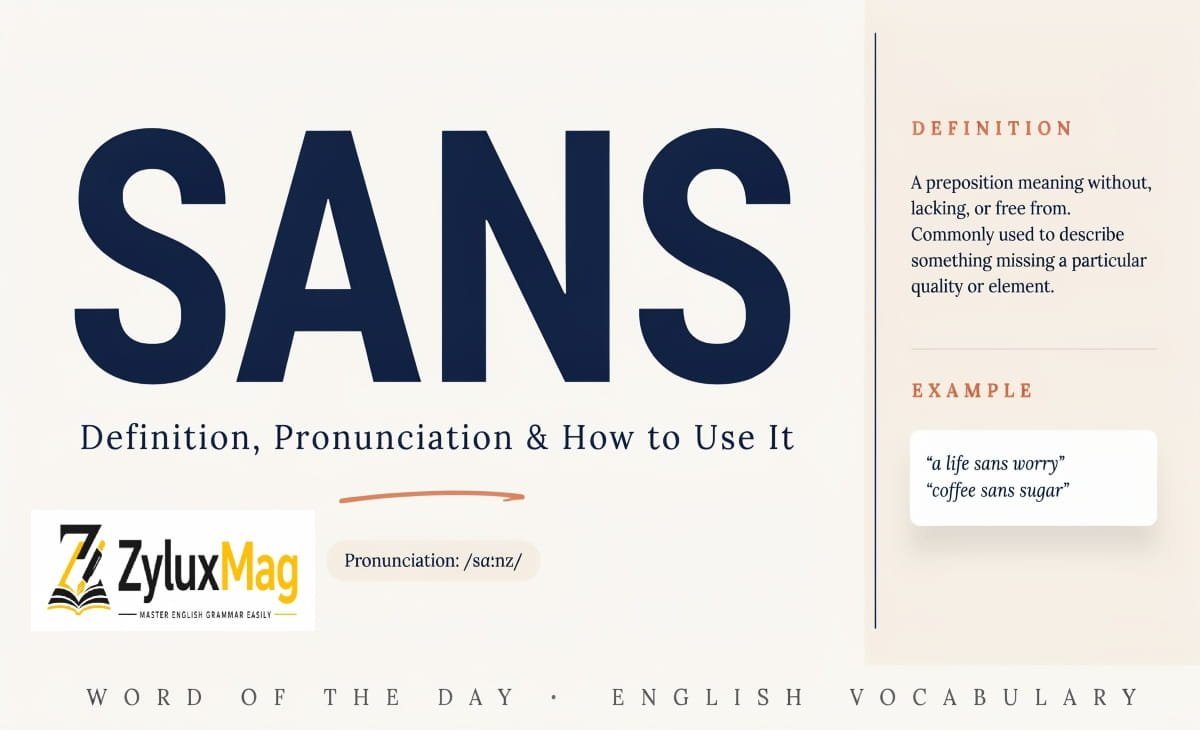
Sans definition is a preposition meaning “without” or “lacking.” It’s placed directly before a noun to show that something is missing or excluded, as in “coffee sans sugar.” It comes from French but is fully naturalized in English — you’ll see it in everyday writing, brand copy, and literature without italics or translation.
How to Pronounce “Sans definition”
In English, sans is pronounced /sænz/ — like “sanz,” rhyming with cans, fans, and plants.
This trips people up because the spelling looks French, and French speakers pronounce it with a nasal vowel and no final consonant sound. English speakers don’t do that. Say it the same way you’d say “sand” without the d, plus a z at the end:
sans = “sanz” (rhymes with cans)
There’s no French accent needed, and no silent letters to worry about.
Is “Sans definition” Formal, Informal, or Old-Fashioned?
Sans has a formal, literary, or playful tone — it isn’t a neutral, everyday word. Writers use it when they want their sentence to sound a little more sophisticated, witty, or old-fashioned, often in headlines, menus, or descriptive writing:
- “Minimalist decor, sans clutter.”
- “He arrived sans invitation.”
In ordinary conversation or professional writing, “without” is almost always the better choice. Reaching for “sans” in an email or report can come across as trying too hard rather than sounding refined.
How to Use “Sans” in a Sentence
The grammar rule is simple: sans is followed directly by a noun or noun phrase — no “of,” and no article needed before an uncountable noun.
| ✅ Correct | ❌ Incorrect |
| She left the party sans her coat. | She left the party sans of her coat. |
| Coffee sans sugar, please. | Coffee sans a sugar, please. |
| He walked in sans shoes. | He walked in sanless shoes. |
| The apartment was designed sans clutter. | The apartment was designed with sans clutter. |
Because sans is a preposition, it behaves exactly like “without” grammatically — it just carries a different tone. If a sentence works with “without” in that spot, it will also work with “sans.”
Common Mistakes with “Sans”
- Mispronouncing it with a French accent. In English, it’s “sanz,” not a nasal French vowel.
- Overusing it to sound sophisticated. Used too often, sans makes writing feel forced or pretentious rather than elegant.
- Adding “of” or an article after it. Sans connects directly to the noun: sans sugar, not sans of sugar or sans a sugar.
- Treating it as a direct swap for “without” in any context. They mean the same thing, but sans is stylistically marked — it’s not appropriate everywhere “without” is.
“Sans” vs. “Without” — What’s the Difference?
Both words mean exactly the same thing. The difference is entirely about tone:
- Without is neutral and standard. It’s correct in any context — formal, informal, spoken, or written.
- Sans is formal, literary, or intentionally stylized. It signals that the writer is making a deliberate choice about voice, not just conveying information.
Rule of thumb: default to “without.” Reach for “sans” only when you specifically want that lighter, more polished, or slightly playful effect — for example, in a headline, a product description, or a witty aside.
“Sans-Serif” — A Related Term Worth Knowing
You’ll also see “sans” inside the word sans-serif, a typography term for fonts without small decorative strokes (serifs) at the ends of letters — think Helvetica or Arial, as opposed to serif fonts like Times New Roman. The “sans” here carries its original meaning: literally, “without serif.”
Quick Reference
| Meaning | Without, lacking |
| Part of speech | Preposition (invariant — no other forms) |
| Pronunciation | /sænz/ — “sanz” |
| Origin | Old French sanz, from Latin sine (“without”) |
| Tone | Formal, literary, or playful — not neutral |
| Everyday equivalent | Without |