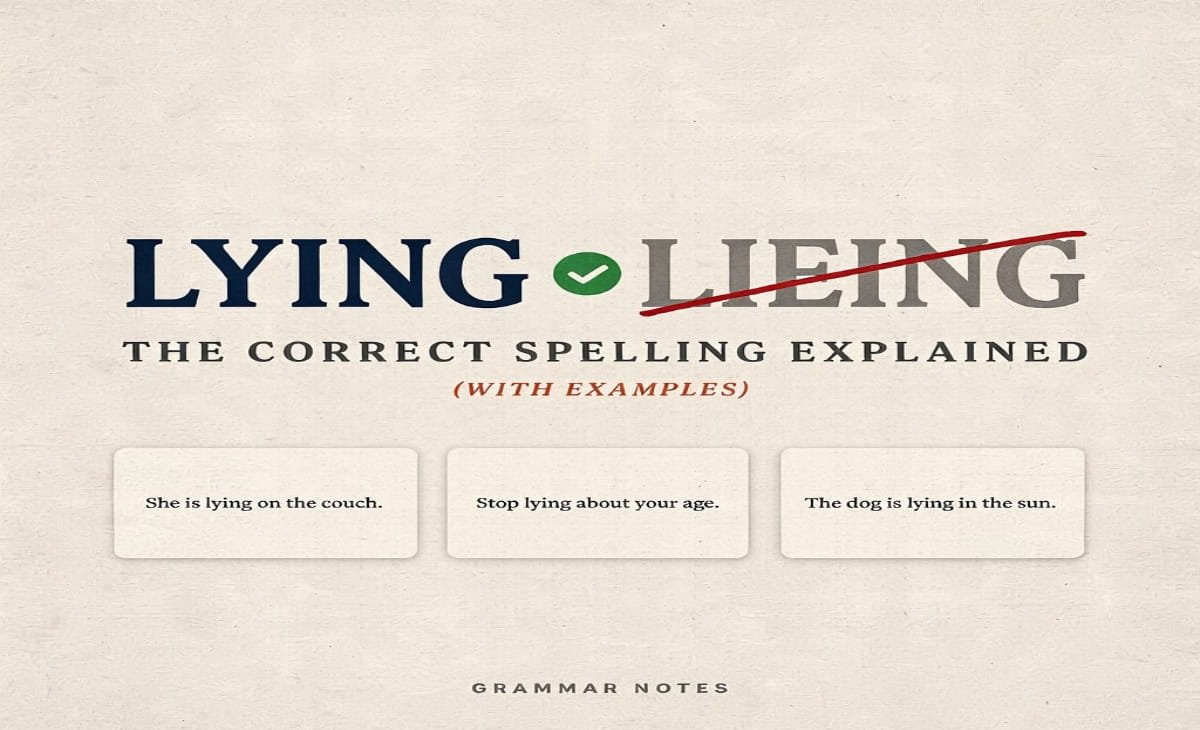
Lying is the correct spelling. “Lieing” is a common misspelling and isn’t recognized in standard English. When a verb ends in -ie, the e changes to y before adding -ing — so lie becomes lying, never lieing.
I still remember the exact moment this rule burned itself into my memory. During a college presentation, I put up a slide that read “She was lieing to protect her friend” — big, bold, projected on a screen in front of thirty classmates. Nobody said anything out loud, but I caught two people exchanging a look, and my professor circled it in red on my printed copy afterward. I remember thinking the word looked wrong while I was making the slide, but I ignored that instinct. I never made that mistake again after that day.
Why “Lieing” Is Incorrect (The Spelling Rule)
The -ie → y Rule
English has a small, consistent spelling rule for verbs ending in -ie: drop the e and change i to y before adding -ing.
- lie → lying
- die → dying
- tie → tying
- vie → vying
Writing “lieing” seems logical if you just add -ing to the end of the word, but that’s not how this group of verbs works. The rule isn’t an exception you need to memorize case by case — it applies the same way every time a verb ends in -ie.
Quick memory trick: If a verb ends in -ie, swap the e for a y before adding -ing.
Other Verbs That Follow the Same Pattern
Because this rule is consistent, once you know it for lie, you already know it for every other -ie verb in English. There’s no separate rule to learn for die, tie, or vie — they all behave exactly the same way.
“Lying” Has Two Different Meanings
One reason people hesitate over this word is that lying isn’t tied to a single meaning. It comes from two different verbs that happen to share the same -ing form.
Lying = Telling an Untruth
This is the lie most people think of first — the verb meaning “to say something that isn’t true.”
- ❌ She was lieing on the report.
- ✅ She was lying on the report.
Conjugation: lie → lied → lied → lying
Lying = Reclining or Resting
This is a separate verb lie, meaning “to be in or move into a flat, resting position.”
- ✅ He was lying on the couch.
Conjugation: lie → lay → lain → lying
Both verbs are spelled lie in their base form and both become lying in the -ing form. The spelling doesn’t change based on meaning — only the past tense does (lied vs. lay), which is often where the real confusion begins naive vs nieve spelling mistake.
The Real Trap: “Lying” vs. “Laying”
Once the spelling of lying is settled, a second, more frequent error usually shows up: confusing lying with laying.
- Lie (recline) is something a person or thing does on its own. It doesn’t take an object.
- Lay (place something down) is something you do to an object. It always needs one.
- ❌ I was laying on the bed.
- ✅ I was lying on the bed.
- ✅ I was laying the book on the table. (correct — “the book” is the object)
Quick Comparison Table
| Base Verb | Meaning | Present Participle | Past Tense |
| Lie | to recline | Lying | Lay |
| Lie | to tell an untruth | Lying | Lied |
| Lay | to place something down | Laying | Laid |
This table is the fastest way to check yourself: if there’s no object receiving the action, you want lying, not laying.
Common Mistakes to Avoid
- Writing “lieing” by adding -ing directly without applying the -ie → y rule.
- Using “laying” with no object, as in “I was laying down,” when it should be “I was lying down.”
- Assuming “lying” only means dishonesty, then getting confused when it appears in sentences about resting or reclining.
- Treating the -ie → y rule as irregular, when it’s actually a small, predictable pattern shared by several common verbs.
Also Asked
Is the past tense “lied” or “lay”?
It depends on the meaning. Use lied for telling an untruth (“He lied about his age”) and lay for reclining (“She lay on the grass”).
Is “lieing” used in British English or any dialect?
No. “Lieing” isn’t a recognized spelling in British, American, or any other standard form of English. The -ie → y rule applies universally, regardless of dialect.
Author Bio
By Admin — ZyluxMag
Admin writes about English grammar, spelling, and everyday word confusions for ZyluxMag, breaking down tricky rules into simple, practical explanations for real-world writing.