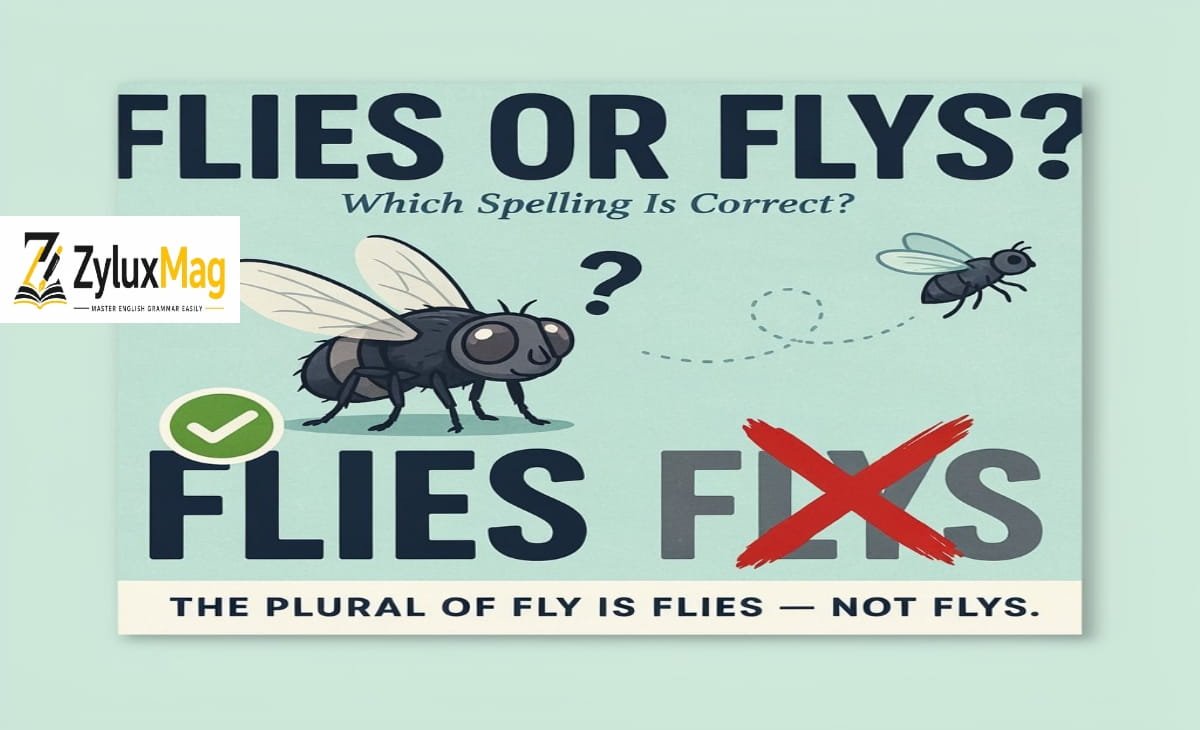
Flies is the correct spelling. It’s the plural of the noun fly (the insect), and it’s also the verb form used with he, she, or it — as in “time flies.” “Flys” is not a standard English word. The only exception is an old-fashioned term for a horse-drawn carriage, which you won’t encounter in everyday writing.
If you’re writing an email, essay, or caption, use flies. Here’s why.
A Mistake I Still Think About
I once sent a pitch email to a potential client and wrote, “I noticed a few flys in your website copy” — meaning typos, but obviously spelling it wrong myself. She wrote back, gently, “I think you mean flies?” I wanted to disappear. I’d been so focused on sounding professional that I never stopped to question a word I’d typed a thousand times without really thinking about it. That one reply taught me more than any grammar book ever did: the words you’re most confident about are exactly the ones worth double-checking. I never made that mistake again.
Why “Flies” Is Correct
The word fly ends in a consonant (l) followed by y. In English, when a word ends in a consonant + y, you form the plural — or the third-person singular verb form — by changing the y to i and adding -es.
That’s why:
- One fly, two flies (the insect)
- I fly, she flies (the verb “to fly”)
This isn’t a random exception — it’s a regular spelling pattern that applies across many English words, not just fly.
The Rule That Trips People Up
Most people who write “flys” aren’t guessing randomly. They’re applying a different, equally real rule — just to the wrong kind of word.
Here’s the distinction:
| Word ends in… | Rule | Examples |
| Consonant + y | Change y → i, add -es | fly → flies, city → cities, baby → babies |
| Vowel + y | Just add -s | day → days, toy → toys, monkey → monkeys |
Words like day and toy end in a vowel before the y (a and o), so they simply take an -s. Fly ends in a consonant before the y (l), so it follows the other pattern. If you’ve been mixing these two rules up, that’s the exact reason “flys” feels like it should work — it doesn’t, because fly is a consonant+y word, also taught vs thought common confusion.
Flies as a Noun vs. Flies as a Verb
The spelling rule applies the same way whether fly is a noun or a verb — it’s easy to think the rule is just “about bugs,” but it isn’t.
As a noun (plural of “fly,” the insect):
- The kitchen window was covered in flies.
As a verb (with he/she/it):
- She flies to Chicago every Tuesday.
- Time really flies when you’re busy.
In both cases, the correct spelling is flies — never flys.
Is “Flys” Ever Correct?
Rarely, and not in modern everyday English. Some dictionaries list flys as an old-fashioned plural of fly used to mean a light, horse-drawn carriage — a sense that’s essentially obsolete today. You might also spot “Flys” used as a stylized brand, product, or band name, but that’s a naming choice, not standard spelling.
For any normal writing — school, work, social media, business — stick with flies.
Quick Self-Check
Next time you’re unsure whether to write flies or flys, ask one question:
Does the word end in a consonant + y?
- Yes → change y to i, add -es → flies
- No (it ends in a vowel + y) → just add -s → days, toys
This same test works for other words too — city becomes cities, puppy becomes puppies, but key becomes keys. Once you spot the pattern, you won’t need to double-check it again.