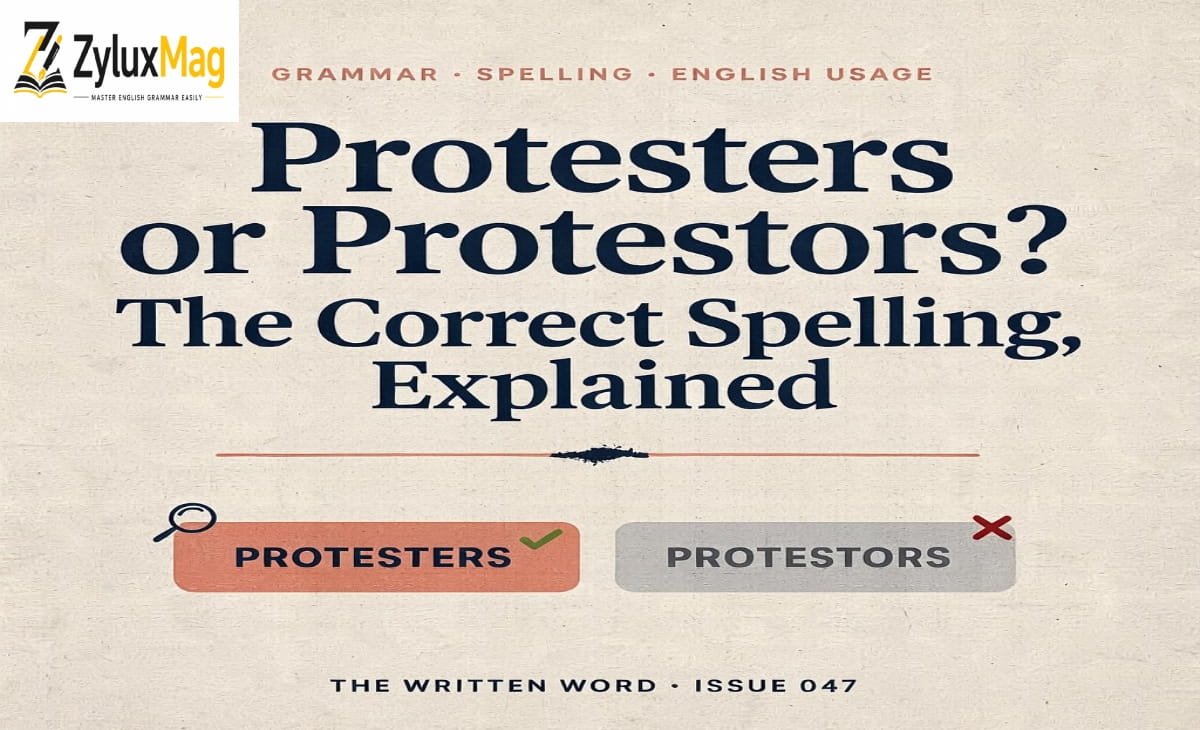
It turns out, you can use both spellings of the word “protesters” and be right! The “protesters” version is more commonly seen and the standard spelling that most style guides (like AP style) and dictionaries use. However, “protestors” is not wrong, it’s just less frequent and you’ll sometimes see it in UK writing or in more legal contexts. Both mean the same thing and have the same sound and grammatical function.
During my second year of college, I actually got into a huge debate with my campus paper editor over this. My article about a campus demonstration had “protestors” everywhere and the editor red-lined every single one, insisting it was a misspelling. I even called her “protestor” to her face, both of us convinced we were in the right.
We had to look it up on my laptop two minutes before the paper went to print and found out the word simply had two accepted spellings.
I’ve never forgotten that moment and so this word sticks in my mind more than most grammar topics do.
Protesters vs. Protestors – Is There a Real Difference?
No! There really is no actual difference in their meaning, pronunciation, or how they’re used grammatically. The single or double ‘s’ doesn’t change what we’re talking about at all.
They’re both just words that mean “a person who objects publicly to something.”
This isn’t even like color/colour with us it’s not necessarily a US vs. UK thing either. Both are used in English-speaking writing, the only difference is that “protesters” is way more common and will appear in virtually all dictionaries. There’s also the belief sometimes mentioned online that “protester” is used for a person and “protestor” is for a technical or legal term, but there’s really no major dictionaries that back that up so I’d just ignore that one for now and stick with the basic understanding that both are valid spellings.
It is also, on a slightly different note,important not to confuse “protester” with “Protestant”-those are completely different similar spelling variations like crier or cryer.
Why Two Spellings Exist
So how did we get two possible spellings?
Well, we take the verb “to protest,” and add an “-er” or “-or” to make it a noun to mean “the one who protests.” English doesn’t really have a consistent rule about whether it will add -er or -or.
We have both writers and actors, teachers and doctors so there’s no strict pattern, and “protest” is just one word that ended up with both forms being treated as acceptable.
You see this with “advisor” and “adviser”-again, two spellings, same word!
The “-or” form is often thought to stem from older Latin words (our English verb “protest” ultimately comes from the Latin word protestari), so that explains its existence rather than it being seen as an actual mistake.
Which One Should You Use?
In professional or published writing: Use “protesters.” This is what most dictionaries agree with and AP style uses, so if you’re sending something to a company or publication, it’s your safest bet.
In everyday writing: You can use either spelling! In a quick text to a friend or on social media, “protestors” is absolutely fine and won’t look out of place. Just stick with one and be consistent in that specific text.
Here are some examples:
Protesters
The protestor’s signs demanded action.
Hundreds of protesters flooded the streets.
Protestors
The protestors’ voices filled the air.
Local protestor spoke on behalf of the community.
Notice that in the example with the possessive, we just add an ‘s (protester’s sign). In the example with the plural possessive, we just add an apostrophe (protestors’ voices). Both rule structures hold up for either spelling.
Common Mistakes and Misconceptions
Believing that “protestor” is a misspelling: It’s not! Major dictionaries recognize it as a valid variant.
Thinking this is a rule about US vs. UK spelling: While it’s true that “protesters” is more common in US English and “protestors” is seen slightly more in UK English, it’s not a clean split like many other spelling differences and is used on both sides of the Atlantic.
Confusing “protester” with “Protestant”: They look similar but have totally different origins and meanings.
Thinking the spellings have different meanings: They do not.
“Correcting” spelling in a quote or organization name: If you are writing or speaking about something and you find the word “protestor” in a direct quote or in the name of an organization, leave it as is! You should not try to “fix” their spelling.
About the Author
This entry was written by Admin, who writes about English grammar, spelling and everyday word usage for ZyluxMag, based on the practical writing and editing experience needed to help readers avoid mistakes they’ll often make in their real-life writing.