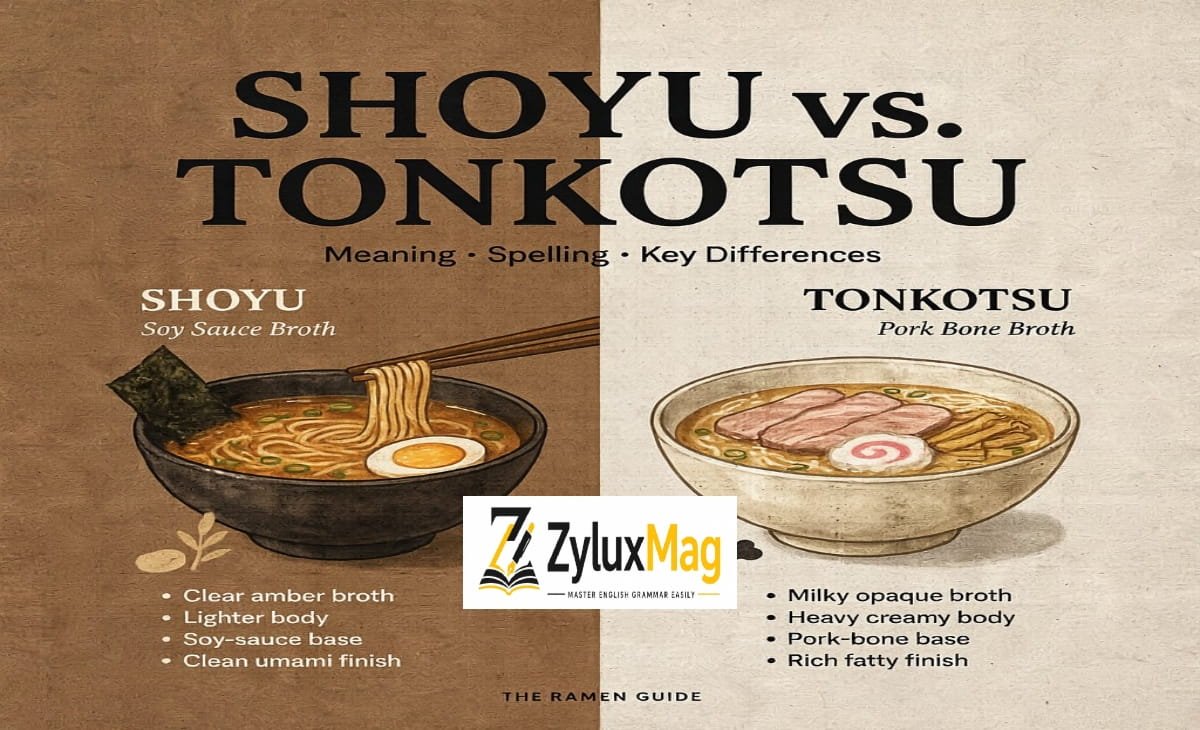
Shoyu and tonkotsu aren’t just two forms of the same thing. Shoyu is a type of savory soy-sauce-based seasoning (known as a tare in ramen terminology) used to flavor other ingredients. Tonkotsu refers to a distinct kind of broth made by simmering pork bones, usually for many hours. So a bowl of shoyu ramen is typically built around chicken or dashi stock flavored with shoyu, whereas tonkotsu ramen is defined by the pork bone broth itself. But before we move any further, here’s an important distinction to keep in mind, which is one of the most common and subtle word blunders in writing about Japanese cuisine: tonkotsu (pork bone broth) is not tonkatsu (fried pork cutlet).
Shoyu and Tonkotsu Aren’t Actually the Same Type of Thing
When the comparison “shoyu vs. Tonkotsu” is made, it actually starts to feel odd the more you look at it. That’s because they’re not fundamentally two items from the same category. It’s more like comparing the word “salt” to the word “stock” – one is an additive, the other is a base ingredient you build the entire dish around.
What Shoyu Means and Does
Shoyu () translates directly to “soy sauce.” In the context of ramen, shoyu refers specifically to a seasoning used in the broth, rather than being the broth itself. Shoyu ramen traditionally involves a separate broth – often a chicken-based stock or a dashi broth (made with things like dried bonito flakes and kombu seaweed) – that is then seasoned with shoyu. The shoyu adds a salty, sometimes slightly sweet or tangy depth and a distinctive light brown color to the soup.
What Tonkotsu Means and Does
Tonkotsu () literally translates to “pig bone.” Here, tonkotsu is a direct description of the broth base. It’s created by boiling pork bones for a significant amount of time until the collagen and marrow from the bones break down into the liquid, creating a thick, opaque, milky-white broth that has a deep, rich pork flavor and a heavier texture than many other ramen broths.
Structurally speaking then, shoyu tells you how something is seasoned, whereas tonkotsu tells you what the broth is actually made from. In fact, shoyu belongs to the same general category of ramen ingredients as shio (salt) and miso (fermented soybean paste) – seasonings – while tonkotsu stands alone as a unique type of broth base.
Shoyu vs. Tonkotsu at a Glance
| Shoyu | Tonkotsu | |
| What it is | A soy-sauce-based seasoning (tare) | A pork-bone broth base |
| Broth appearance | Light brown, fairly clear | Cloudy, milky white |
| Category | Seasoning (alongside shio, miso) | Broth base, its own category |
| Common word confusion | — | Often confused with “tonkatsu” (pork cutlet) |
| Typical English phrasing | “shoyu broth,” “shoyu ramen” | “tonkotsu broth,” “tonkotsu ramen” |
Don’t Mix This Up: Tonkotsu vs. Tonkatsu
This is perhaps the most crucial distinction this article can teach you about ordering ramen, so it gets a section of its own.
Tonkotsu = a ramen broth made from slow-simmered pork bones.
Tonkatsu = a breaded and deep-fried pork cutlet, typically served as a main dish.
These words are only separated by a single letter, and the similarity in their sounds when spoken quickly is the reason they are so frequently confused. Whether you’re dining out or writing about it, it’s vital to get them right: “tonkotsu” describes the broth; “tonkatsu” describes fried pork one-letter mistakes like taught vs thought.
How to Write “Shoyu” and “Tonkotsu” Correctly in English
As loanwords from Japanese, these terms are commonly used in English, and a few guidelines generally apply:
Capitalization
Unless they appear at the beginning of a sentence or in a headline or title, shoyu and tonkotsu should be written in lowercase. They are common nouns:
“I’m in the mood for tonkotsu ramen.”
“The restaurant’s shoyu ramen is particularly well-regarded.”
Italics or Not?
Style guides vary, and there’s no single definitive answer. Generally, if a word is unfamiliar to your intended audience, italicizing it on its first use and potentially in subsequent uses can be helpful. However, since “ramen” itself is now widely understood, using italics for “shoyu” and “tonkotsu” is becoming less common. The most important thing is to be consistent within your own piece of writing.
Plural Forms
Both words are treated as invariant in English, meaning they don’t take an “-s” when referring to more than one.
“We ordered two bowls of ramen: one shoyu and one tonkotsu.”
“Please bring two shoyu and one tonkotsu.”
Using Them as Adjectives
You can use both words as noun adjuncts, placing them directly before the noun they modify.
- “a shoyu broth”
- “a tonkotsu ramen restaurant”
- “shoyu-based soup”
- Shoyu and Tonkotsu in a Sentence
“The subtle saltiness of the shoyu complemented the rich umami of the broth.”
“The creamy tonkotsu was a perfect balance of depth and richness.”
“This ramen shop specializes in authentic tonkotsu.” (Avoid “tonkatsu ramen,” which would refer to fried pork cutlet served in ramen.)
“Are you leaning towards the shoyu or the tonkotsu today?”
Common Mistakes to Avoid
- Treating shoyu and tonkotsu as interchangeable terms. Remember, one is a seasoning and the other is a broth.
2. Mixing up “tonkotsu” (broth) and “tonkatsu” (fried cutlet). A single-letter mistake with significant consequences.
3. Believing shoyu ramen is just soy sauce dissolved in water. It’s a seasoned broth.
4. Adding an “-s” to create a plural. “Shoyu” and “tonkotsu” remain singular. - Capitalizing them mid-sentence like they are proper names.
A Mistake I Actually Made
I once had a freelance assignment to write descriptions for a Japanese restaurant’s menu, and I confidently wrote: “Our tonkatsu ramen is slowly simmered for 18 hours to achieve its signature rich flavor.” The owner was incredibly polite in his reply, explaining that tonkatsu is a fried cutlet and not something you simmer for that long, and that he meant tonkotsu. I felt an immediate wave of mortification mixed with a sense of sheer disbelief that I’d managed such a basic error.
It taught me a valuable lesson that day, making me a far more meticulous proofreader than I was before.
Details, even seemingly minor ones, really do make all the difference.
About the Author
Admin Admin writes about English grammar, vocabulary, and the subtle nuances of language that often cause confusion. When not wrestling with tricky word pairs, Admin is usually learning the hard way that precision is key, one letter at a time.