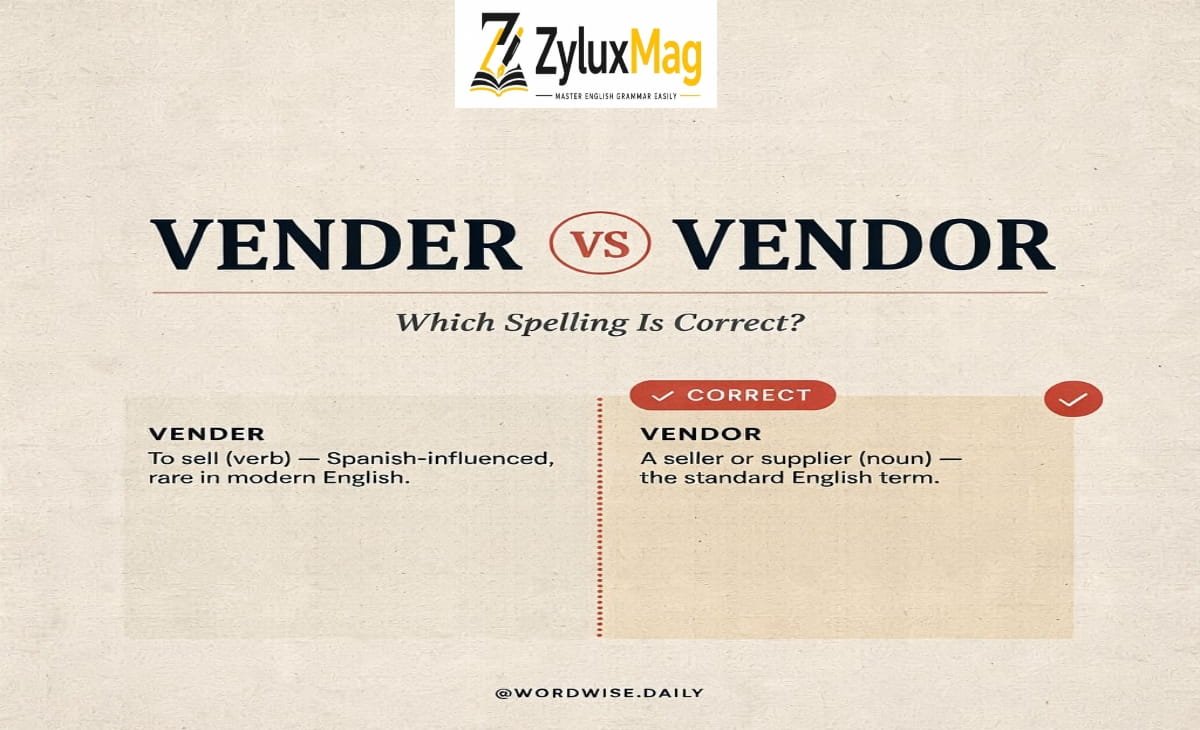
Vender vs Vendor is the correct and standard spelling in modern English. “Vender” is a recognized but uncommon variant — not a separate word, and not a mistake, just an older or less-used form. In business, legal, and everyday writing, always use vendor.
A few years ago, I sent a pitch email to a potential client and wrote, “I’ve worked with several software venders in the past.” She wrote back, super polite, just gently correcting my spelling before even discussing the project. I remember my face going hot reading it. I’d always half-known “vender” looked off, but I’d never actually checked — I just typed what felt familiar and hit send. That one tiny correction stuck with me way longer than it should have, and now I triple-check that word every single time it shows up in a client email.
Is “Vender” a Real Word?
Yes — but it’s rare. Dictionaries like Merriam-Webster and the American Heritage Dictionary list “vender” as a valid variant spelling of “vendor,” not as an error. So if you’ve seen it written that way somewhere, you weren’t looking at a typo.
That said, “rare” matters here. In everyday use, “vendor” appears far more often, and it’s the spelling expected in professional, legal, and academic writing. Think of it less like affect vs. effect (two different words that trip people up) and more like adviser vs. advisor — one word, two accepted spellings, with one being far more common than the other.
Why Two Spellings Exist for the Same Word
The Latin Root: “-or” as an Agent Ending
“Vendor” comes from the Latin venditor (“seller”), by way of Old French vendeor, both tracing back to the verb vendere (“to sell”). That Latin -or ending is the same pattern you see in other business and role-related nouns: contractor, distributor, supervisor, director. This is a big part of why “vendor” feels like the “natural” spelling in English — it fits a familiar family of words.
Where “Vender” Comes From
English also has a native pattern for turning verbs into “person who does this” nouns: add -er, as in seller, buyer, builder. “Vender” follows that same logic — verb “vend” plus “-er.” It’s not incorrect reasoning; it’s just a spelling that lost out to “vendor” over time. You’ll still find “vender” in older texts, including English writing from the 1700s and 1800s, but it never became the standard in modern usage.
Vendor vs. Vender at a Glance
| Vendor | Vender | |
| Status | Standard, preferred spelling | Rare, older variant |
| Common in | Business, legal, and everyday writing | Occasional older or literary texts |
| Dictionary listing | Primary entry | Listed as a variant of “vendor” |
| Recommended use | ✅ Always use this | ❌ Avoid in formal writing |
Vendor in a Sentence
- We signed a new contract with our software vendor.
- The street vendor sold fresh mangoes every morning.
- Please confirm the invoice with the vendor before Friday.
You’ll occasionally spot “vender” in older or literary writing — for example, in a 19th-century description of “an illicit vender of spirits.” That’s authentic historical usage, not something to copy in a modern email or contract.
Don’t Confuse This With the Spanish Word “Vender”
If you’re learning English and also know some Spanish, there’s a natural mix-up here. In Spanish, vender is a common verb meaning “to sell” (Quiero vender mi coche — “I want to sell my car”). It’s spelled exactly like the rare English variant, but the two aren’t related in modern usage and don’t work the same way.
- English vendor = a noun, a person or business that sells things.
- Spanish vender = a verb, the action of selling.
If you’re writing in English, this Spanish verb has no bearing on which spelling to choose — “vendor” is still correct words that have multiple accepted spellings.
Common Mistakes to Avoid
Mistake: “vender machine”
❌ I bought this from a vender machine.
✅ I bought this from a vending machine.
The machine that sells snacks or drinks is a “vending machine,” never a “vender machine” — this is a separate, unrelated error, not just a spelling slip.
Mistake: using “vender” in professional writing
❌ The software vender fixed the bug.
✅ The software vendor fixed the bug.
In contracts, invoices, emails, and any formal or business context, “vendor” is the expected spelling. Using “vender” won’t always be flagged as wrong, but it will look inconsistent with standard professional English.
Vender vs Vendor vs. Supplier
These words overlap but aren’t identical:
- Vendor — often used for a business or individual selling directly to customers or clients, especially in retail, events, or contracts (a food vendor, a software vendor).
- Seller — a general term for anyone selling something, formal or informal.
- Supplier — usually refers to a business that provides goods to another business, often earlier in a supply chain, rather than directly to the end customer.
They’re related, but not interchangeable in every context — a supplier might never interact with the final customer, while a vendor often does.
Author Bio
Faizan Babar is a freelance writer and the voice behind ZyluxMag’s English grammar and vocabulary section. With years of hands-on experience writing client emails, pitches, and professional content, he’s made (and fixed) more spelling mix-ups than he’d like to admit — and now shares those lessons so readers don’t have to learn them the hard way. When he’s not untangling tricky word pairs, he’s helping freelancers and everyday writers sound sharper and more confident in their English.