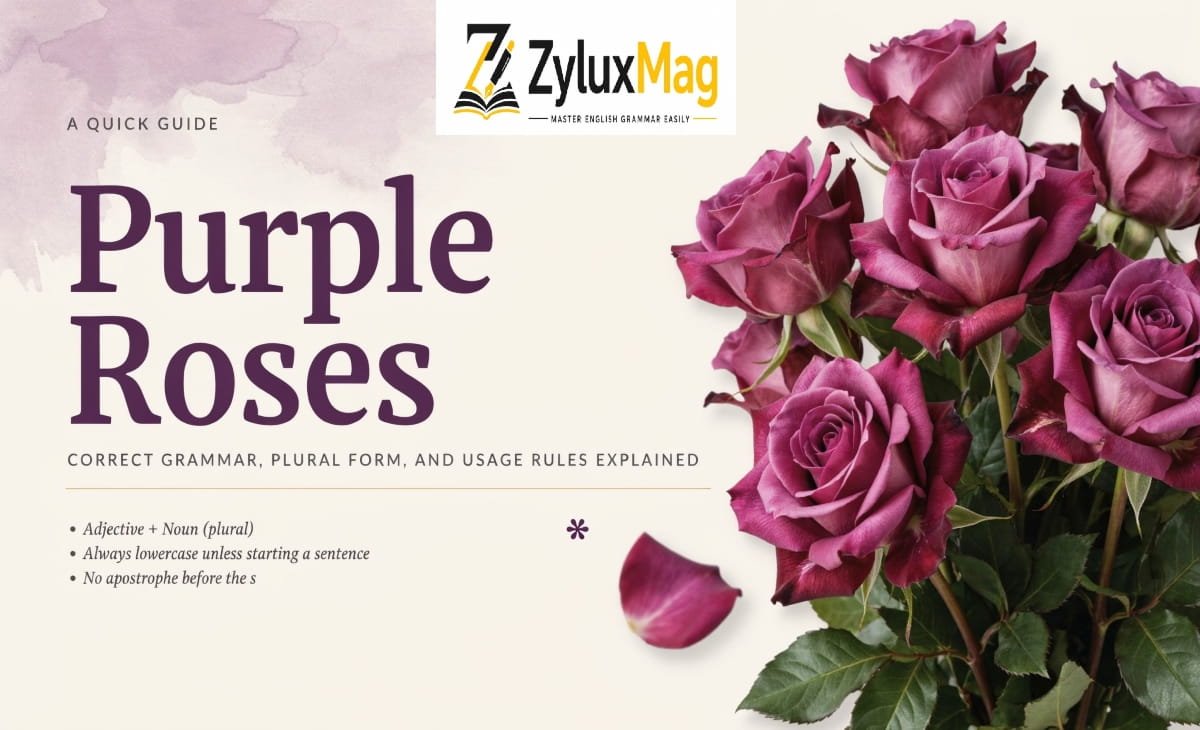
Purple roses is the correct form. It’s plural, and it never takes an apostrophe. “Purple” is a color adjective, and color adjectives in English don’t change form no matter how many roses you’re talking about — one purple rose, ten purple roses, the same word every time. You’d only add an apostrophe if you were showing possession, as in the purple rose’s petals (one rose) or the purple roses’ petals (more than one).
(If you landed here looking for what purple roses symbolize rather than how to write the phrase correctly, that’s a different topic — this article is about grammar and usage only.)
Is It “Purple Roses” or “Purple Rose’s”?
“Purple roses” — no apostrophe. The apostrophe version isn’t a plural at all; it’s a possessive, and it only belongs in a sentence where the rose owns something.
| Sentence | Correct? |
| She planted twelve purple roses. | Correct — simple plural |
| She planted twelve purple rose’s. | Wrong — apostrophe has no job here |
| The purple rose’s fragrance filled the room. | Correct — singular possessive (one rose’s fragrance) |
| The purple roses’ fragrance filled the room. | Correct — plural possessive (several roses’ fragrance) |
A simple check: if you can replace “purple rose’s” with “purple rose is” or “purple rose has” and the sentence still makes sense, you’re using a contraction by mistake, not a real word. If neither works, and you’re not showing ownership, drop the apostrophe.
Why “Purple” Never Changes Form
In English, color adjectives are invariable — they don’t inflect for number, and they don’t agree with the noun they describe. That’s different from languages like French or Spanish, where an adjective might change to match a plural or feminine noun. In English, “purple” stays exactly the same whether it’s describing one rose or a hundred:
- a purple rose
- two purple roses
- a field of purple roses
Only the noun (rose → roses) changes to show plural. The adjective never does. This rule applies to color words generally — red flowers, blue skies, green leaves — not just to roses.
Where Does “Purple” Go in a Sentence?
English adjectives follow a fairly fixed order when you stack more than one before a noun: opinion, size, age, shape, color, origin, material, purpose, then the noun. Color adjectives like “purple” sit close to the noun, after most other descriptive words.
Example: Stacking “Purple” With Other Adjectives
| Correct | Incorrect |
| beautiful, long-stemmed purple roses | purple beautiful long-stemmed roses |
| a dozen fresh purple roses | a purple dozen fresh roses |
Notice that “purple” comes right before “roses,” after any opinion or size words. Moving it earlier in the sentence usually sounds unnatural to a fluent speaker, even though there’s no single rule being broken — it’s a matter of conventional word order.
Comma Rules: “Red, White, and Purple Roses” vs. “Deep Purple Roses”
This is where most writers get tripped up, because two different situations look similar but follow opposite comma rules.
Use commas when you’re listing separate colors. In “red, white, and purple roses,” you’re describing a mix of roses in different colors, so each color is a separate item in a list. This is called a list of coordinate adjectives, and commas (or “and”) separate them:
- Red, white, and purple roses filled the vase.
- She grew red, pink, and purple roses in the same garden.
Don’t use a comma when one word is describing the shade of another. In “deep purple roses,” “deep” isn’t a separate item — it’s modifying “purple” itself, describing exactly how purple the roses are. This is a cumulative adjective, and cumulative adjectives are never separated by commas:
- Deep purple roses lined the path.
- ~~Deep, purple roses lined the path.~~
A quick test: try inserting “and” between the two adjectives. “Red and white and purple roses” still works — so it needs commas. “Deep and purple roses” doesn’t work — so no comma.
A moment that made this rule stick for me: In my final year of college, I gave a presentation on symbolism in poetry and wrote “deep, purple roses” on a slide, thinking the comma made it sound more poetic. My professor paused, looked at the screen, and asked, “Is ‘deep’ doing something on its own here?” I had no idea what she meant. Turns out I’d separated two words that were supposed to work together, like putting a wall between two people mid-sentence. I felt my face go red in front of the whole class. I never forgot that lesson again — some adjectives need space, and some really don’t Hasn’t or Haven’t.
When to Capitalize “Purple Roses”
In ordinary sentences, “purple roses” stays lowercase, because it’s just a common noun phrase describing a type of flower:
- The bouquet had a dozen purple roses.
- The bouquet had a dozen Purple Roses.
Capitalize it only when it functions as a proper noun — for example, as the title of a book, film, song, or business name:
- She read Purple Roses over the weekend. (a book title)
- The shop is called Purple Roses Florist. (a business name)
“Purple Roses” vs. “Purple Prose” — Don’t Confuse These
These two phrases sound alike but mean completely different things.
- Purple roses are, literally, roses that are purple.
- Purple prose is an idiom for writing that’s overly elaborate or flowery — sentences stuffed with unnecessary adjectives and dramatic language. It has nothing to do with actual flowers.
If your writing (or someone else’s) is being criticized as excessive or overdone, the correct phrase is “purple prose,” not “purple roses”:
- His description of the sunset was pure purple prose.
- ~~His description of the sunset was pure purple roses.~~
Quick Reference: Purple Roses Grammar Cheat Sheet
| Rule | Correct | Incorrect |
| Plural form | purple roses | purple rose’s |
| Singular possessive | the purple rose’s petals | the purple roses’s petals |
| Plural possessive | the purple roses’ petals | the purple rose’s petals (for more than one rose) |
| Listing separate colors | red, white, and purple roses | red white purple roses |
| Describing one shade | deep purple roses | deep, purple roses |
| Everyday use | purple roses | Purple Roses |
| Title or proper noun | Purple Roses (book, shop name) | purple roses (when it’s actually a title) |
| Related idiom | purple prose (flowery writing) | purple roses (flowery writing) — wrong phrase |
About the Author
Faizan Babar is the owner and main writer at ZyluxMag, where he covers English grammar and vocabulary with a focus on real-world usage, not just textbook rules. He writes from firsthand experience — the kind of mistakes and lessons that actually happen in classrooms, workplaces, and everyday writing — to make grammar easier to remember and apply.