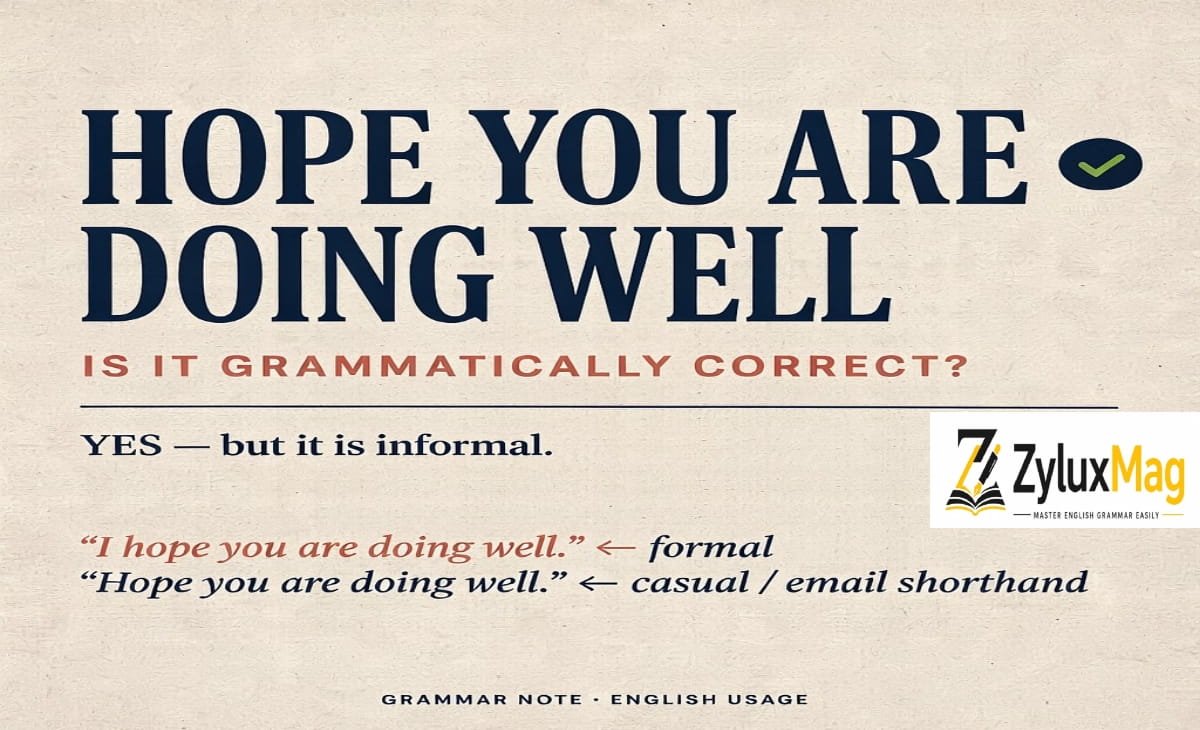
Short answer: “Hope you are doing well” is fine to use in casual writing, but it’s technically an incomplete sentence — it’s missing the subject “I.” The fully correct, formal version is “I hope you are doing well.” Both are widely used and easily understood. The dropped-subject version just reads as more casual.
Here’s the full breakdown of why that happens, and how to use the phrase correctly in any situation.
Why “Hope You Are Doing Well” Is Missing a Subject
Every complete English sentence needs a subject and a verb. In “hope you are doing well,” the verb is “hope,” but there’s no subject attached to it — no one is stated as doing the hoping.
The full sentence is actually:
I hope you are doing well.
When people drop the “I,” they’re using something called subject ellipsis — leaving out a word that’s so obvious from context that the sentence still makes sense without it. You’ll see the same thing happen in other everyday expressions:
- (I) Hope so.
- (I) Wish you were here.
- (I) Guess we’ll find out.
This isn’t a typo or a random mistake. It’s a recognized, informal pattern in spoken and written English. It just isn’t considered fully “correct” for formal writing, where every sentence is expected to have its subject stated.
The Correct Full Sentence: “I Hope You Are Doing Well”
If you want the grammatically complete version — the one appropriate for formal emails, cover letters, or professional messages — include the “I”:
I hope you are doing well.
This version has everything a standard sentence needs:
| Part | Word(s) | Role |
| Subject | I | Who is doing the hoping |
| Verb | hope | Main verb |
| Object clause | you are doing well | What is being hoped |
Use this full version whenever you want your writing to read as polished or professional. Use the shortened version (“Hope you’re doing well”) when you want a lighter, more conversational tone.
“Hope You Are Doing Well” vs. “Hope You Are Well” — What’s the Real Difference?
These two phrases look almost identical, but they use different verb tenses, and that changes the meaning slightly.
| Phrase | Tense | Meaning | Best for |
| I hope you are doing well | Present continuous | Suggests an ongoing situation — how things have been going for someone recently (health, work, life in general) | Everyday emails, checking in, follow-ups |
| I hope you are well | Simple present | Describes a general, more static state — a broader, more classic wish for someone’s wellbeing | Formal letters, older-style or traditional correspondence |
In practice, native speakers use these almost interchangeably, and neither is “more correct” than the other — they’re just slightly different in feel. “Doing well” sounds a little more current and active. “Are well” sounds a touch more traditional and formal, which is why you’ll see it more often in classic letter-writing or British formal English.
“You’re” vs. “Your” — The Mistake That Breaks This Phrase
My first month at a marketing job, I sent a “just checking in” email to a client I really wanted to impress. I typed, “Hope your doing well” and hit send before my coffee even kicked in. Ten minutes later my manager forwarded it back with one line: “Might want to fix this before he replies.” I stared at it for way too long before I saw it — your, not you’re. Such a tiny letter, such a big red flag. I’ve triple-checked that word in every email since.
This is one of the most common errors people make when writing this exact phrase, and it changes the sentence completely.
- ✅ I hope you’re doing well. (you’re = you are — correct)
- ❌ I hope your doing well. (your = possessive — incorrect here)
“You’re” is a contraction of “you are,” so it’s the only correct choice in this sentence. “Your” shows possession (as in “your book” or “your idea”) and doesn’t work grammatically in this phrase at all.
A quick way to check: mentally expand the contraction. If “you are doing well” makes sense, you need “you’re.” If it doesn’t, you need “your.”
Do You Need a Comma After It?
Usually, no. When “I hope you are doing well” stands as its own sentence, it doesn’t need a comma at the end:
✅ I hope you are doing well. I wanted to follow up on our meeting yesterday.
A comma becomes necessary only if you’re joining it directly to a second clause in the same sentence with a conjunction like “and”:
✅ I hope you are doing well, and I wanted to follow up on our meeting yesterday.
Without the conjunction, keep it as two separate sentences rather than joining them with just a comma — otherwise you create a run-on sentence:
❌ I hope you are doing well, I wanted to follow up on our meeting yesterday.
Formal or Informal? When You Can Drop the “I”
Here’s a simple rule for deciding which version to use:
Include “I” when:
- Writing a cover letter or job application
- Emailing someone you don’t know well
- Writing to a client, manager, or someone senior to you
- Writing any formal business correspondence
You can drop “I” when:
- Texting or messaging a friend or colleague you know well
- Writing a quick, casual check-in
- The tone of the rest of your message is already informal
If you’re ever unsure which one to use, default to including “I.” It’s never wrong, and it always reads as slightly more polished.
How to Reply to “I Hope You Are Doing Well”
When someone opens a message with this phrase, a short, natural reply keeps the tone friendly without overexplaining:
I am doing well, thank you. I hope you are too.
Or, more casually:
Doing well, thanks! Hope you are too.
Note the same subject rule applies here: “I am doing well” is the complete form; “Doing well” on its own is the shortened, informal version — grammatically fine in casual conversation, just not the version you’d use in a formal reply looking forward to seeing you grammar rule.
A Few Alternatives Worth Knowing
Because “I hope you are doing well” is used so often, it can start to feel repetitive if you use it with the same person every time. A few natural swaps:
- I hope this email finds you well. — more traditional, good for formal or first-time contact
- I hope everything is going well with you. — slightly broader, works well professionally
- I hope you’re having a good week. — casual and specific, good for people you know
- How have you been? — direct and conversational, best for informal contexts
None of these are “more correct” than “I hope you are doing well” — they’re simply useful for variety when you’re writing to the same person often.