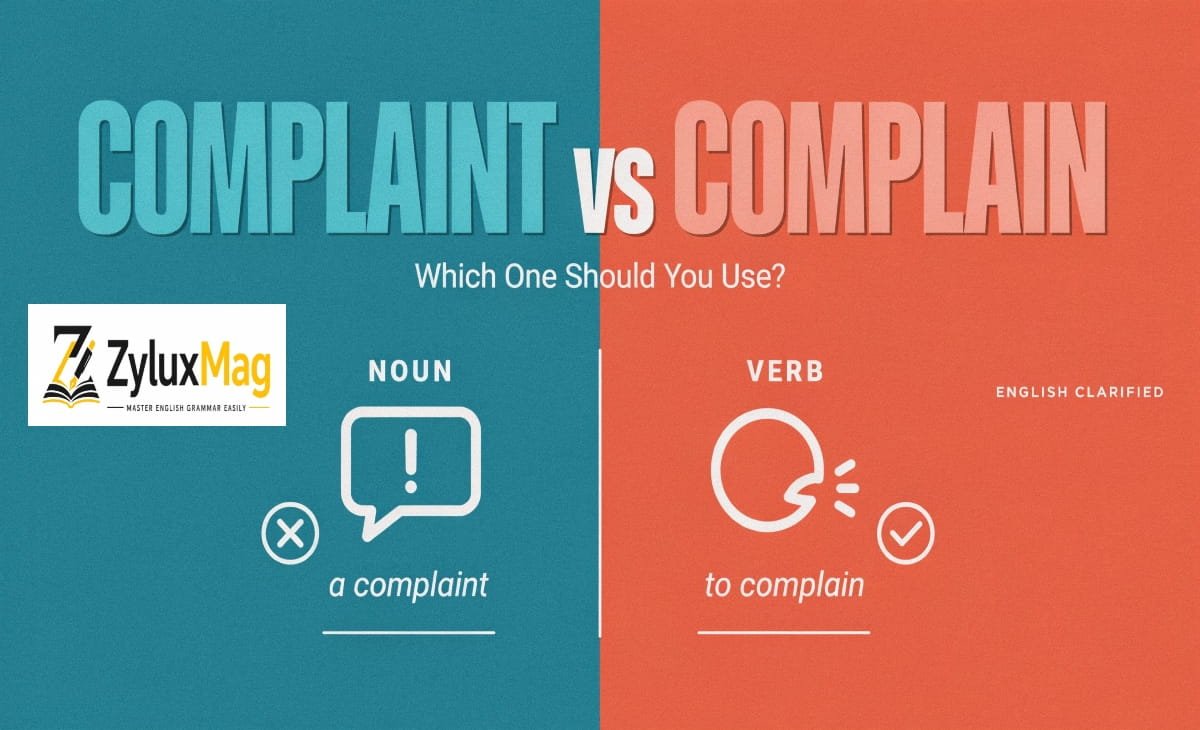
Complaint is a noun — a thing (a statement, report, or symptom of dissatisfaction). Complain is a verb — an action (to express dissatisfaction). If you can put a, the, or my in front of the word, use complaint. If you can put I, she, or they in front of it, use complain.
That one distinction solves almost every mix-up between these two words. Here’s how to apply it with confidence.
A few years into freelancing, I sent a client an email that said, “I want to complaint about the delayed feedback.” I hit send before my coffee even kicked in. Ten minutes later, she replied — kindly, but pointedly — with the correct version and a tiny winky face. I stared at my screen, mortified. I’d been writing professionally for two years and still fumbled a grammar rule most people learn in school. That night I made myself a cheat sheet taped above my desk: complaint has a T, it’s a thing. I haven’t mixed them up since — but I definitely remember why.
The One Rule That Solves This
Both words come from the same idea — expressing that something is wrong — but they do different jobs in a sentence.
- Complaint names a thing: a statement, a report, a criticism, sometimes even a physical symptom.
- Complain describes an action: the act of saying something is wrong.
A quick way to remember it: complaint has a T because it’s a thing. Complain doesn’t — because it’s something you do, not something you have.
To check your own sentence, run this two-part test:
- Can you place “a,” “the,” or “my” in front of it? a complaint, the complaint, my complaint — all work. → Use complaint.
- Can you place “I,” “she,” or “they” in front of it? I complain, she complains, they complain — all work. → Use complain.
If a word fails both tests in your sentence, you’ve probably picked the wrong one.
“Complaint” in a Sentence (Noun)
As a noun, complaint refers to the statement or report itself — not the act of making it. It regularly pairs with verbs like make, file, lodge, receive, and handle, because those verbs need a thing to act on.
- He filed a complaint about the late delivery.
- She made a complaint to the manager about the noise.
- The company received several complaints this week.
- Our team is responsible for handling customer complaints.
Because it’s a countable noun, complaint has a normal plural form: complaints. There’s no irregular spelling to worry about here.
Complaint also shows up in a specific medical sense, meaning the main symptom a patient reports:
- The patient’s chief complaint was chest pain.
“Complain” in a Sentence (Verb)
As a verb, complain describes the act of expressing dissatisfaction. It follows regular verb conjugation, so it changes form depending on the subject and tense — this is where most mistakes happen.
- I complain about the traffic every morning.
- She complains about the traffic every morning. (third-person singular takes the -s)
- They complained about the delay yesterday. (past tense)
- He is always complaining about something. (present participle)
The trap: complains (verb) and complaints (noun plural) look and sound almost identical, but they aren’t interchangeable.
- ✅ He complains constantly. (verb — describes what he does)
- ✅ He has filed several complaints. (noun — describes the reports he’s made)
- ❌ He has filed several complains.
- ❌ He complaints constantly.
Complain About, Of, or To?
This is the part most guides skip, but it trips people up in real writing.
| Preposition | When to use it | Example |
| complain about | The everyday, general choice — for situations, problems, or behavior | She complained about the wifi. |
| complain of | Formal or medical contexts, especially physical symptoms | The patient complains of a headache. |
| complain to | Identifies the person receiving the complaint | He complained to the landlord about the heating. |
You can combine these: She complained to her manager about the schedule. The person (to her manager) and the issue (about the schedule) each get their own preposition.
In casual, everyday speech, complain of can sound slightly stiff or old-fashioned outside medical contexts — complain about is the safer default unless you’re writing something formal or clinical.
Common Mistakes (and How to Fix Them)
| ❌ Incorrect | ✅ Correct | Why |
| I want to complaint about the service. | I want to complain about the service. | To is followed by a base verb, not a noun. |
| She made a complain. | She made a complaint. | Make needs a noun object. |
| He complaint yesterday. | He complained yesterday. | Complaint isn’t a verb, and it has no past tense. |
| He filed a complains. | He filed a complaint. | A signals a singular noun is needed. |
| She complain every day. | She complains every day. | Third-person singular subjects need the -s ending. |
One more misconception worth clearing up: there’s no British vs. American English difference here. Both words are spelled and used the same way on both sides of the Atlantic — the noun/verb distinction is the same everywhere correct verb usage.
Quick Reference Table
| Complaint | Complain | |
| Part of speech | Noun | Verb |
| Function | Names a thing | Describes an action |
| Common pairings | a, the, my, file, make, receive | I, she, they, about, of, to |
| Forms | complaint → complaints (plural) | complain → complains → complained → complaining |
| Example | He filed a complaint. | He complains often. |