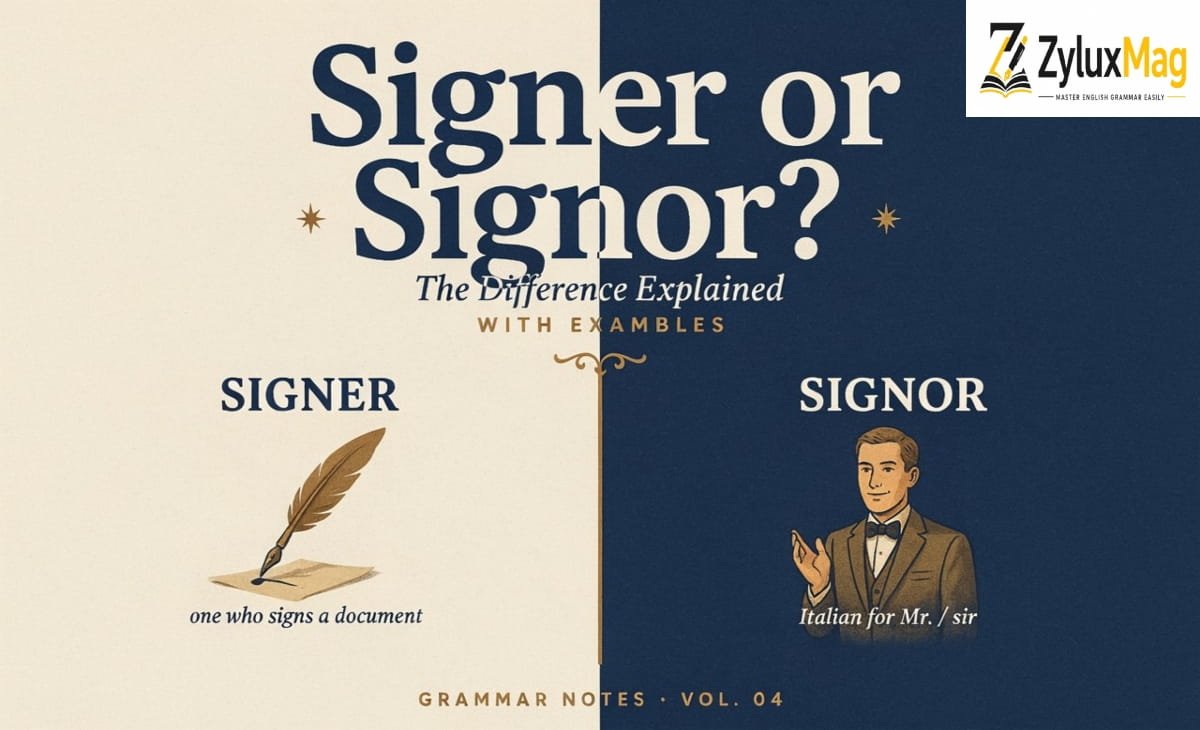
Signer and signor are two different words that just happen to look alike.
- Use signer for someone who signs something — a document, a check, a contract.
- Use signor as an Italian title of respect for a man, similar to “Mr.” or “Sir.”
They aren’t spelling variants of each other, and they’re not interchangeable in any context. Here’s how to tell them apart for good.
What “Signer” Means
A signer is a person who signs something. It’s built from the verb “sign” plus the ending “-er,” the same way “teacher” comes from “teach” or “writer” comes from “write.” It’s a plain, functional English word, and you’ll see it most often in legal, business, and everyday writing.
It has a second, less common meaning too: someone who communicates using sign language can also be called a signer.
How to Use “Signer” in a Sentence
- Please have all signers initial page three before submitting the form.
- She was the third signer of the petition.
- The bank requires an authorized signer on every business account.
- The interpreter was also a fluent signer, translating the speech into ASL.
What “Signor” Means
Signor is a word borrowed from Italian, where signore is a respectful title for a man — the rough equivalent of “Mr.” or “Sir” in English. It traces back to the Medieval Latin word senior, meaning “elder” or “superior” (the same root that gives Spanish its señor and French its seigneur). English writers have used “signor” since at least the 1500s, mostly in reference to Italian people, culture, or older literature.
It’s pronounced seen-YOR — nothing like “signer.” That difference in sound is worth noting, because the confusion between the two words is almost entirely visual: they share several letters, but they don’t sound alike and don’t mean anything close to the same thing.
Signor has no legal or contractual meaning. It doesn’t refer to signing anything at all.
How to Use “Signor” in a Sentence
- Good evening, Signor Rossi.
- The letter was addressed to Signor Bianchi, a well-known art dealer in Florence.
- In the novel, Signor Verdi is described as a quiet, dignified man.
Signer vs. Signor: How to Choose the Right One
| Signer | Signor | |
| Meaning | A person who signs something | An Italian title for a man (like “Mr.”) |
| Word type | English noun | Italian loanword |
| Origin | “sign” + “-er” | Italian signore, from Latin senior |
| Pronunciation | SY-ner | seen-YOR |
| Used in | Legal, business, everyday English | Italian cultural or literary references |
| Example | “The signer must initial each page.” | “Good evening, Signor Rossi.” |
| Plural | signers | signori (or signors) |
| US vs. UK English | No difference | No difference |
A simple way to decide: if paperwork is involved, you want signer. If Italian culture or a title of respect is involved, you want signor.
“Authorized Signer” or “Authorized Signor”? (The Most Common Mix-Up)
This is where the confusion actually causes problems. Banks, contracts, and legal forms frequently need to name the person who has permission to sign on an account or agreement — and the correct term is always authorized signer, never “authorized signor.”
- ❌ Please list the authorized signor on this form.
- ✅ Please list the authorized signer on this form.
“Signor” has no place in a legal or financial document. It’s a term of address for a person, not a description of a role or authority. If you see “signor” used this way — and it does happen, often from autocorrect or a simple slip — it’s an error, not an accepted variant.
One more myth worth clearing up: signer and signor are not British and American spellings of the same word. Both spellings are fixed, and neither changes based on region. English writers everywhere use “signer” for someone who signs, and “signor” only appears when referring to an Italian man or Italian-influenced context.
A Mistake I Actually Made
A few years ago, I was finishing a freelance contract for an Italian client and needed to send over the signature page. I typed, “Please note the authorized signor for this agreement is Mr. Alberti,” hit send, and moved on with my day. Ten minutes later he replied, half-joking, “I’m flattered, but I think you mean signer?” I froze, reread my email, and felt my face go hot. I’d been so focused on his very Italian name that my brain quietly swapped the words without asking me first. I fixed it, laughed it off, and never made that mistake again, also naive vs nieve spelling confusion.
Other Forms You Might See
Signor belongs to a small family of related Italian words:
- Signore — the full, formal version of “signor,” meaning the same thing.
- Signora — the feminine form, used for a married or older woman, similar to “Mrs.” or “Ma’am.”
- Signori — the plural form, used for more than one man (or a mixed group), and also the standard plural of “signor” in English dictionaries.
None of these relate to signing a document. They all belong to the same Italian title system as “signor.”
Quick Questions, Quick Answers
Is “signer” or “signor” used in sign language contexts?
“Signer” — a person who communicates in sign language is called a signer, though this sense is less common than the “person who signs a document” meaning.
What’s the plural of “signor”?
Either signori (the Italian plural) or signors (the anglicized plural). Both appear in English dictionaries.
Does British English spell it “signor” and American English spell it “signer,” or vice versa?
No. This is a common misconception. Both words keep the same spelling in British and American English — the choice between them depends on meaning, not region.
About the Author
Faizan Babar writes about English grammar and vocabulary at ZyluxMag, breaking down commonly confused words and everyday writing mistakes into simple, practical explanations. His work draws on years of hands-on writing experience — including a few word mix-ups of his own along the way.