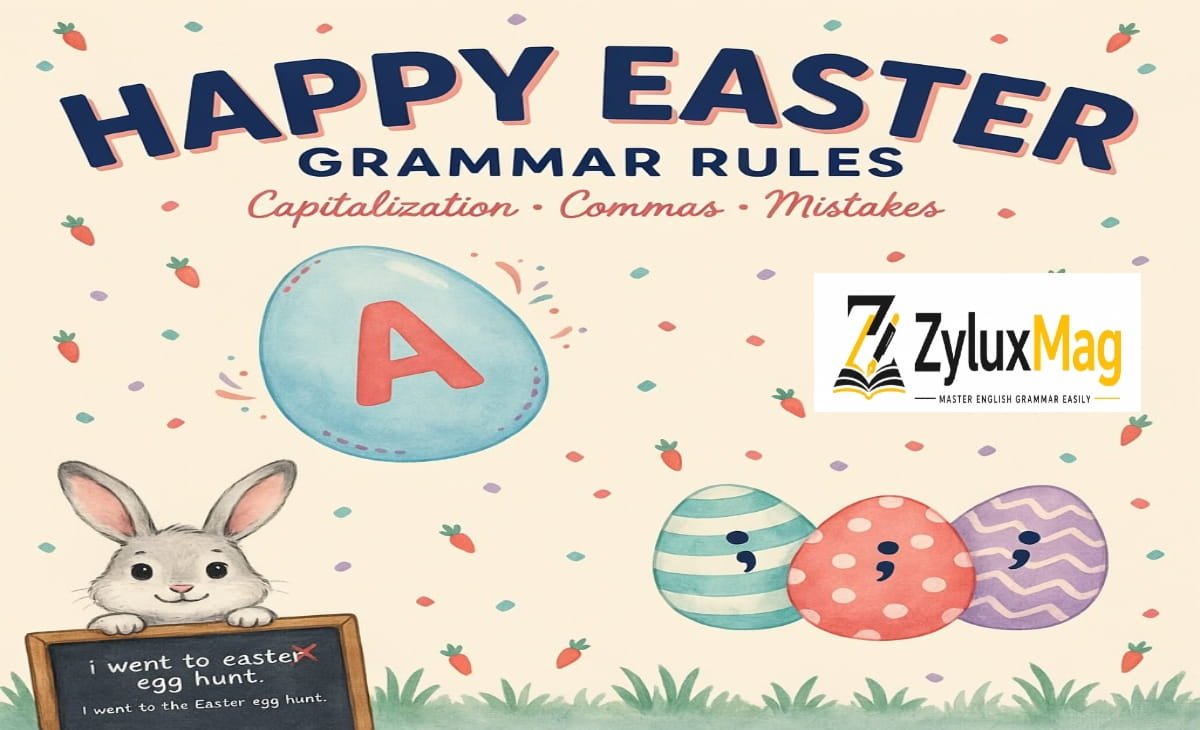
Happy Easter is always written with a capital E on “Easter,” because it’s a proper noun naming a specific holiday — the same way you’d capitalize “Christmas” or “Diwali.” There’s no apostrophe anywhere in the phrase. And you only need a comma if you’re naming the person you’re greeting: “Happy Easter, Grandma!” Without a name, skip the comma: “Happy Easter to you and your family.”
That covers the basics. But I’ll admit — I didn’t always get this right myself. Last Easter, I sent our family group chat a message: “happy easter grandma hope you have a great day.” My cousin, who never misses a chance to tease me, replied instantly: “aren’t you like… a grammar person?” I laughed it off, but she wasn’t wrong — no capital on Easter, no comma before Grandma’s name. It was such a small thing, but it stuck with me, because I realized even people who know the rules mess them up when they’re typing fast without thinking. Now I actually double-check my own texts before hitting send — and that’s exactly why I’m breaking this down properly below.
Here’s the reasoning behind each rule, plus the mistakes that trip people up most.
Why “Easter” Is Always Capitalized
“Easter” is a proper noun — it names one specific holiday, not a general category. English capitalizes the names of holidays the same way it capitalizes the names of people, cities, and countries.
Easter vs. Seasons
This is where the confusion usually starts. Seasons (spring, summer, autumn, winter) are common nouns — they refer to a general recurring period of the year, not a single named event. So they stay lowercase:
- ✅ We’re getting married in spring.
- ✅ Easter falls in spring this year.
Notice that even in the second sentence, “spring” stays lowercase while “Easter” doesn’t. That’s the whole rule in one sentence: holidays are capitalized, seasons aren’t.
This capitalization rule applies whether you’re using “Easter” in a religious sense or a purely seasonal, commercial one (Easter sales, Easter eggs, Easter weekend plans). The word itself is always a proper noun, regardless of the context you’re using it in correct sentence structure.
Do You Need a Comma After “Happy Easter”?
This is the part most guides skip — and it’s the one that actually causes mistakes.
The rule is simple: add a comma when you follow the phrase with the name of the person you’re speaking to. This is the same “direct address” comma you’d use in “Good morning, everyone” or “Thanks, Sarah.”
| Sentence | Comma needed? |
| Happy Easter! | No |
| Happy Easter, Sarah! | Yes — you’re naming who you’re talking to |
| Happy Easter to the whole family. | No — no name is being directly addressed |
| Happy Easter, everyone! | Yes — “everyone” is who you’re addressing |
If there’s no name or direct address after the phrase, don’t force a comma in. “Happy Easter to you” and “Happy Easter to your family” are both complete and correctly punctuated without one.
Common Mistakes to Avoid
- Writing it in lowercase: “happy easter” — easy to do when typing fast on a phone, but “Easter” should always be capitalized, even mid-sentence.
- Adding an apostrophe: “Happy Easter’s” is incorrect. There’s no possessive or contraction here, so there’s no apostrophe.
- Saying “Happy Easter’s Day”: This isn’t a standard English phrase. Just say “Happy Easter” — it doesn’t need “Day” attached.
- Using the wrong preposition: “Happy Easter for you” sounds off in English. The natural phrasing is “Happy Easter to you.”
- Inconsistent capitalization in longer phrases: “Happy easter Sunday to all!” mixes capitalized and lowercase forms in the same sentence. Both “Easter” and “Sunday” should be capitalized: “Happy Easter Sunday to all!”
“Happy Easter” in Different Contexts
Casual (cards, texts, social captions):
- Happy Easter!
- Happy Easter, you two!
- Hope you have the best Easter ever!
Formal (emails, professional messages):
- Wishing you a very Happy Easter.
- I hope you have a peaceful Easter with your family.
- Happy Easter to you and your team.
The grammar rules don’t change between casual and formal writing — only the tone does. Formal messages tend to spell out the full wish (“Wishing you a very Happy Easter”) rather than using the short exclamation on its own.
Related Terms — Capitalized or Not?
| Term | Capitalized? |
| Easter Sunday | Yes — both words |
| Easter Monday | Yes — both words |
| Easter Bunny | Yes — it’s treated as a proper name |
| Easter egg | Only “Easter” — “egg” is a common noun |
| Easter break | Only “Easter” — “break” is a common noun |
The pattern is consistent: “Easter” itself is always capitalized. Whether the second word is capitalized too depends on whether it’s part of a specific named day (Easter Sunday, Easter Monday) or just a regular noun paired with it (Easter egg, Easter break).
Quick-Reference Cheat Sheet
- Capitalize: Easter — always, in every context.
- Apostrophe: Never — “Happy Easter” has no possessive form.
- Comma: Only before a name or direct address (“Happy Easter, Tom!”).
- Preposition: Use “to” — “Happy Easter to you,” not “for you.”
- Casual example: Happy Easter, everyone!
- Formal example: Wishing you a very Happy Easter this year.