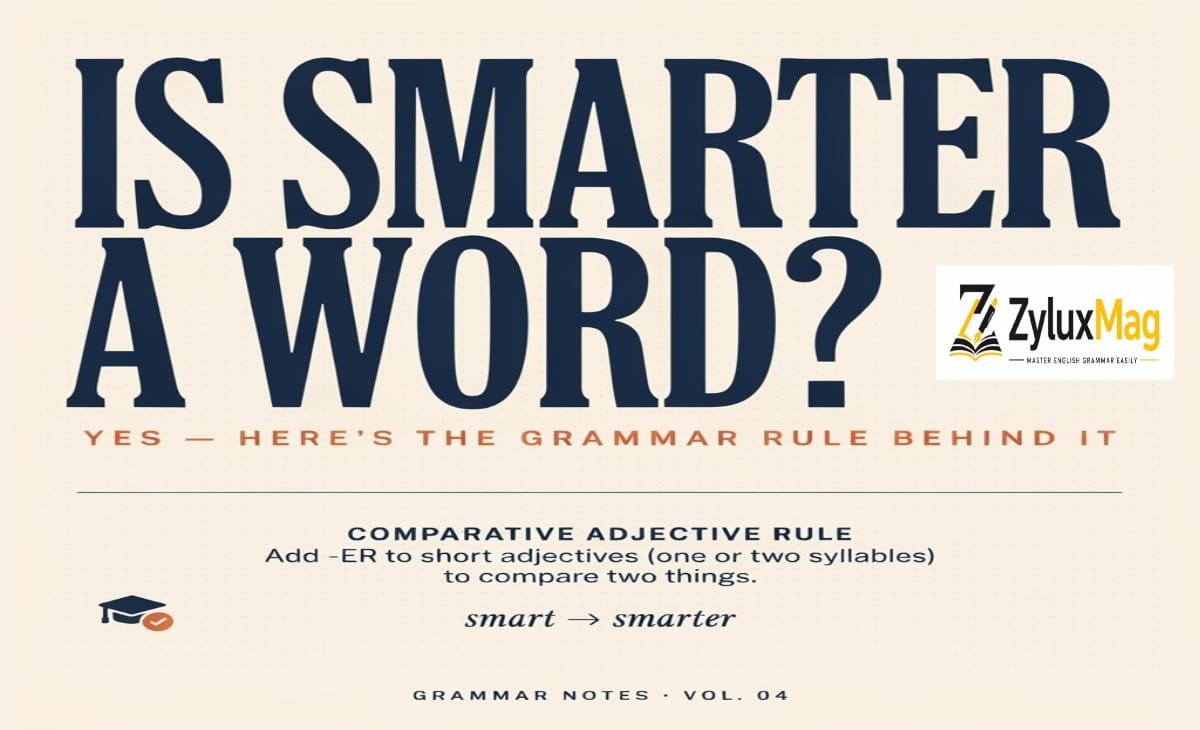
Yes, smarter is a word. It’s the standard comparative form of the adjective smart, listed in Merriam-Webster directly under the entry for smart (smarter, smartest). You use it whenever you’re comparing two people, things, or ideas — for example, She is smarter than her brother.
If you’ve ever hesitated between “smarter” and “more smart,” here’s the rule that clears it up for good.
Why “Smarter” Is Correct (The Comparative Rule)
English adjectives form their comparative in one of two ways: by adding -er, or by placing more in front of them. Which one you use depends mostly on how many syllables the adjective has.
Smart has one syllable, and one-syllable adjectives almost always take -er. So:
- smart → smarter → smartest
No spelling changes are needed here. Unlike a word such as big (which doubles its final consonant to become bigger), smart simply adds -er with no adjustment: smart + er = smarter.
This is the same pattern you see in tall → taller, fast → faster, and old → older. “Smarter” isn’t an exception or an informal shortcut — it’s the regular, expected comparative form for a short adjective like this. similar grammar confusion appears in different vs differently.
“Smarter” vs. “More Smart” — Which Is Right?
“Smarter” is correct. “More smart” is not standard English, even though it’s easy to say by accident.
- ❌ She is more smart than her brother.
- ✅ She is smarter than her brother.
The confusion usually comes from a longer synonym, intelligent. Because intelligent has four syllables, it can’t take -er — it has to use “more”:
- intelligent → more intelligent (not “intelligenter”)
If your brain is used to saying “more intelligent,” it’s easy to slide “more” onto smart by habit. But smart and intelligent follow different rules because they have a different number of syllables. Short word, -er ending. Long word, “more” in front.
A few years ago, I was pitching a content package to a new client and wanted to sound impressive. I typed, “This strategy will make your content more smart and more effective,” hit send, and felt great about myself for exactly four minutes. Then the client replied — politely, but with the word “smarter” quoted back at me in brackets. I stared at my screen, mortified, and went straight to a grammar site to double-check. Turns out I’d been overcomplicating a rule I actually knew. That tiny correction stuck with me way harder than any lesson from a textbook ever did.
Smarter vs. Smartest: Comparative vs. Superlative
Smarter and smartest are related but not interchangeable — they answer different questions.
- Smarter (comparative) compares two things. She is smarter than her classmates.
- Smartest (superlative) compares three or more things, picking out the top one. She is the smartest student in the class.
A quick way to check: if you can finish the sentence with “than [something],” you need smarter. If you’re picking a winner out of a group, you need smartest.
Quick Reference: Why -er and “More” Both Exist
| Adjective | Syllables | Comparative | Superlative |
| smart | 1 | smarter | smartest |
| happy | 2 | happier | happiest |
| intelligent | 4 | more intelligent | most intelligent |
Once you see the pattern by syllable count, it applies far beyond just smart — it’s the same logic behind almost every comparative adjective in English.
“Smarter” in Real Use
“Smarter” works the same way whether you’re talking about people, decisions, or objects — and it’s completely appropriate in formal writing, not just casual speech.
- He came up with a smarter solution to the problem.
- The new phone is smarter than its predecessor.
- She’s getting smarter about how she manages her time.
You’ve also likely seen it in the popular saying “work smarter, not harder” — a phrase built entirely on this same comparative form, encouraging efficiency over sheer effort rather than intelligence itself.
Common Mistake to Avoid
The one mistake worth remembering: don’t pair smart with “more.”
- ❌ This plan is more smart than the last one.
- ✅ This plan is smarter than the last one.
If you keep in mind that smart is short and follows the -er pattern — just like fast, tall, and old — you won’t second-guess it again.