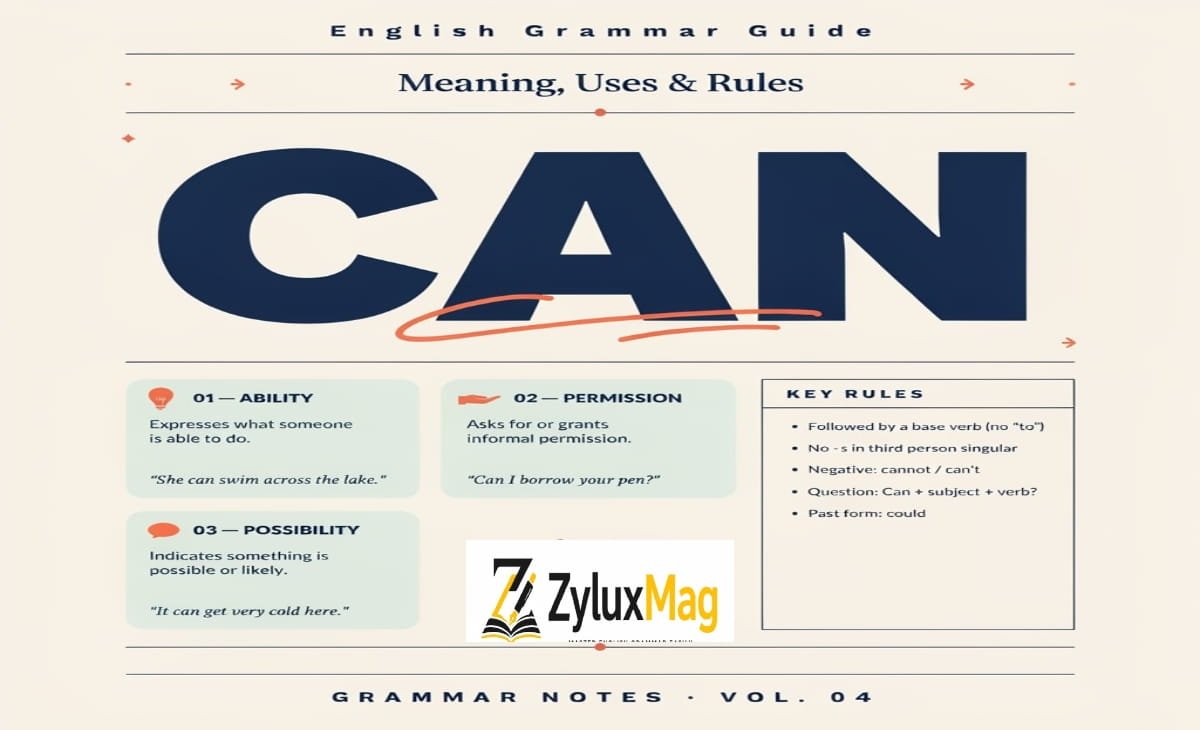
Can is a modal verb. We use it to talk about ability, permission, and possibility, and to make informal requests and offers. It is followed by the base form of a verb, does not take -s, and does not change with the subject: She can swim. Can I sit here? Anyone can make mistakes.
If you were looking for the container or the verb meaning “to preserve food,” see “Other meanings of can” near the end.
| Use | Meaning | Example |
| Ability | Someone has the skill or means to do something | She can speak three languages. |
| Permission | Someone is allowed to do something | You can leave early today. |
| General possibility | Something is sometimes true or possible | Winters here can be harsh. |
| Request or offer | Asking for help, or offering it | Can you help me? Can I carry that? |
| Negative conclusion | Something is impossible, based on what we know | That can’t be Sam. He’s abroad. |
What “can” is used for
Ability
Use can to say that someone or something has the skill, knowledge, or means to do something.
- He can speak three languages.
- Birds can fly, but penguins can’t.
- I can’t come tonight. I’m working.
The last example shows that can also covers ability created by circumstances, not just skill.
With verbs of perception and thinking (see, hear, smell, understand, remember, believe), English normally uses can instead of a continuous form:
- I can see the sea from here. (not I am seeing the sea from here)
- I can’t remember her name.
Permission
Can means “is allowed to.” It is very common in everyday English.
- You can borrow my bike.
- Can we use our phones in the exam? No, you can’t.
For a more formal tone, English uses may. That choice is explained under “Can or may?” below.
General possibility
Can describes what is sometimes possible or typical. It does not predict one particular event.
- Driving in fog can be dangerous.
- Anyone can make mistakes.
- The weather in April can change quickly.
For a specific event, use may, might, or could: It may rain tomorrow. (not It can rain tomorrow.)
Requests and offers
- Can you open the window, please? (request)
- Can I help you? / Can I carry that for you? (offer)
- I can give you a lift to the station. (offer)
Could makes a request more polite or tentative: Could you open the window, please?
“Can’t” as a conclusion
When we are sure something is impossible because of what we know, we use can’t.
- That can’t be Sam. He’s abroad this week.
- You can’t be serious.
- She can’t have left already. Her coat is still here.
The positive version of this idea uses must: That must be Sam. Do not use mustn’t for a negative conclusion. Mustn’t expresses prohibition: You mustn’t park here means parking is forbidden. You can’t park here is also common for prohibition, so can’t has three meanings: no ability (I can’t swim), not allowed (You can’t park here), and impossible (That can’t be true). Context tells you which one is meant.
How to build sentences with “can”
Can is the same for every subject: I, you, he, she, it, we, they can.
| Type | Example |
| Statement | She can swim. |
| Negative | She cannot swim. / She can’t swim. |
| Yes/no question | Can she swim? |
| Short answers | Yes, she can. / No, she can’t. |
| Question word | Where can she swim? |
| Negative question | Why can’t she swim? |
| Question tag | She can swim, can’t she? |
Because can is a modal verb, some things never happen with it:
- No -s in the third person: He can swim, not He cans swim.
- No to after it: I can swim, not I can to swim.
- No do/does/did: Can you swim?, not Do you can swim? I can’t swim, not I don’t can swim.
- Only the base form follows it: She can go, not She can went or She can going.
- No infinitive, -ing form, or past participle: there is no to can and no have could. Where you need one of these forms, use be able to (see below).
Cannot, can not, or can’t?
- Cannot is the standard written form in both British and American English: You cannot enter without a ticket.
- Can’t is the contraction, used in speech and informal writing: I can’t find my keys.
- Can not is correct only when not belongs to the words that follow: You can not only sing but also dance.
Two words can also change the meaning. You cannot go means you are not allowed to, or are unable to. You can not go means you have the option of not going. Some writers also use can not for emphasis, but it is less common, so cannot is the safe choice in formal writing.
Write can’t with an apostrophe. Cant without one is a different word.
Choosing between “can” and its neighbors
Can or may?
For permission, both are correct. May is more formal.
An old rule says can means ability and may means permission, and that using can for permission is wrong. In practice, can for permission is standard in everyday English, and major dictionaries accept it. Some teachers and formal style guides still prefer may, so it helps to know both.
- Everyday speech: Can I sit here? is completely natural.
- Polite or professional contexts: May I sounds a little more courteous, though Can I is also widely used.
- Formal notices and rules: may is the usual choice: Visitors may not enter the laboratory.
Can or could?
Could is the past form of can for general ability. It is also a softer, more polite form Is Smarter a Word?
- General past ability: When she was four, she could swim.
- Polite request: Could you help me with this?
- Hypothetical situation: I could help if I had time.
- Reported speech: He said he could come on Friday.
- Specific possibility: It could rain later.
In a polite request, could does not refer to the past. It only sounds more tentative than can.
Can or “be able to”?
Can is the natural everyday choice in the present. Be able to fills the gaps where can has no form.
Early in my freelance days, I emailed a new client: “Don’t worry, I will can send the draft by Friday.” I hit send feeling very professional. Her reply confirmed the deadline, and then added one polite line: “will be able to, by the way.” I stared at my screen for a full minute, ears burning. I knew can never takes -s or to, but nobody had told me it has no future form, also I kept the client, and I’ve never written “will can” again. That one small email is the reason the table below exists.
| Situation | Use | Example |
| Present ability | can (or am/is/are able to, more formal) | I can drive. |
| General ability in the past | could or was/were able to | She could swim at four. |
| One successful achievement in the past | was/were able to (or managed to) | We were able to get tickets last night. |
| Future | will be able to | You will be able to drive next year. |
| Present perfect | have/has been able to | I haven’t been able to sleep well lately. |
| After another modal | be able to | You should be able to finish by five. |
| After to | be able to | I’d love to be able to play the piano. |
| After a preposition or as a subject | being able to | Being able to cook is useful. / She’s proud of being able to swim. |
Could or was able to in the past. She could swim at four describes a general ability over a period of time. She was able to swim across the lake yesterday describes one successful occasion, often with some effort. Using could for a single achievement in an affirmative sentence (She could swim across the lake yesterday) usually sounds wrong or incomplete.
There are two common exceptions. Negative sentences accept could for a single event (I couldn’t open the door yesterday). Verbs of perception and thought also accept it (I could hear music from next door).
Future ability. Do not say will can. Say will be able to: I will be able to help you next week. In many cases, plain can works too when you are arranging something: I can meet you at six tomorrow.
Can, may, or might for possibility?
Can describes what is generally possible: Smoking can cause serious illness. May, might, and could describe what is possible in one specific situation: It may be cold this April. Compare April can be cold (it often is) with It may be cold this April (perhaps this year).
Mistakes to avoid with “can”
| Incorrect | Correct | Why |
| She cans swim. | She can swim. | Modal verbs take no -s in the third person. |
| He can to swim. | He can swim. | Can is followed by the base form without to. |
| I can swimming. | I can swim. | No -ing form after a modal. |
| Do you can swim? | Can you swim? | Modals form questions by inversion, not with do. |
| I don’t can swim. | I can’t swim. | Modals form negatives with not, not do not. |
| I will can help you. | I will be able to help you. / I can help you. | Can has no future or infinitive form. |
| She could win the match yesterday after a long fight. | She was able to win / managed to win the match yesterday. | A single successful past event needs was able to. |
| You mustn’t be serious. | You can’t be serious. | Can’t expresses a negative conclusion. Mustn’t expresses prohibition. |
| I cant come. | I can’t come. | The contraction needs an apostrophe. |
How “can” sounds in speech
In normal, unstressed speech, can is a weak form, pronounced /kən/, almost like “kn.” When it is stressed, or comes at the end of a sentence, it has the strong form /kæn/: Yes, I can. I can’t swim, but she can.
Can’t normally keeps a full vowel and is stressed. In Southern British English it is usually /kɑːnt/, and in standard American pronunciation /kænt/. In fast speech the final /t/ can be softened, so can and can’t are easy to confuse when listening. Focus on the vowel and the stress: a weak can is short and unstressed, and can’t is longer and stronger. Context helps too.
Other meanings of “can”
Can has other meanings that have nothing to do with the modal verb.
- Noun: a metal container: a can of soup, a can of cola, a watering can. In British English, food cans are often called tins, while can is common for drinks.
- Verb: to preserve food in sealed cans or jars: We canned the peaches last summer. This is a regular verb with the forms can, cans, canned, canning, so She cans peaches every August is correct. It is a separate word from the modal.
- Informal verb (mainly American): to fire someone: They canned him last week.
Canned is not the past tense of the modal can. The past form of the modal is could.
Practice: check what you’ve learned
- Choose the correct form: He (cans / can) play the guitar.
- Correct the mistake: Do you can swim?
- Correct the mistake: I will can join you next week.
- Choose the better option: After two hours of trying, we (could / were able to) fix the sink.
- Complete the sentence: That (can’t / mustn’t) be Maria. She’s on holiday in Spain.
- Complete with a form of be able to: I haven’t ______ sleep well lately.
- Complete with cannot or can not: She ______ only sing; she also writes her own songs.
- Make this more formal: Can I use your phone?
- Choose the better option: It (can / may) rain later, so take an umbrella.
- Is canned the past tense of the modal verb can in They canned the peaches?
Answers
- can. Modal verbs take no -s.
- Can you swim? Modals form questions by inversion, without do.
- I will be able to join you next week. (Or simply I can join you next week.) Can has no future form.
- were able to. This describes one successful occasion.
- can’t. It expresses a negative conclusion. Mustn’t means prohibition.
- been able to. I haven’t been able to sleep well lately.
- can not. Not belongs to not only, so the two-word form is correct.
- May I use your phone? May is more formal. Can I is not wrong, just less formal.
- may. It is a specific possibility. Might or could would also work.
- No. Canned is the past tense of the regular verb can meaning “to preserve food.” The past form of the modal can is could.
About the Author
Admin is the founder and main writer of ZyluxMag, an English grammar and vocabulary blog. Every guide here starts with the questions real learners ask, and is written with clear rules, natural examples, and the kind of mistakes we have all made at some point, like the “will can” email in this article. If you spot an error or want a grammar topic covered, let us know.