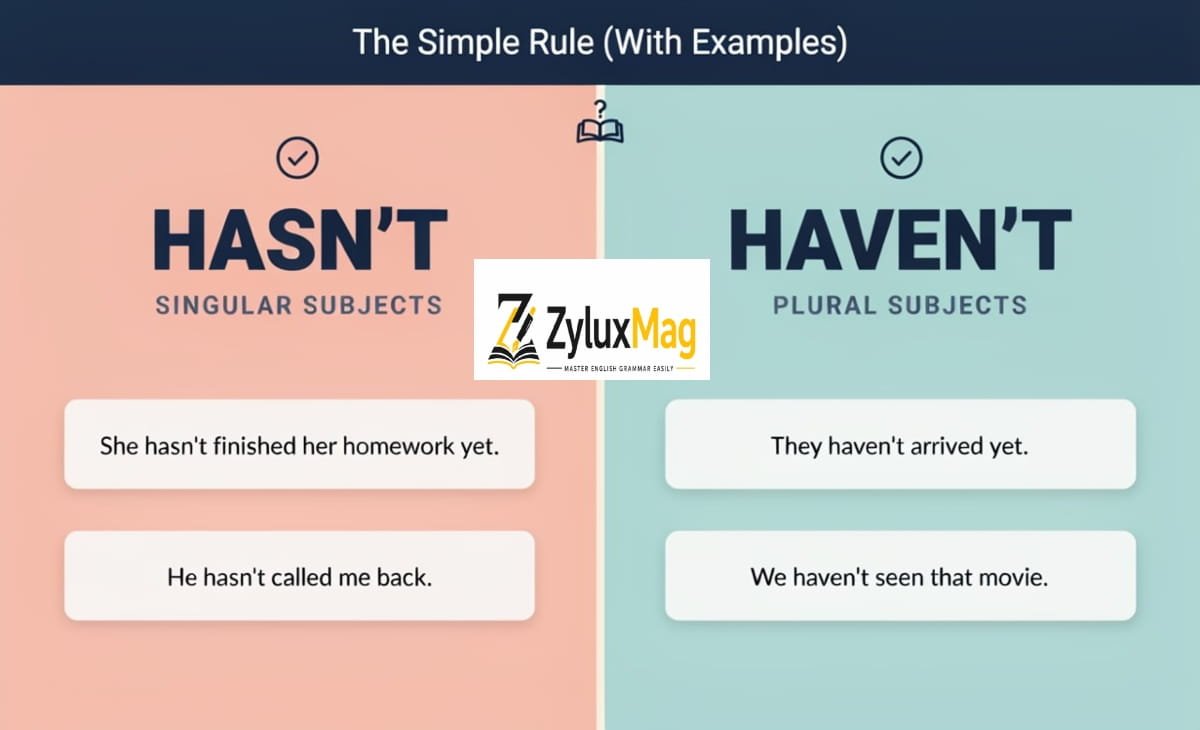
Hasn’t is the contraction of “has not.” Use it with he, she, it, or any singular noun — for example, “She hasn’t left yet.” With I, you, we, or they, use “haven’t” instead.
That’s the core rule. Here’s everything that follows from it.
“Hasn’t” vs “Haven’t” — Which One Is Correct?
The choice between “hasn’t” and “haven’t” depends entirely on the subject of the sentence — not on meaning, tone, or region. They mean exactly the same thing; they just pair with different subjects.
| Subject | Contraction | Example |
| I | haven’t | I haven’t eaten yet. |
| You | haven’t | You haven’t answered my message. |
| He / She / It | hasn’t | He hasn’t called back. |
| We | haven’t | We haven’t decided yet. |
| They | haven’t | They haven’t arrived. |
| Singular noun (the dog, my sister, the store) | hasn’t | The store hasn’t opened yet. |
| Plural noun (the dogs, my friends) | haven’t | My friends haven’t replied. |
A quick way to check yourself: if you’d say “he/she/it has,” you say “hasn’t.” If you’d say “I/you/we/they have,” you say “haven’t.” like weren’t vs wasn’t, subject-verb agreement matters here too.
How to Spell “Hasn’t” Correctly
The apostrophe replaces the “o” in “not,” so the correct spelling is h-a-s-n-‘-t. A common typing mistake is placing the apostrophe before the “n” instead of before the “t”:
- ❌ has’nt
- ✅ hasn’t
If you keep mixing this up, it helps to remember that “hasn’t” is just “has” + “not” squeezed together — the apostrophe always sits where letters were removed, right before the final “t.”
Using “Hasn’t” in a Sentence
Statements
“Hasn’t” most commonly appears in negative statements about something that hasn’t happened up to now:
- She hasn’t finished her homework.
- The package hasn’t arrived yet.
- He hasn’t seen that movie.
Questions
“Hasn’t” can also start a question, usually to express surprise or seek confirmation of something you expected to be true:
- Hasn’t the train left already?
- Hasn’t she called you back yet?
This is a normal, grammatically correct way to open a sentence — there’s no rule against starting a question with “hasn’t.”
Tag Questions
In tag questions, “hasn’t” appears at the end of a positive statement to ask for agreement or confirmation. The subject in the tag must match the subject earlier in the sentence:
- He’s finished the report, hasn’t he?
- The meeting has started, hasn’t it?
Note that the tag always uses a pronoun (he, she, it), not the full noun again — even if the main sentence used a name or noun.
“Hasn’t” + Past Participle (Not Past Tense)
During a group presentation in university, I confidently told the class “the data hasn’t showed any changes” while pointing at my slide like I knew exactly what I was talking about. My professor paused, smiled, and said, “showed, or shown?” The room laughed, I turned red, and I sat back down still not fully understanding what I’d done wrong. I went home that night, looked it up properly, and finally got it — hasn’t needs a past participle, not a regular past-tense verb. I’ve never mixed that one up again.
“Hasn’t” is the negative form of the present perfect tense, which means it must be followed by a past participle, not a simple past-tense verb. This is where many learners go wrong.
- ❌ He hasn’t went home.
- ✅ He hasn’t gone home.
- ❌ She hasn’t did her homework.
- ✅ She hasn’t done her homework.
- ❌ They hasn’t ate lunch.
- ✅ They haven’t eaten lunch.
The present perfect connects a past action to the present moment — it’s used when something is expected to have happened by now but hasn’t. That’s different from the simple past, which just states that something didn’t happen at a specific point in time:
- He hasn’t gone home (he’s still here now, as of this moment).
- He didn’t go home (a plain statement about the past, often tied to a specific time — he didn’t go home last night).
“Hasn’t Got” vs “Doesn’t Have”
Both phrases express that someone doesn’t possess something, but they belong to different varieties of English:
- “Hasn’t got” is common in British English, especially in speech: He hasn’t got a car.
- “Doesn’t have” is standard in American English and is also widely used and understood in British English: He doesn’t have a car.
Both are grammatically correct. If you’re writing for a British audience or a casual, spoken tone, “hasn’t got” fits naturally. If you’re writing for an American audience or a more neutral, formal tone, “doesn’t have” is the safer choice.
Common Mistakes with “Hasn’t”
| ❌ Wrong | ✅ Right | Why |
| I hasn’t seen him. | I haven’t seen him. | “I” takes “haven’t,” not “hasn’t.” |
| They hasn’t arrived. | They haven’t arrived. | “They” takes “haven’t.” |
| He hasn’t went home. | He hasn’t gone home. | Use the past participle, not the simple past. |
| She has’nt called. | She hasn’t called. | The apostrophe goes before the “t,” not before the “n.” |
| He hasn’t got no money. | He hasn’t got any money. | Avoid double negatives in standard English. |
One more distinction worth keeping in mind: “hasn’t” and “didn’t” aren’t interchangeable. “Hasn’t” (present perfect) is used when the timeframe is still open or connected to now — she hasn’t finished (she still might). “Didn’t” (simple past) is used for a completed, closed timeframe — she didn’t finish the race (a specific past event, done and over).
Quick Recap Cheat Sheet
- Hasn’t = has not → used with he/she/it/singular nouns
- Haven’t = have not → used with I/you/we/they/plural nouns
- Spelling: apostrophe goes before the t (hasn’t, not has’nt)
- Followed by a past participle, not a past-tense verb (hasn’t gone, not hasn’t went)
- Can start questions and appear in tag questions (Hasn’t she left? / He’s left, hasn’t he?)
- “Hasn’t got” (British) and “doesn’t have” (American) both mean the same thing
- “Hasn’t” ≠ “didn’t” — present perfect vs. simple past