“Everything” (one word) is correct in almost all writing. It’s a singular indefinite pronoun meaning “all things,” and it always takes a singular verb — “Everything is ready,” not “Everything are ready.” “Every thing” (two words) is grammatically valid but rare. It’s used only when you want to stress each individual item rather than a group as a whole, as in “Every thing on that shelf needs dusting.” When you’re not sure which to use, choose “everything.”
What’s the Difference Between “Everything” and “Every Thing”?
The two forms look almost identical, but they work differently.
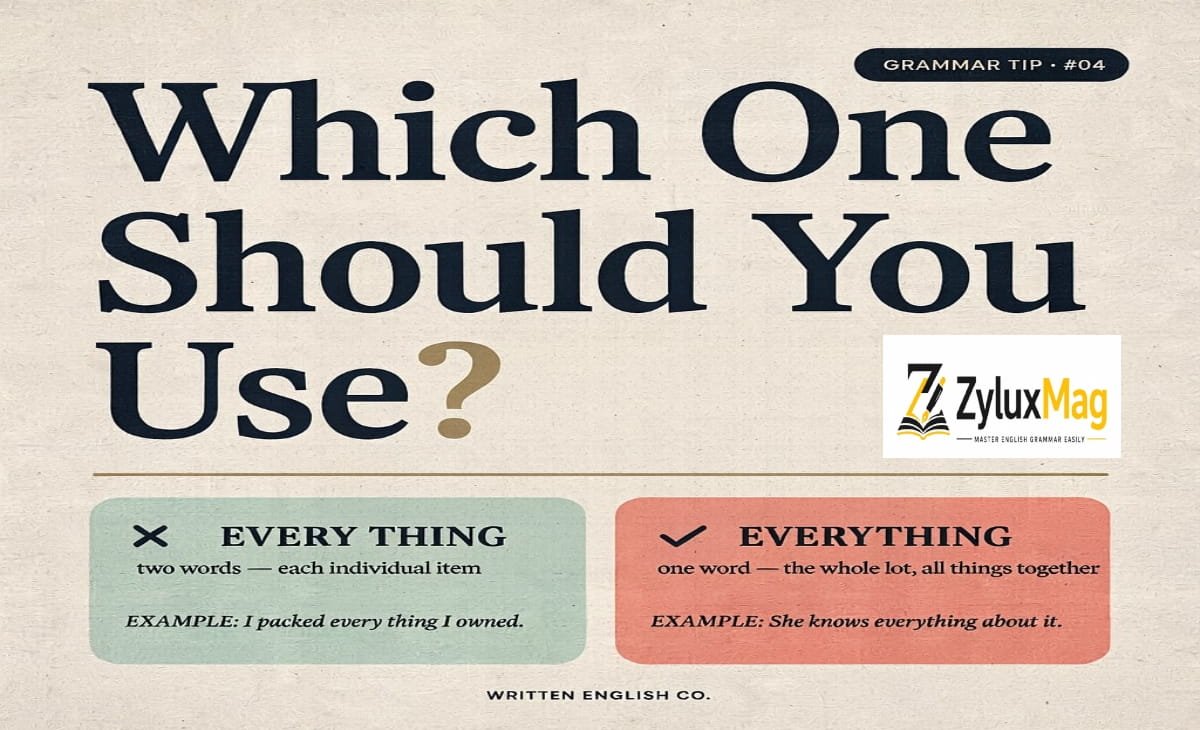
Everything (one word)
“Everything” is an indefinite pronoun. It stands in for all things, treated as one collective whole — you’re not picturing individual items, just the total.
- She packed everything before the trip.
- Everything happened so fast.
- I told him everything.
This is the default form in modern English, in both formal and everyday writing, and there’s no real US/UK split here — American and British English both treat “everything” as the standard spelling.
Every thing (two words)
“Every thing” is a noun phrase, not a pronoun, al “Every” acts as a determiner modifying the noun “thing,” the same way it modifies any other noun (“every book,” “every chair”). Because “thing” is a separate, countable noun here, the phrase draws attention to individual items rather than the group as a whole.
- Every thing in the drawer was neatly labeled.
- Every single thing on that list needs checking.
This form isn’t a mistake, but it’s uncommon. Most of the time, even when a writer technically means “each individual thing,” “everything” still reads as the more natural choice. Just like the confusion between weren’t and wasn’t, many writers struggle with verb agreement when using words like ‘everything.
Is “Everything” Singular or Plural?
Grammatically, “everything” is always singular — even though it refers to more than one thing in meaning. English pronoun agreement follows form, not logic, so “everything” pairs only with singular verbs and singular pronouns.
- ✅ Everything is fine.
- ❌ Everything are fine.
- ✅ Everything was scattered across the floor.
- ❌ Everything were scattered across the floor.
- ✅ I packed everything and put it in the car. (not “them”)
This is the single most common error people make with this word — treating “everything” as plural because it conceptually covers many things. Grammatically, it never is.
When Does “Every Thing” Actually Belong?
Use “every thing” only when the sentence genuinely needs to emphasize separateness — that each item matters or acts on its own, not as part of a group.
A simple test: try replacing the word with “all things.” If the sentence still makes sense and the meaning doesn’t change, use “everything.” If you specifically mean “each individual thing,” two words may fit — but even then, “everything” usually still works and sounds more natural.
- Everything on the menu is overpriced. (the menu as a whole)
- Every thing on the menu was inspected individually. (each dish, checked one by one)
Notice that even in the second example, “everything” wouldn’t be wrong — it just wouldn’t carry the same deliberate, item-by-item emphasis.
Everything vs. Every Thing — Examples Side by Side
| Everything (collective) | Every thing (individual) |
| Everything is packed. | Every single thing is packed and labeled. |
| I explained everything to her. | I checked every last thing before leaving. |
| Everything on this shelf is dusty. | Every thing on this shelf needs its own spot. |
One more test worth knowing: set phrases only work as one word. Expressions like “everything happens for a reason,” “money isn’t everything,” and “everything under the sun” can’t be split into “every thing” without sounding broken. If a phrase feels fixed or idiomatic, it’s always “everything.”
Common Mistakes to Avoid
- Using a plural verb. “Everything are done” is incorrect — always “Everything is done.”
- Assuming “every thing” is simply wrong. It isn’t a typo; it’s just rare and reserved for specific emphasis.
- Thinking this is a US vs. UK spelling issue. It isn’t — both varieties of English default to “everything.”
- Using “every thing” in formal writing to sound more precise. It usually has the opposite effect, reading as outdated or like an error rather than as intentional emphasis.
Don’t Confuse This With “Everyone vs. Every One”
This mix-up looks similar but isn’t the same rule. “Everyone” refers only to people (“Everyone arrived on time”), while “every one” is used to emphasize each individual item or person, often followed by “of” (“Every one of the boxes was empty”). The logic is similar to “everything” vs. “every thing” — one word for the general, collective sense; two words for individual emphasis — but “everyone/every one” is specifically about people or countable items, not things in general.