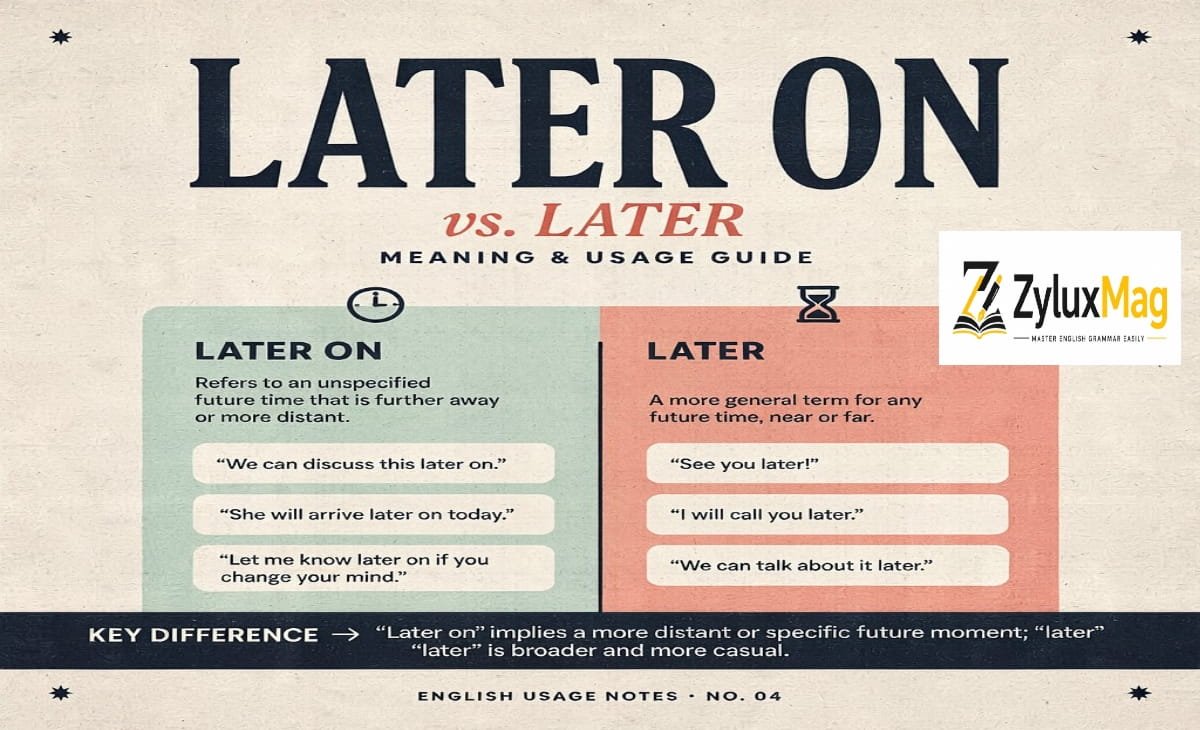
“Later on” is an adverb phrase that means “at a time after now” or “at a point after something already mentioned.” It works the same way as “later,” just with a slightly more conversational or narrative feel — for example, “I’ll call you later on” or “Later on, she realized what he meant.”
What Does “Later On” Mean?
Its points to a time that comes after the present moment, or after a point already established in a conversation or story. It doesn’t give an exact time — just that something happens afterward.
It’s used in two main ways:
- After now: “Let’s talk about this later on.” (sometime after this conversation)
- After a mentioned point: “He joined the company in 2010. Later on, he became the manager.” (after that earlier point in the story)
Both uses are standard English, correct in speech and in writing.
Is “Later On” the Same as “Later”?
Yes, in meaning. “Later on” and “later” both refer to a future or subsequent time, and dictionaries treat them as direct synonyms. The difference is one of tone, not grammar.
“Later” is quicker and more neutral. It works well in short, everyday sentences: “I’ll see you later.”
“Later on” carries a slightly softer, more reflective tone. It’s common in storytelling or when describing how something unfolded over time: “She struggled at first. Things got easier.”
Neither word is more “correct” than the other. Choosing between them is a matter of style, not rule-following.
| Later | Later On | |
| Meaning | At a time after now | At a time after now, or after a mentioned point |
| Tone | Direct, neutral | Slightly more conversational or narrative |
| Works best in | Short, everyday statements | Storytelling, describing a sequence of events |
| Grammatically correct? | Yes | Yes |
How to Use “Later On Meaning” in a Sentence
At the end of a sentence, no comma is needed:
- “We’ll sort out the details later on.”
- “I’m free now, but I can call you later on if that’s easier.”
At the start of a sentence, use a comma after it:
- “Later on, he admitted he’d been wrong.”
- “Later on, the weather improved.”
Mid-sentence, describing a sequence, it often follows a semicolon or a new clause:
- “She started as an intern; later on, she became CEO.”
“Later on” can also pair with time words for more specific reference: later on in the day, later on in life, much later on, a little it.
Common Mistakes with “Later On”
Writing it as one word. “Later on” is always two separate words. “Lateron” is not correct in standard English.
Assuming “on” is always unnecessary. Some writers treat “on” as pure filler and cut it automatically. That’s not quite right — in narrative or sequential contexts (“She grew up in Boston. It, she moved to Chicago”), “later on” reads more naturally than a bare “later” would.
Confusing it with the casual goodbye “Later!” When “later” is used informally to mean “goodbye,” it doesn’t take “on.” You’d say “Later, guys!” — not “Later on, guys!” This informal farewell use is a separate meaning from the time-related “later on” discussed above.
Quick Answers
Is “It” grammatically correct?
Yes. It’s a standard adverb phrase recognized by major dictionaries, and it’s appropriate in both speech and writing.
Is It formal or informal?
Neither strictly. It’s neutral to slightly conversational, and fits comfortably in everyday writing, emails, and casual speech. For more formal or concise writing, plain “later” is often the tighter choice.
Can you start a sentence with It?
Yes. When it opens a sentence, follow it with a comma: “Later on, we found out the real story.”