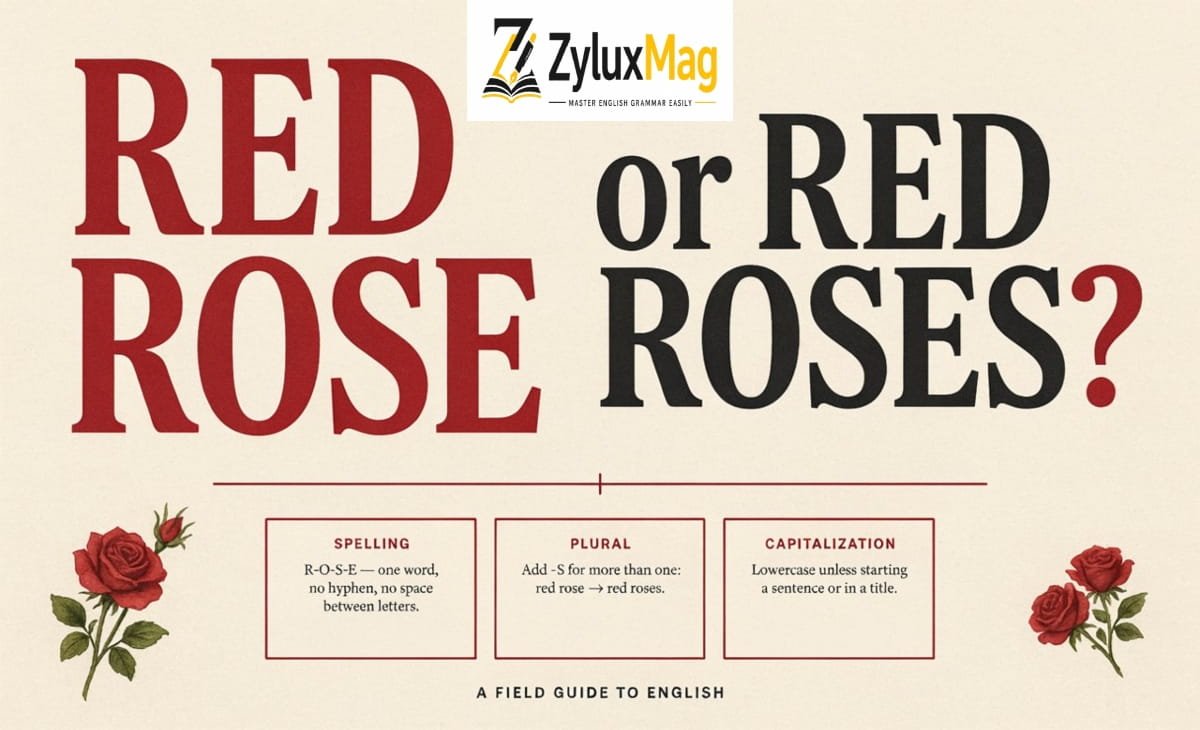
Red rose is lowercase in ordinary writing — it’s a common noun phrase, not a proper noun. The plural is “red roses,” never “reds rose” or “red rose’s.” Use “a red rose” the first time you mention one, and “the red rose” when referring back to a specific rose already mentioned.
That covers the basics. Here’s the full breakdown, including the mistakes people make most often.
Is “Red Rose” Capitalized?
No — not in normal sentences. “Red rose” is made up of an ordinary adjective (“red”) and an ordinary common noun (“rose”), so it follows the same rule as any other color-plus-object phrase, like “blue sky” or “green apple.”
She placed a red rose on the table. He gave her a bouquet of red roses.
Capitalize it only when it functions as a proper noun — meaning it names something specific, like a title, an emblem, or a brand:
The Red Rose of Lancaster was the badge of the House of Lancaster. He ordered a box of Red Rose tea. The novel is called The Red Rose.
The rule in one line: if “red rose” is just describing a flower, keep it lowercase. If it’s naming something — a title, a brand, an emblem — capitalize it.
The Plural of “Red Rose” — “Red Roses,” Not “Reds Rose”
“Rose” is a countable noun, and it follows the regular English plural pattern: add -s.
one red rose → two red roses
The adjective “red” never changes form, no matter how many roses you’re talking about. English adjectives don’t take plural endings — only the noun does.
| Incorrect | Correct |
| reds rose | red roses |
| red rose’s (meaning more than one) | red roses |
| a bunch of red rose | a bunch of red roses |
That middle row is worth pausing on: “red rose’s” looks like it could be a plural, but the apostrophe changes its meaning entirely — it signals possession, not plurality. Which brings us to the next point.
Possessive Form — “Red Rose’s” vs. “Red Roses'”
The placement of the apostrophe depends on whether you’re talking about one rose or several.
- Singular possessive (one rose): add ‘s
The red rose’s petals were still wet with dew. - Plural possessive (more than one rose): add just an apostrophe after the existing -s
The red roses’ fragrance filled the room.
A simple way to check yourself: say the phrase out loud without the apostrophe first. If you mean one rose owning something, add ‘s. If you mean several roses, the plural “roses” already ends in -s, so you only add the apostrophe after it.
A few years ago, I was writing product descriptions for a small flower shop’s website — my first real freelance gig. I typed “assorted red rose’s available for same-day delivery” and hit send without a second look. The owner replied within the hour, gently asking if I’d meant “roses.” I stared at that message longer than I’d like to admit. One stray apostrophe, and suddenly it looked like I didn’t know the difference between a plural and a possessive. I triple-check every apostrophe now, especially in anything client-facing. Small mark, big impression.
“A Red Rose” or “The Red Rose”? — Choosing the Right Article
This comes down to a general rule of English, not anything specific to roses:
- Use “a red rose” when you’re introducing one for the first time, or speaking generally.
He handed her a red rose. - Use “the red rose” when you’re referring to a specific rose the reader or listener already knows about.
He handed her a red rose. The red rose had come from his own garden plural rules for color-based nouns like purple roses.
If you’re speaking about roses in general — not one specific flower — you typically use the plural with no article at all:
Red roses are often given as a symbol of love.
“Rose” the Flower vs. “Rose” the Verb (Don’t Confuse Them)
This is a distinction most grammar pages skip, but it matters for reading comprehension. “Rose” is a homograph — one spelling, two completely different meanings:
- Noun — the flower: She picked a red rose.
- Verb — the past tense of “rise”: Prices rose sharply last year.
The two are unrelated in meaning, but identical in spelling and pronunciation, which can cause momentary confusion in a sentence like:
As the sun rose, she saw a red rose on the windowsill.
Here, the first “rose” is a verb (past tense of “rise”), and the second is a noun (the flower). Context — usually the words right around it — tells you which one you’re dealing with. If “rose” is preceded by “a,” “the,” or a color like “red,” it’s almost certainly the flower.
Note: “rose” is also a homophone of “rows” (as in rows of chairs, or the verb “to row a boat”) — same sound, different spelling and meaning. Worth knowing if you’re working from listening practice rather than text.
Common Mistakes with “Red Rose”
| Incorrect | Correct | Why |
| Reds rose | Red roses | The plural -s belongs on the noun, not the adjective. |
| Red rose’s (used as a plural) | Red roses | An apostrophe + s shows possession, not plurality. |
| Red roses’s petals | Red roses’ petals | Plural possessives don’t get a second -s. |
| I love Red Rose. | I love red roses. | Capitalize only when it’s a proper noun (a title, brand, or emblem). |
| She rose to give him a rose. | She stood up to give him a rose. | Rewording avoids the awkward verb/noun repetition of “rose.” |
About the Author
Faizan Babar writes about English grammar and vocabulary for everyday learners and working writers. Drawing on years of hands-on freelance and editorial experience, he breaks down grammar rules using real mistakes, real emails, and real conversations — not just textbook definitions.