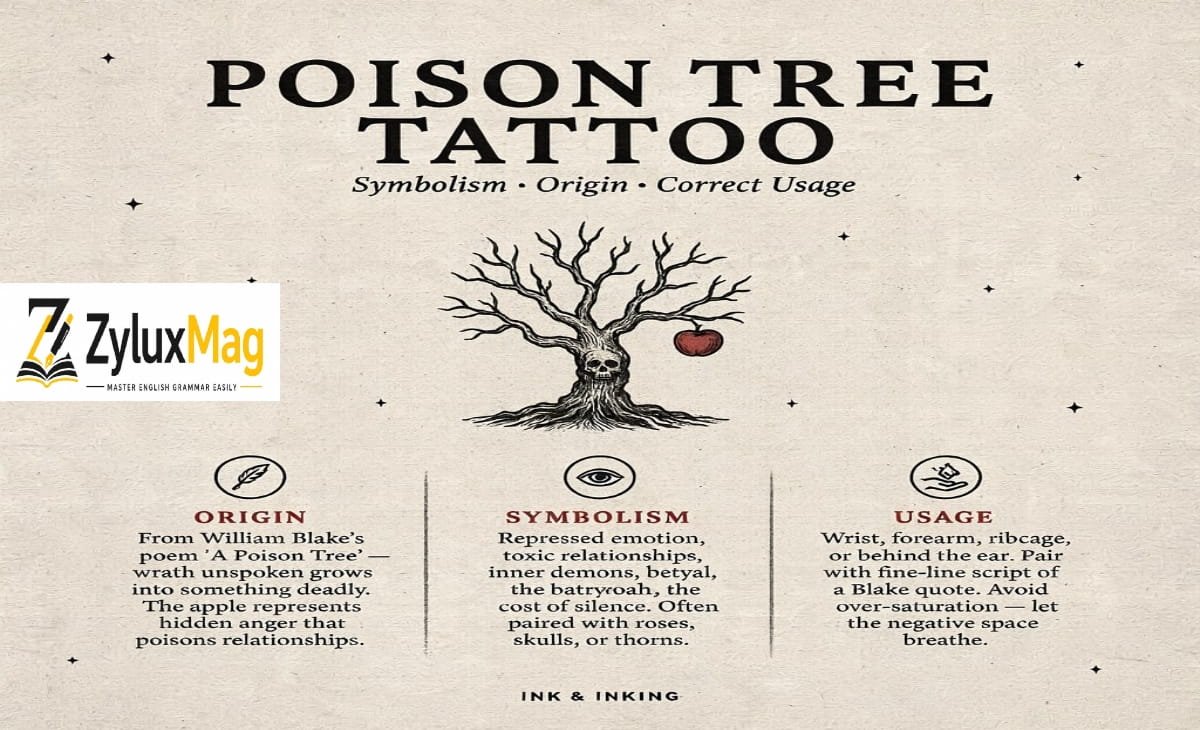
A Poison Tree Tattoo Meaning symbolizes suppressed anger and hidden resentment that is left to grow – its meaning is often based on William Blake’s 1794 poem A Poison Tree. It can also be read as a symbol of change by some who get the design: a choice to face the repressed emotion instead of letting it silently grow. That’s the quick explanation.
Here’s the origin, what changes when, and how to say it correctly before you say it anywhere.
The Origin: William Blake’s “Poison Tree Tattoo Meaning” The poem can be summarized in one line
A Poison Tree Tattoo Meaning is an English poem written by William Blake and published in 1794 as part of his collection Songs of Experience. The idea is simple, but brutal: a man is angry with his friend and the anger passes. He is angry with his enemy and keeps it, it doesn’t pass, because he doesn’t say it, it grows. Blake depicts his anger as a tree that the man waters with fear and basks in with a false smile until it bears the poisoned apple.
The enemy eats the apple and dies – the poem ends there.
The tattoo borrows that image directly: a tree grown from something unspoken rather than expressed, and a lesson on what goes unspoken. Here’s how you write the title right: A Poison Tree is the name of a poem, and it should be italicized (or set apart as a quotation when italics are unavailable), with the initial words capitalized – not “a poison tree” or “A poison Tree”.
What Does a Poison Tree Tattoo Signify?
Playing off of that source material, the meaning is generally understood to be: Repressed or unspoken anger Bitter resentment that brews away from the conscious mind Inner turmoil or the disconnect between emotion and outward appearance Personal change – for many who have this tattoo, it’s a reminder to stop choosing it, not a celebration of it Symbols of the Poison Tree Are Not Evil or Malicious Despite the word “poison”, the tattoo isn’t an evil symbol. For most, getting this design is about a lesson learned about bottled-up emotion – not anger itself the meaning behind phrases like stay gold.
Does “Poison Tree” = “Poisonous Tree” and Vice Versa?
Both phrases show up in internet searches, but they aren’t interchangeable: the phrase poison tree features the word poison in a noun-modifier construction (the same as “poison ivy” or “poison dart”) and is the correct term for referring to the tattoo, because it matches Blake’s actual title: A Poison Tree.
To use poisonous tree means to employ an adjective in order to describe a tree that produces poison, which may be grammatically acceptable but is not a close match to the poem’s title (and is, therefore, technically less correct). There’s also a completely different phrase that confuses the matter with this one:
Term Meaning Origin Poison tree tattoo Repressed anger/hidden resentment William Blake’s poem A Poison Tree (1794) Fruit of the poisonous tree A legal term: evidence obtained illegally cannot be introduced in court because it came from a tainted (illegal) source U.S. legal doctrine (unrelated to Blake’s poem) What Is This Fruit? It isn’t illegal to get a “poisonous” tree tattoo, but people sometimes confuse the legal term for Blake’s poem. Most legal articles discussing this appear as an explanation of the legal concept, with the two meanings separate.
I once made the mistake myself, writing a tattoo description article for an online magazine, and submitting “poisonous tree tattoo” as a search term when the actual design was clearly based on Blake’s poem.
It was rejected with the comment: “That’s not a plant, that’s a poem.
Write that again.”
Ah well, lessons learned – the hard way.
Does the Design Mean Anything?
The poem gives the tattoo its meaning, but the overall symbolism can shift depending on the specifics of the design: Design elements What they tend to denote A single, highlighted or glowing fruit Active, unresolved anger – an emotion still being carried with you, in some way No fruit or withered, bare branches Resolution – an emotion that has been faced and released visible, tangled roots How deep or longstanding an emotion has been dormant A tree in or next to a figure What the personal connection to that emotion actually was Common Misconceptions “It’s a dark tattoo.” Not so: the poem depicts a dangerous tree because the anger behind it was unspoken, not because being angry is inherently sinister or evil.
It’s connected to the legal phrase ‘fruit of the poisonous tree.
Again, no. When you see this term used in legal contexts, it has nothing to do with the poem, it’s just a coincidence of wording. Now you know the difference! About the Author Faizan Babar The author of Zylux Mag, he covers English language usage, word definitions, and language mix-ups for literature fans who are also writers.
He’s learned his lessons about choosing the right words the hard way, through years of editing copy that sits on the page and waits for the reader.
About the Author
Faizan Babar is the writer behind ZyluxMag, covering English grammar, word meanings, and everyday language mix-ups through real-world writing experience. He writes from firsthand encounters with tricky phrasing — the kind that only show up once you’re actually editing copy for a living.