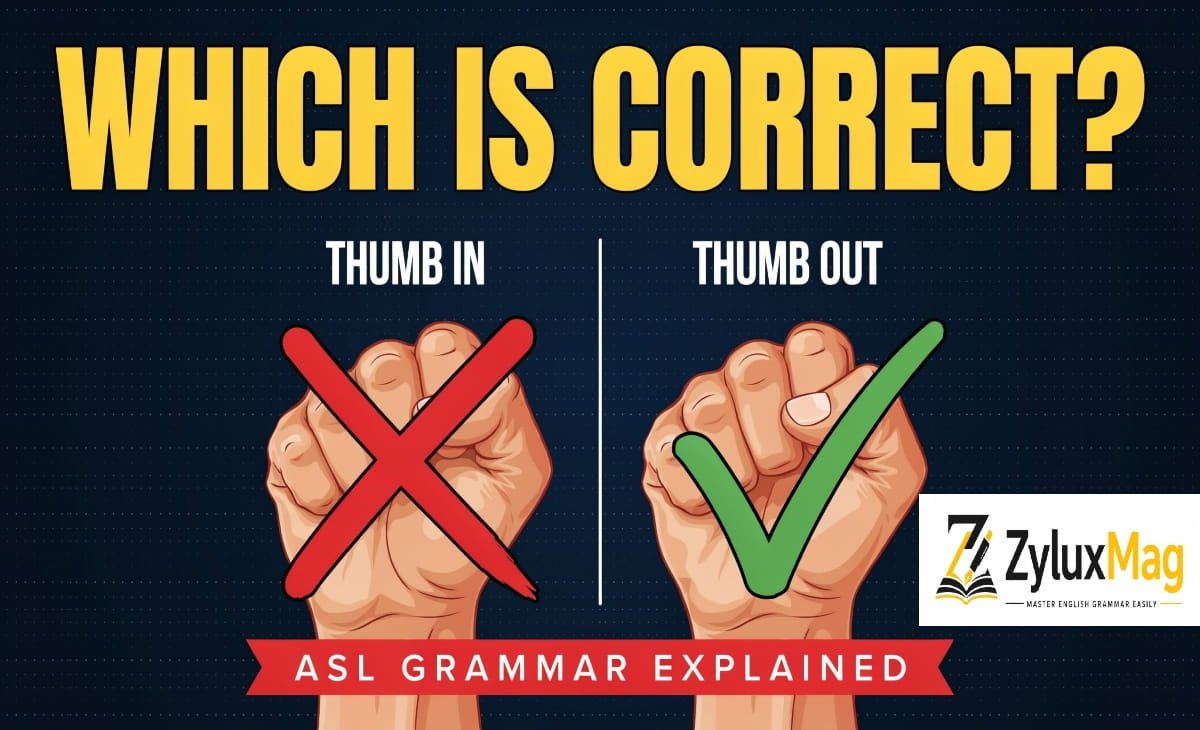
Thumb In or Thumb Out aren’t a fixed grammar term with one meaning — they’re a descriptive phrase for hand and thumb position, and the right answer depends entirely on what you’re doing. On a steering wheel, keeping your thumbs out is the safer habit, because a thumb hooked inside the rim can be injured if the airbag deploys. For gripping a tool, sports equipment, or a pen, either position can be correct — it’s a matter of comfort and control, not safety.
What “Thumb In” and “Thumb Out” Mean
Stripped of context, the two terms are simple:
- Thumb in – the thumb is tucked or wrapped inward, closer to the palm or around an object.
- Thumb out – the thumb is extended outward, away from the palm or along the side of an object.
That’s the whole literal meaning. What changes is the situation you apply it to — and that’s where most confusion comes from, because people use the same two words for driving, gripping tools, and holding a pen.
Three Different Situations Where People Use This Phrase
Driving — Thumb In or Out on the Steering Wheel
This is the most common use of the phrase. It refers to where your thumbs sit while holding the steering wheel, usually with your hands at the 9-and-3 or 8-and-4 position.
- Thumb in: hooked around the inside of the wheel’s rim.
- Thumb out: resting flat along the outside of the rim, not wrapped around it.
Recommended: thumb out. If the airbag deploys, a wheel can jerk suddenly, and a thumb hooked inside the rim is more likely to get caught or injured. Resting your thumbs along the outside of the wheel lets you keep a firm hold without that risk.
Example: “Keep your thumbs resting on the outside of the wheel, not hooked around the inside, in case the airbag goes off.”
My driving instructor once grabbed the wheel so fast I thought we’d hit something. We hadn’t. I’d just parked my thumb right inside the rim, feeling pretty confident about my grip, when he snapped, “Thumb out! Always!” I laughed it off until he explained why — one hard airbag deployment and that “confident grip” could snap my thumb backward. I’d been driving for months with my thumbs tucked in like it was no big deal. That car ride is the only reason I now instinctively rest my thumbs flat on the wheel, and it’s exactly why I finally looked up what “thumb in or thumb out” actually means.
Gripping Tools and Sports Equipment
Here, the phrase describes how you wrap your hand around something like a hammer, a bat, or a racket handle.
- Thumb in: wrapped around the handle for a locked, powerful grip.
- Thumb out: extended along the handle for more control and finer movement.
Recommended: it depends on the task. A thumb-in grip gives more force, which is useful for swinging a hammer or hitting a ball. A thumb-out grip gives more precision, which helps with detailed or delicate work.
Example: “Use a thumb-in grip when you need power, and a thumb-out grip when you need control.”
Pen/Handwriting Grip
This use describes how the thumb sits while holding a pen or pencil.
- Thumb in: curled close against the pen, near the fingers.
- Thumb out: relaxed and slightly extended, not pressed tightly against the pen.
Recommended: thumb out. A relaxed, thumb-out grip is generally easier on the hand during long writing sessions and reduces strain. A tightly curled thumb-in grip is more common in people who press too hard on the page.
Example: “If your hand cramps while writing, try loosening your grip and letting your thumb rest out instead of curling it in.”
Quick Comparison
| Context | Thumb In | Thumb Out | Recommended |
| Driving (steering wheel) | Hooked around the rim | Resting flat along the rim | Thumb out (safety) |
| Tool/sports grip | Wrapped for a locked grip | Extended for control | Depends on the task |
| Pen/handwriting | Curled close to the pen | Relaxed, extended | Thumb out (comfort) |
Is It “Thumb In,” “Thumb-In,” or “Thumbs In”? (Grammar Note)
This is where the phrase actually touches on grammar, and it’s worth getting right.
Hyphenation: Add a hyphen when the phrase works as an adjective directly before a noun. Leave it unhyphenated when it functions as a verb phrase.
- ✅ “a thumb-in grip” (adjective before a noun → hyphenated)
- ✅ “keep your thumb in” (verb phrase → no hyphen)
- ❌ “a thumb in grip” (missing the hyphen where it’s needed)
- ❌ “keep your thumb-in” (hyphenated where it shouldn’t be)
Singular vs. plural: Use “thumb” when you’re talking about one hand at a time, and “thumbs” when both hands are involved.
- “Keep your thumb relaxed against the pen.” (one hand, one thumb)
- “Keep your thumbs out on the wheel.” (two hands, both thumbs)
| Form | When to use | Example |
| thumb in / thumb out | As a verb phrase | “Keep your thumb in.” |
| thumb-in / thumb-out | As an adjective before a noun | “a thumb-out grip” |
| thumb / thumbs | Singular for one hand, plural for two | “your thumb” (pen) vs. “your thumbs” (wheel) |
Common Mistakes to Avoid
- Assuming there’s one universal answer. “Thumb in” or “thumb out” isn’t right or wrong on its own — it depends on whether you’re driving, gripping a tool, or holding a pen. Don’t apply advice from one context to another.
- Dropping the hyphen in adjective use. Write “a thumb-in grip,” not “a thumb in grip,” when the phrase describes a noun.
- Using “thumb” and “thumbs” inconsistently. Match the number of thumbs actually involved — one hand takes “thumb,” two hands take “thumbs.”
- Treating it as a fixed idiom. It isn’t a set expression with one dictionary meaning — it’s a literal, descriptive phrase that changes meaning with context hyphenation rules like kickback vs kick back.
About the Author
Admin is the founder and lead writer at ZyluxMag, where clear, practical English explanations meet real-world context. With years of hands-on experience writing about grammar, vocabulary, and everyday language mistakes, Admin focuses on breaking down confusing English phrases into simple, usable rules — the kind you actually remember the next time you’re writing an email, gripping a pen, or driving a car.