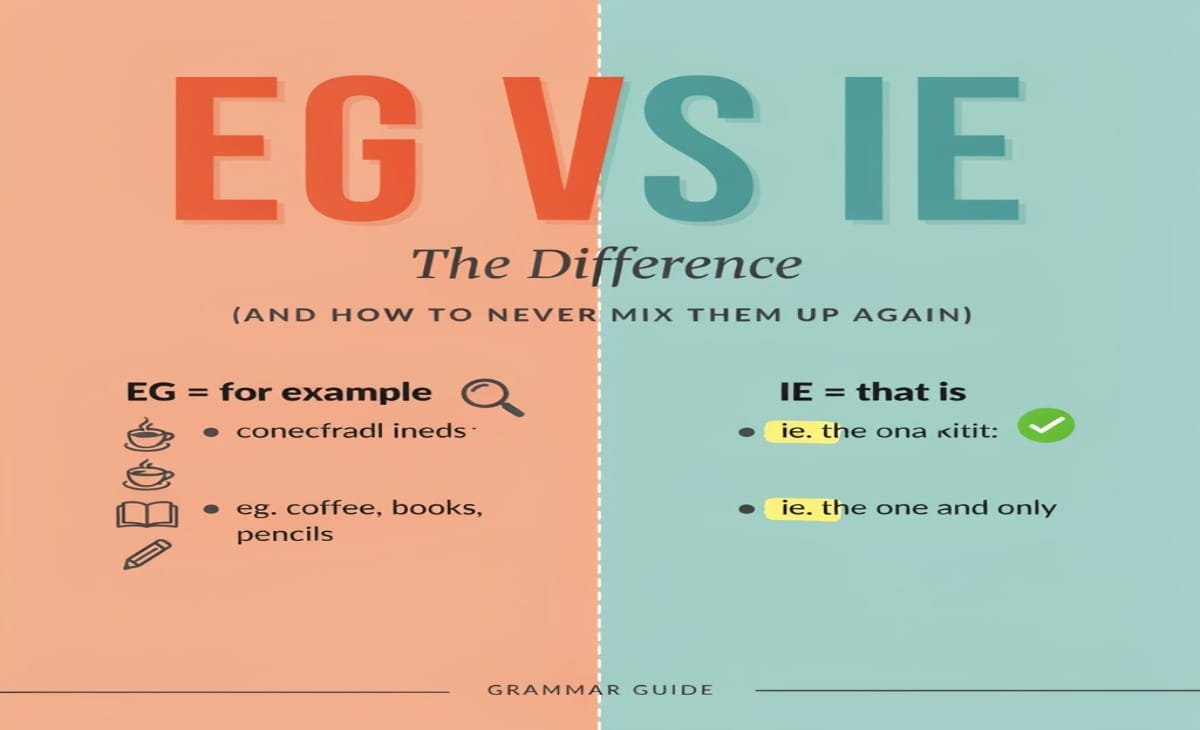
E.g. Means “for example.” Use it to introduce one or more examples from a larger group. I.e. Means “that is.” Use it to restate or clarify exactly what you just said.
A simple test: If you can swap in the words “for example,” use e.g. If you can swap in “that is” or “in other words,” use i.e.
Bring something warm, e.g., a coat or sweater. (a few examples out of many possible options)
Bring your travel document, i.e., your passport. (restating exactly what “travel document” means)
A Mistake That Taught Me This the Hard Way
A few years ago I sent a client a project update asking for the final items needed: “Please send the missing assets, i.e., the logo file and product photos.” What I meant as an example-there were actually four other files I needed besides-led to the client only sending those two and considering the job complete. Cue an awkward follow-up email and an annoyed client reply.
That mix-up cost me a full day of back-and-forth, and ever since I’ve tried to pause before hitting send on any communication containing a list, asking myself: “Am I giving an example, or am I naming the whole thing?”
That brief pause has been remarkably effective differently vs different usage.
What Each One Actually Means
E.g. – “exempli gratia”
E.g. Is short for the Latin phrase exempli gratia, which means “for the sake of example.” It signals that what follows is a possible illustration-not the whole truth.
Example: “You’ll need a form of ID, e.g., a driver’s license or student card.” (A driver’s license is one possible option; so would be your passport or anything else acceptable to your institution.)
I.e. – “id est”
I.e. Is short for id est, Latin for “that is.” It doesn’t introduce an example-rather, it renames something or clarifies exactly what it is.
Example: “You’ll need a government-issued photo ID, i.e., a passport or driver’s license.” (In this case, the phrase after “i.e.” spells out the entire range of what counts, not just one possibility.)
E.g. vs. I.e. at a Glance
| E.g. | I.e. | |
| Latin origin | exempli gratia | id est |
| Meaning | “for example” | “that is” |
| Use it when… | giving one or more examples from a larger set | restating or clarifying exactly what you mean |
| Example sentence | She enjoys winter sports, e.g., skiing and skating. | She enjoys winter sports, i.e., skiing and skating. |
Example sentence
She enjoys winter sports, e.g., skiing and skating.
She enjoys winter sports, i.e., skiing and skating.
Notice how the same sentence drastically changes meaning depending on which abbreviation you use. With e.g., skiing and skating are two sports she enjoys out of potentially many. With i.e., skiing and skating encompass all the winter sports she enjoys.
The 5-Second Test to Pick the Right One
To ensure you’re using the right abbreviation, say the entire sentence out loud but substitute the meanings of the abbreviations for them:
Try swapping “for example” in for the abbreviation. If the sentence still makes sense, use e.g.
Try swapping “that is” or “in other words” in for the abbreviation. If this is what you’re communicating, use i.e.
A quick few examples:
“I love reading fiction, _ mystery novels.” You mean “for example” (she reads other genres too). E.g.
“My favorite genre is the one with detectives and crime-solving, _ mystery.” You mean “that is” (you are naming the genre). I.e.
“Please bring proof of address, _ a recent utility bill.” You mean “for example” if a utility bill is just one acceptable option. E.g. You mean “that is” if it’s the only document accepted. I.e.
If neither “for example” nor “that is” fits naturally, you’ve likely just need a different word or phrase rather than an abbreviation.
How to Punctuate E.g. And I.e. Correctly
Periods
In standard American English, both abbreviations are written with periods after each letter: e.g. And i.e. (not “eg” or “ie”).
The Comma Rule
In American style guides-Chicago, APA, and AP included-a comma follows the abbreviation.
Correct: “Bring warm layers (e.g., a coat, gloves, and a hat).”
Incorrect: “Bring warm layers (e.g. A coat, gloves, and a hat).”
Note that not every style guide agrees on the comma after “i.e.” -some, like Fowler’s, suggest omitting it. However, for general professional and everyday writing, the comma is the safer and most expected choice.
British English Difference
British publications usually drop the periods and the comma entirely, writing “eg” and “ie.”
American: “Bring your ID (e.g., a passport).”
British: “Bring your ID (eg a passport).”
There’s no “wrong” version-it simply depends on the style you’re following. If you’re writing for a specific institution, refer to its style guide. If there isn’t one, the American version (with periods and a comma) is generally more accepted.
Should They Be Italicized?
No. Though they are both Latin abbreviations, modern style guides treat both as standard English words rather than foreign terms.
Common Mistakes to Avoid
- Using “e.g.” when there’s only one correct answer. “You’ll need to bring the required form, e.g., Form 27-B.” “You’ll need to bring the required form, i.e., Form 27-B.” If Form 27-B is the only form accepted, you are not giving an example-you are specifying the exact form required. Use “i.e.”
2. Using “i.e.” when you are only giving one of many examples. “She collects vintage items, i.e., old records.” “She collects vintage items, e.g., old records.” Old records are one type of vintage item that she collects-they do not encompass the entire meaning of vintage items. Use “e.g.”
3. Pairing “e.g.” with “etc.” in the same list. “Bring snacks, e.g., chips, pretzels, etc.” “Bring snacks, e.g., chips and pretzels.” By using “e.g.,” you imply that the list is incomplete, making “etc.” redundant.
4. Dropping periods in formal American writing. “Bring an ID, eg a passport.” “Bring an ID, e.g., a passport.” Unless you are intentionally following British style, the periods are needed.
5. Confusing informal shortcuts with true meanings Some remember “e.g.” as “example given.” This is not the true Latin origin, but it can help trigger the correct usage (related to examples). The danger comes when such a shortcut bypasses the real test: whether the word you’re clarifying is just an example (e.g.) or actually the definition of the preceding phrase (i.e.).
6. Overusing them in formal writing In research papers, academic reports, or formal letters, it is generally clearer to spell out “for example” or “that is,” particularly outside of parentheses. Reserve “e.g.” and “i.e.” primarily for use in parentheses and lists.
Quick Practice: Which One Fits?
Fill in each blank with e.g. or i.e.
- He plays several instruments, ___ the guitar and piano.
- The meeting is on the first working day of the week, ___ Monday.
- Please avoid high-sugar drinks, ___ soda and energy drinks.
- The capital of Japan, ___ Tokyo, is home to over 13 million people.
- You can pay with any major card, ___ Visa or Mastercard.
Answers:
- e.g. — the guitar and piano are examples; he may play others too.
- i.e. — “the first working day of the week” is being defined exactly as Monday.
- e.g. — soda and energy drinks are examples of high-sugar drinks, not the only ones.
- i.e. — Tokyo is the capital being named, not one example among several capitals.
- e.g. — Visa and Mastercard are examples of accepted cards; other cards may work too.