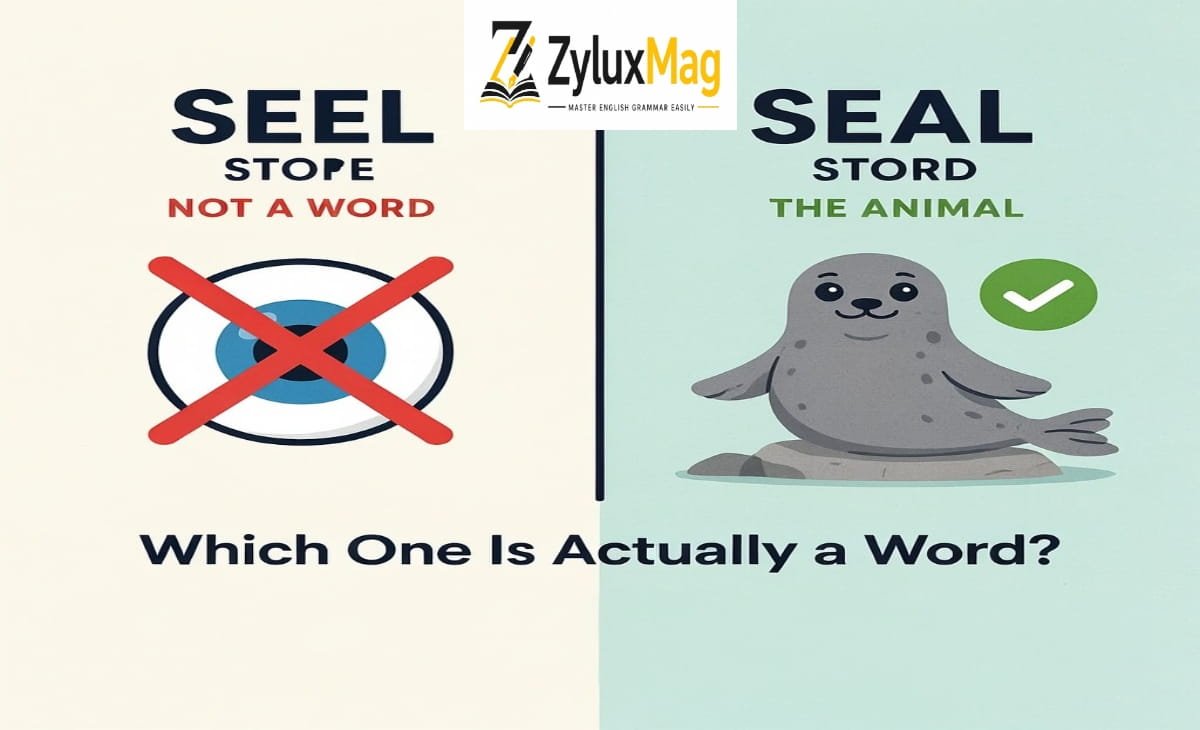
Seel vs Seal is the word you’re almost always looking for. It’s the common English word for the marine animal, a stamp or closure, or the verb meaning to close something securely. “Seel” is a real but obsolete word, found only in old falconry and literary texts, meaning to sew shut a hawk’s eyelids. If you’re writing something today, you want “seal.”
“Seal” Is the Word You Want
“Seal” does a lot of work in English. It functions as both a noun and a verb, and the meanings split into a few clear categories.
Seal as a Noun
The animal: a sea mammal with flippers, known for barking and lounging on rocks. “A seal slid off the dock and into the water.”
A stamp or emblem: an official mark used to authenticate a document. “The letter carried the royal seal.”
A closure or fastening: something that keeps a container airtight or watertight. “Check that the jar’s seal hasn’t been broken similar-looking words like signer or signor.
Seal as a Verb
Meaning to close something securely or to make something final and official.
“Seal the envelope before mailing it.”
“They sealed the deal with a handshake.”
“The court sealed the records.”
In every one of these cases, “seal” is spelled with an a, not two e’s.
So Is “Seel” a Real Word?
Technically, yes – but you’ll almost never need it. “Seel” is a verb meaning to sew a hawk’s eyelids shut, a practice once used in falconry training to keep a bird calm. Major dictionaries still list it, but the Oxford English Dictionary marks it as obsolete, with its last recorded use around the mid-1700s.
Where “Seel” Actually Comes From
This matters because it shows “seel” isn’t a variant spelling of “seal” – it’s a completely different word with a different history.
Seal comes from the Latin sigillum, meaning “a stamp” or “small image,” which is also the root of the closure and document-stamp meanings. The animal sense comes from a separate Old English/Old Norse word.
Seel comes from Middle English silen, traced back through Anglo-French to the Latin cilium, meaning “eyelid.”
Different roots, different meanings, no real overlap – the words just happen to look and sound alike.
Why the Two Get Confused
The confusion isn’t really about grammar. It’s almost always one of these:
Phonetic guessing – “seal” and “seel” would sound identical if “seel” were pronounced normally, so a writer unsure of the spelling guesses wrong.
Autocorrect or typing slips – doubling the wrong vowel.
Encountering “seel” in an old text – readers of historical fiction or Renaissance-era literature sometimes spot the word and wonder if it’s a typo, then search to check.
Quick Reference: Seal vs Seel
| Seal | Seel | |
| Status | Standard modern English | Obsolete / archaic |
| Meaning | Animal; stamp or closure; to close/secure | To sew shut a hawk’s eyelids (falconry) |
| Used today? | Yes, constantly | No — only in historical or literary contexts |
| Word type | Noun and verb | Verb only |
| Origin | Latin sigillum | Latin cilium (“eyelid”) |
Common Mistakes to Avoid
Mistake: Assuming “seel” is just an alternate spelling of “seal.”
It isn’t. They’re unrelated words that happen to look similar.
1-Seel the envelope shut.
2-Seal the envelope shut.
Mistake: Trusting spell-check to catch it.
Because “seel” is a genuine dictionary word, many spell-checkers won’t flag it as an error. This is worth knowing – the tool that usually saves you from typos won’t save you here.
Mistake: Using “seel” for style or emphasis.
Some writers assume an unusual spelling adds flair. In practice, it just reads as a mistake to almost every reader, since the word has no active use in modern English.
A Mistake I Actually Made
I once sent a client a note about “sealing the deal” on a content package, except I typed “seeling” – twice, in the same email. He replied with just one line: “Is this a falconry reference?” I had no idea what he meant, so I looked it up, and that’s how I learned “seel” is an actual word about sewing a hawk’s eyelids shut.
I laughed, then felt mildly horrified.
I’d sent an editing pitch with a spelling mistake spell-check hadn’t even flagged. Ever since, I triple-check that word before hitting send.
FAQs
How do you pronounce “seel”?
The same way you’d pronounce “seal” – /sil/. This is exactly why the confusion happens so easily.
Will spell-check catch “seel” as a mistake?
Not reliably. Since “seel” is a valid (if obsolete) dictionary word, many spell-checkers accept it without flagging anything. Proofread manually if you’re unsure which word you meant.
Is “seel” ever correct in modern writing?
Only in very specific cases – quoting historical or literary text, writing about falconry history, or intentionally using archaic language for stylistic effect in fiction. Outside of those situations, “seal” is what you want.
About the Author
Faizan Babar is a writer and content strategist at ZyluxMag, where he covers English grammar, vocabulary, and everyday writing mistakes. With years of experience writing for clients and publications, he’s made (and fixed) more spelling slip-ups than he’d like to admit – and turns those lessons into practical guides for other writers. When he’s not editing a copy, he’s probably double-checking his own.