Felicitation is defined as an expression of good wishes or congratulations, particularly in a formal or ceremonial context. This term originates from the verb “felicitate,” which means “to congratulate” or, in some regional forms like South Asian English, “to honor someone with an award.”
In everyday language, you will likely encounter “felicitations” more often; “felicitation” on its own is technically grammatically correct but is far less frequently used. I can recall an instance where a friend had just gotten engaged, and I intended for my message to sound a little more special when I typed “Sending you my sincerest felicitation!” Her response, within seconds, was, “Aw, thank you…
But is that even a word?”
Embarrassed, I quickly did an online search mid-conversation, and discovered I should have used “felicitations”-the actual phrase people use to offer congratulations. The incident still provides us with a good laugh, and she humorously refers to it as my “one-felicitation era”; a small error that continues to remind me that this word almost always includes that crucial “s.”
Felicitation vs. Felicitations – Which Is Correct?
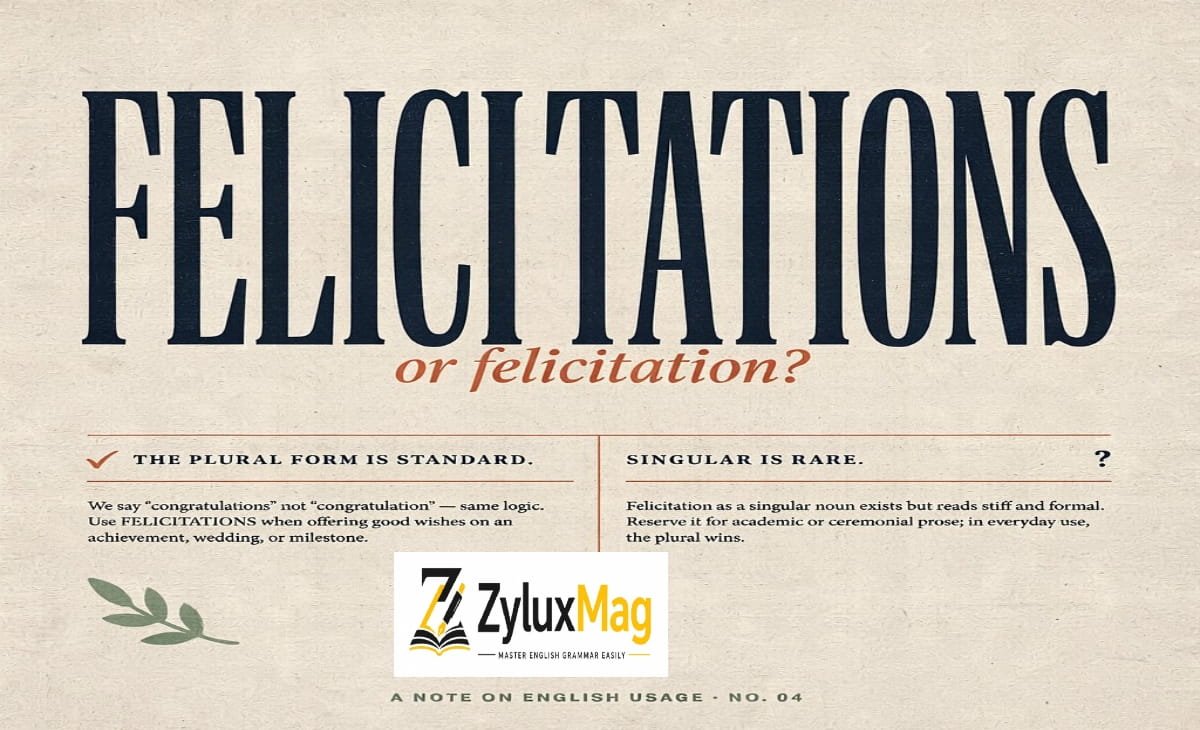
Both “felicitation” and “felicitations” are grammatically correct, but their usage differs depending on the context.
Felicitation (singular): This form refers to the act or instance of congratulating someone. It’s typically used when describing the event itself, rather than directly expressing good wishes to someone:
A felicitation was arranged for the outgoing director.
The award included a formal felicitation common spelling confusion like naive or nieve.
Felicitations (plural): This form is used as a direct greeting or exclamation to congratulate someone, similar to “Congratulations!”:
– Felicitations on your new position!
– Please accept my felicitations on your engagement.
General guideline: Use the plural form “felicitations” when you are directly offering good wishes to someone. Use the singular form “felicitation” when you are referring to an event, ceremony, or an act of congratulating.
Felicitation vs. Congratulation — What’s the Real Difference?
The two words mean almost the same thing, but they don’t carry the same weight.
| Felicitation | Congratulation | |
| Tone | Formal, ceremonial, literary | Neutral, everyday |
| Typical context | Official events, awards, speeches | Personal messages, everyday professional use |
| Frequency in modern English | Rare | Very common |
| Usual form | Felicitations | Congratulations |
Usual form: Congratulations
Practical application: Using “Congratulations on your promotion!” is natural in almost any situation.
However, “Felicitations on your promotion!”
is correct, but it sounds noticeably more formal, even a bit old-fashioned, in casual conversation.
Save “felicitations” for formal occasions, speeches, official communications, or when you want to adopt a deliberately formal tone.
Don’t Confuse “Felicitation” with “Felicitous”!
Many learners mistakenly confuse “felicitation” and “felicitous” because of their similar appearance, despite their distinct meanings.
Felicitation (noun): an expression of congratulations.
Felicitous (adjective): fitting, well-chosen, or apt. It has no relation to congratulating someone.
Both words trace back to the Latin “felix” (meaning “happy” or “fortunate”), which explains their similar spelling, but their modern meanings have diverged.
Correct:
– Her felicitations on the award were heartfelt. (meaning congratulations)
– That was a felicitous choice of words in his speech. (meaning well-chosen/apt)
Incorrect:
– ~~That was a felicitation choice of words.~~ (felicitation is a noun for congratulating; it cannot modify a “choice of words.”)
If you mean to say that something is “well-chosen” or “fitting,” use “felicitous.”
The Verb Form: “Felicitate”
“Felicitate” is the verb that underlies both “felicitation” and “felicitations.” Its basic meaning is “to congratulate”:
– The mayor felicitated the winning team.
It’s worth noting a regional variation: in South Asian English, “felicitate” is frequently used more broadly to mean “to honor someone with an award or public recognition,” which implies more than just offering congratulations:
– She was felicitated for her lifetime contribution to education.
Here, “felicitated” indicates that she was formally honored, likely through an award or a ceremony, which is a more official action than a simple verbal “well done.”
What Is a “Felicitation Ceremony”?
A felicitation ceremony is a formal event organized to publicly recognize or honor someone’s achievements, contributions, or service. This term is commonly encountered in educational institutions, workplaces, and government settings, particularly in South Asian regions, where it signifies an event more significant than a simple congratulation. It usually involves presenting a certificate, an award, a memento, or delivering a speech in the honored individual’s praise.
How to Use “Felicitation” in a Sentence
It’s important to use the correct preposition with “felicitations”; it is “felicitations on” (an achievement), not “felicitations for”:
– Please accept my felicitations on your engagement.
– Please accept my felicitations for your engagement. (Incorrect)
Here are a few examples of natural usage across different contexts:
Personal note: Warmest felicitations on the birth of your daughter.
Corporate email: On behalf of the entire team, please accept our felicitations on your well-deserved promotion.
Formal speech: It is my privilege to extend felicitations to this year’s award recipients.
News-style usage: The president sent felicitations to the newly elected leader.
Common Mistakes to Avoid
Using “felicitation” when “felicitous” is intended. Remember that they are different parts of speech with entirely different meanings and cannot be used interchangeably.
Using the singular “felicitation” as a direct greeting. When wishing someone well, use the plural form “Felicitations!” rather than “Felicitation!”
Employing the wrong preposition. The correct preposition is “felicitations on” when referring to an accomplishment, not “felicitations for.”
Misspelling the word. Be mindful of common typos like “feliciation” or “felicitaion”; the correct spelling is “felicitation” with a “-cit-” in the middle.
Using it in contexts where it sounds unnatural. In everyday casual conversation or writing, “congratulations” is almost always the more appropriate choice. Save “felicitations” for formal or ceremonial settings.
Quick Reference
- Felicitation (noun) — the act of congratulating.
- Felicitations (plural) — the greeting itself; the most commonly used form.
- Felicitate (verb) — to congratulate, or in South Asian English, to formally honor.
- Felicitous (adjective, unrelated meaning) — apt or well-suited.
- Correct preposition: felicitations on (an achievement), not for.
About the Author
Admin is the creator of ZyluxMag, contributing articles on English grammar, vocabulary, and common language errors. Through years of writing and editing, coupled with the occasional embarrassing typo, Admin has developed a keen eye for words that sound a little too fancy-a skill honed, in part, by the creation of this article.