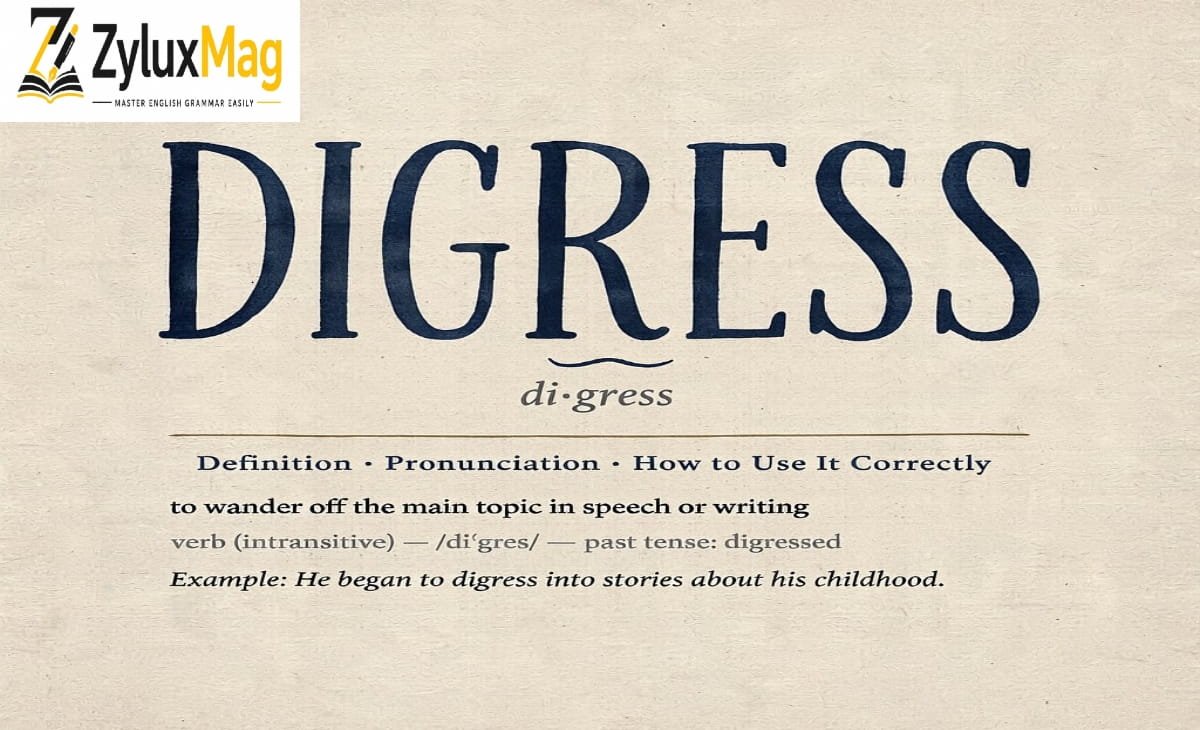
Digress means to move away from the main topic when speaking or writing, usually temporarily, before returning to it. It’s an intransitive verb, so you digress from a subject — never about it or on it. For example: “She digressed from her prepared speech to thank her mentor.”
I once got on a call with a client to walk her through her website copy, and somewhere between “homepage headline” and “about page,” I ended up telling her about my terrible Wi-Fi router and a package that got lost by the courier. Ten minutes gone. When I finally caught myself, I laughed and said, “Sorry, but I digress” — and she replied, “Oh, so that’s what that phrase means, I always wondered.” That’s the day I realized digress wasn’t just a fancy word from vocabulary lists. It’s just what happens when your brain takes a scenic detour.
What Does Digress Meaning?
Digress Meaning is to wander off the main subject of a conversation, speech, or piece of writing — and, in most cases, come back to it afterward. It’s a neutral, everyday word used in both formal and casual English.
- “The professor digressed to share a personal story before returning to the lecture.”
- “I know I’m digressing, but this is important.”
Digress is a verb, and it’s intransitive — it doesn’t take a direct object. You can’t “digress something”; you can only digress from something or into something.
Related word forms:
| Form | Part of speech | Example |
| digress | verb | “Don’t let him digress.” |
| digressed | verb (past tense) | “He digressed halfway through his speech.” |
| digressing | verb (present participle) | “She kept digressing into unrelated stories.” |
| digression | noun | “The book is full of digressions.” |
| digressive | adjective | “His writing style is famously digressive.” |
Pronunciation and Word Origin
Digress Meaning is pronounced /daɪˈɡrɛs/ — stress falls on the second syllable (dy-GRESS), not the first. This trips up a lot of learners, since many similar-looking words in English stress the first syllable.
The word comes from the Latin dīgredī, meaning “to go apart” or “to step away” — from dis- (“apart”) + gradi (“to go, to step”). That root explains the core meaning well: digressing is literally “stepping away” from your path before returning to it.
How to Use “Digress” Correctly in a Sentence
The most common error with this word isn’t the meaning — it’s the grammar around it.
Digress + “From” (Not “About” or “On”)
Because digress is intransitive, it needs a preposition to connect to what you’re moving away from. The correct preposition is from:
- ✅ “He digressed from the main topic.”
- ✅ “She digressed from her notes to answer a question.”
- ❌ “He digressed about his childhood.”
- ❌ “She digressed on a tangent.”
If you want to describe what you digressed into, use into:
- ✅ “He digressed into a long story about his childhood.”
A simple way to remember it: you digress from the topic you’re leaving, and into the topic you’re entering.
Word Forms — Digress, Digressed, Digression, Digressive
Keep these straight, since each has a different grammatical role:
- Digress / digressed / digressing — the verb, describing the action
- Digression — the noun, referring to the off-topic passage itself: “The digression lasted almost ten minutes.”
- Digressive — the adjective, describing a style or tendency: “His novels are known for their digressive structure.”
What Does “But I Digress” Mean?
“But I digress” is a common idiomatic expression used to signal that a speaker or writer has wandered off-topic and is now returning to the main point. It’s often used lightly or humorously, as a way of acknowledging the detour without apologizing for it.
- “That reminds me of a trip I took to Japan — but I digress, let’s get back to the budget.”
- “Anyway, but I digress. The real question is whether the plan will work.”
This phrase has been used in English for centuries and appears frequently in speeches, essays, and casual conversation as a natural, self-aware way to steer a discussion back on track.
Digress vs. Regress vs. Transgress: Don’t Mix Them Up
These three words look and sound similar, share a Latin root pattern, and are frequently confused — but their meanings are unrelated.
| Word | Meaning | Example |
| Digress | To move off-topic temporarily | “He digressed from the lecture to tell a joke.” |
| Regress | To go back to an earlier, usually worse, state | “His health regressed after he stopped the treatment.” |
| Transgress | To break a rule, law, or moral boundary | “She transgressed the company’s code of conduct.” |
The shared element is the Latin root -gress- (from gradi, “to go” or “to step”), but each prefix sends it in a completely different direction: di- (“apart”) gives you a detour, re- (“back”) gives you a reversal, and trans- (“across”) gives you a violation of a boundary.
Synonyms and Antonyms for Digress
Synonyms: stray, wander, deviate, veer off, ramble, meander
Antonyms: stay on topic, stick to the point
These synonyms aren’t perfectly interchangeable — ramble and meander suggest a longer, looser departure, while veer off suggests something sudden. Digress is the more neutral, general-purpose choice.
Common Mistakes to Avoid With “Digress”
- Wrong preposition: Don’t say “digress about” or “digress on.” Use “digress from” (leaving a topic) or “digress into” (entering a new one).
- Treating it as transitive: You can’t “digress a topic.” Digress always needs from or into to connect to its subject.
- Confusing it with regress or transgress: These words sound alike but mean very different things — see the comparison above.
- Misspelling it: The correct spelling is digress (one “s” after the “e,” double “s” at the end) — not “digres” or “digresss.”
- Mispronouncing the stress: The stress is on the second syllable — dy-GRESS, not DY-gress.
- Assuming digressing is always a mistake: In storytelling, speeches, and conversation, a well-placed digression can add color or humor. It’s only a problem when it’s unintentional or excessive.