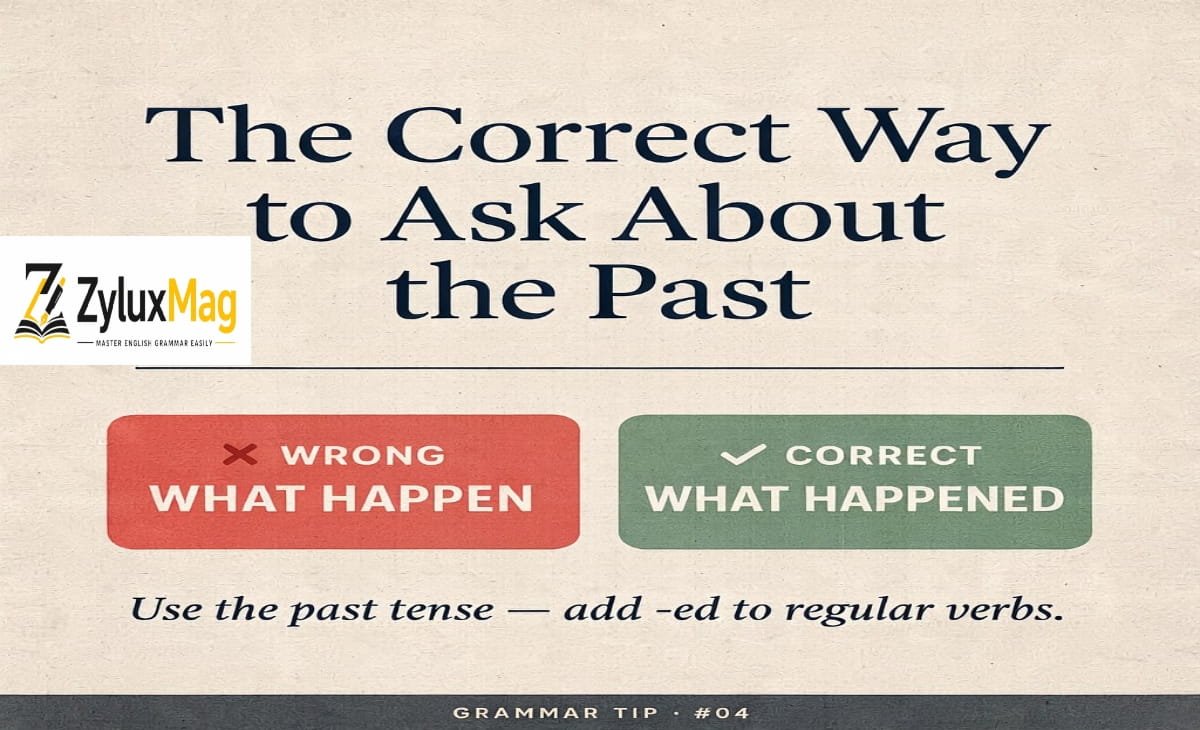
“What happened?” is correct when you’re asking about something that already occurred. “What happen” on its own is not standard English — it’s missing its past-tense ending.
If you’re texting a friend, writing an email, or telling a story, “happened” is the word you want. Here’s why.
I still cringe thinking about this one. Early in my freelance writing days, a client sent me a rushed voice note about a project delay, and I typed back fast: “Oh no, what happen with the deadline?” Hit send before I even reread it. Ten seconds later I saw it sitting there in the thread, missing its ending like a sentence that tripped and forgot to get back up. The client never mentioned it, but I noticed. That tiny slip made me realize how much a single letter — just -ed — tells someone you’re paying attention, even in a two-line email.
Why “What Happen” Is Incorrect
The One-Tense Rule
English only marks the past tense once in a sentence — either on the helping verb or on the main verb, never on both, and never on neither.
- With a helping verb: “Did it happen?” (the past shows up on “did”)
- Without a helping verb: “It happened.” (the past shows up on the main verb)
“What happen?” breaks this rule. There’s no helping verb to carry the past tense, and “happen” itself hasn’t changed to show it either. The sentence is left with no past-tense marker at all — which is why it reads as unfinished or broken, even though the meaning is easy to guess.
“Happen” vs “Happened” — What Changes
“Happen” is the base form of the verb — the form you’d use in the present tense with I/you/we/they (“Things happen”), or after “to” (“It’s about to happen”). It carries no time information on its own.
“Happened” is the past simple form. Adding -ed is what tells the listener the event is already over.
So the fix is simple: when you’re asking about something that already took place, the verb needs -ed.
- ❌ What happen at the party last night?
- ✅ What happened at the party last night?
- ❌ What happen to your car?
- ✅ What happened to your car?
“Happen,” “Happens,” “Happened,” “Has Happened” — What’s the Difference?
Once you see “happened” next to its related forms, the pattern becomes much clearer.
| Form | Tense | Used for | Example |
| happen | Base form | Infinitives, or after modals/other helping verbs | “I don’t want anything bad to happen.” |
| happens | Present simple | General truths, habits, things that happen regularly or by rule | “Accidents happen when you’re not careful.” |
| happened | Past simple | A specific event that already finished | “What happened at the meeting?” |
| has happened | Present perfect | A past event connected to right now, or a visible result you can still see | “What has happened to this street? It looks completely different.” |
| is happening | Present continuous | Something in progress right now | “What’s happening in there? It’s very loud.” |
The key thing to notice: only “happen” has no tense marker of its own. Every other form tells you when just by its shape.
“What Happened” in Real Sentences
- “What happened? You look upset.”
- “I heard there was some drama last night — what happened?”
- “What happened to the report I sent you yesterday? Did you get it?”
- “She told me everything that happened at the interview.”
Notice that “what happened” is a complete question by itself. It doesn’t need “did” in front of it — “What did happen?” is grammatically possible but sounds unusual and overly emphatic, as if you’re stressing that something definitely took place. In everyday English, “What happened?” is the natural choice.
Don’t Confuse It With These Similar Phrases
“What’s Happening?” — A Different Question Entirely
“What’s happening?” asks about something going on right now, not something finished. It’s also used casually as a greeting, similar to “What’s up?”
- “What happened?” → Something already occurred; you want the story.
- “What’s happening?” → Something is going on at this moment.
These aren’t interchangeable. If your friend just walked into a chaotic room, “What’s happening?” fits. If they’re describing last night’s party, “What happened?” is what you need.
“No Matter What Happens” — Why There’s an -s Here
This one trips people up because it looks like it should follow the same “add -ed for past” logic — but it doesn’t, because it isn’t about the past at all.
“No matter what happens, I’ll support you” refers to the future or to any general situation, not something that already occurred. That’s why it uses “happens” (present simple, for general truths), not “happened.” Compare:
- “No matter what happens tomorrow, we’ll be ready.” (general/future — happens)
- “No matter what happened yesterday, we’re still friends.” (specific past event — happened)
Same structure, different tense, different meaning — the verb form changes based on when you’re actually talking about.
Is “What Happen” Ever Acceptable?
In careful writing, formal English, and standard grammar, no — “what happen” is considered incorrect.
That said, dropped verb endings like this do appear in certain spoken varieties of English, including some Caribbean creoles and informal dialects, where verb tense can work differently than it does in standard English. That’s a matter of dialect, not a mistake in the way we usually mean it. But for schoolwork, professional writing, exams, or anywhere standard English is expected, “what happened” is the form to use.
Also you can read about Hasn’t or Haven’t
Common Mistakes to Avoid
- Treating “what happen” as just a shorter, casual version of “what happened.” It isn’t a style choice — it’s missing the piece of the sentence that shows time.
- Adding an unnecessary “did”: “What did happen?” isn’t wrong, but it’s not the natural everyday phrasing either. Save it for moments of real emphasis.
- Mixing up “what happened” and “what’s happening.” One asks about the past, the other about right now — check which one you actually mean before you type.
- Assuming “no matter what happen” follows the same rule. This context calls for “happens,” not “happened,” because it’s about the future or general situations, not a finished event.
Quick Self-Check
If you can naturally add a past-time word — yesterday, last night, already, earlier — and the sentence still sounds right, you need it.
“What happened yesterday?” ✅ — sounds natural, so “happened” is correct. “What happened yesterday?” ❌ — the missing past tense becomes obvious.