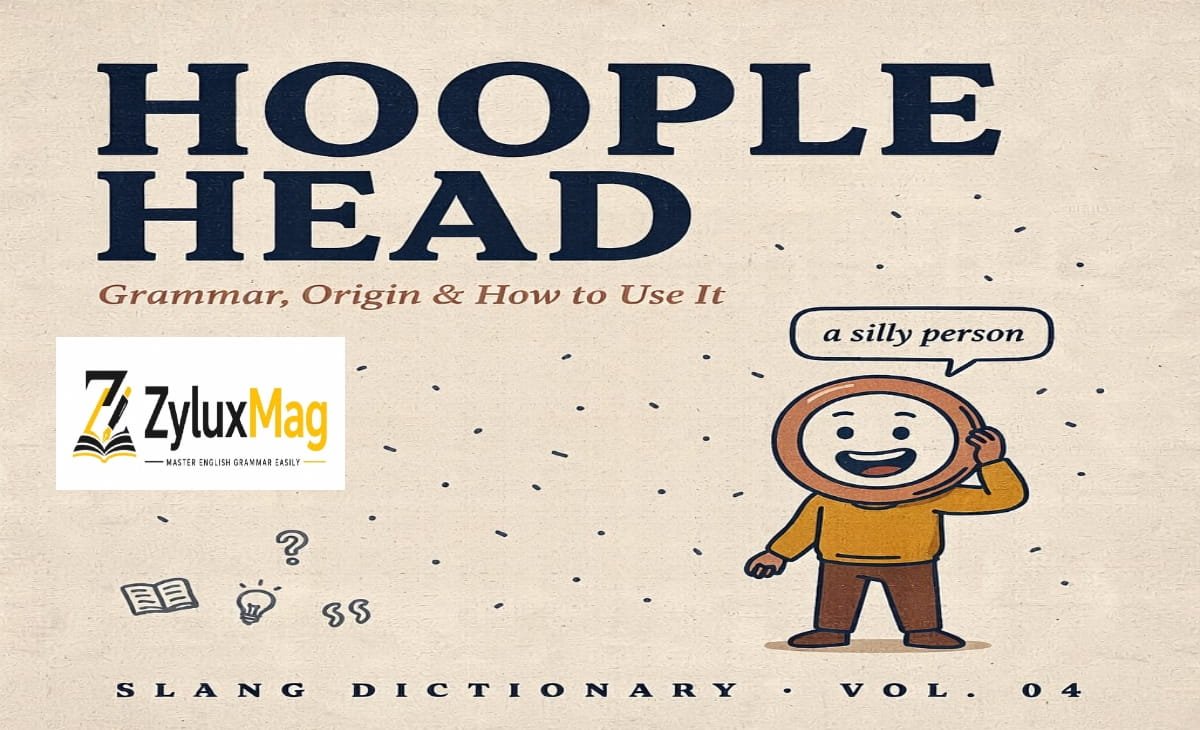
Hooplehead is an informal noun meaning a foolish, clueless, or uneducated person — a lighthearted insult similar to “blockhead” or “dimwit.” It’s slang, not standard dictionary English, and it’s best known from Al Swearengen’s dialogue in HBO’s Deadwood.
What Does “Hooplehead” Mean?
At its core, a hooplehead is someone who acts foolishly, misses the obvious, or doesn’t seem to think things through. The word carries two overlapping shades of meaning:
- An idiot or a fool — someone who makes a silly or careless mistake.
- An uneducated or unrefined person — someone treated as ignorant or “low-class.”
The tone matters more than the dictionary definition. Hooplehead rarely lands as a harsh, cruel insult the way “moron” or worse might. It usually sounds old-fashioned and a little theatrical — closer to calling someone a “nitwit” than attacking them seriously. Delivered with anger, it’s clearly an insult. Delivered with a grin, it’s closer to teasing.
Grammar at a Glance
| Feature | Detail |
| Part of speech | Noun |
| Plural | hoopleheads |
| Spelling variants | hooplehead (one word, most common) or hoople head (two words, the spelling used in Deadwood) |
| Capitalization | Lowercase — it’s a common noun, not a proper name |
| Register | Informal, slang |
| Standard dictionary status | Not found in Merriam-Webster or Dictionary.com; appears in slang references such as Green’s Dictionary of Slang |
| Tone | Playful to mildly cutting, depending on delivery |
“Hooplehead” vs. “Hoople Head” — Which Spelling Is Correct?
Both spellings are used, and neither is officially “correct,” since the word isn’t standardized in mainstream dictionaries. As a general guideline: the closed form, hooplehead, is the more common spelling in general use, while hoople head (two words) is the version most associated with the Deadwood scripts. If you’re writing for a general audience, the one-word form is the safer choice.
Is It Formal or Informal English?
Hooplehead is informal slang. It belongs in casual conversation, dialogue, or humorous writing — not in reports, emails, academic writing, or any context where you’d avoid words like “goofball” or “dimwit.” If you’re an English learner deciding whether a word is safe to use at work or in writing for school, treat “hooplehead” as a clear no.
Like lesser-known words such as frescade, ‘hooplehead’ isn’t widely used in modern English but still appears in specific contexts.
Where Does “Hooplehead” Come From?
The exact origin isn’t fully settled, and several theories circulate online. It’s worth separating what’s well-documented from what’s a popular guess.
The barrel-making theory (unverified): A frequently repeated story claims the word originally referred to workers who made the metal hoops around wooden barrels — low-skill work that supposedly made “hooplehead” a stand-in for “unskilled” and, by extension, “unintelligent.” This explanation is widely repeated across the internet, but it isn’t backed by slang lexicographers’ research, so it should be treated as folklore rather than confirmed history.
The Major Hoople theory (better documented): Slang researcher Jonathan Lighter, author of the Historical Dictionary of American Slang, traces the term to hoople — likely connected to Major Hoople, a blustering, dishonest, and none-too-bright character from the 1920s newspaper comic strip Our Boarding House, created by Gene Ahern. This theory has stronger documentation behind it than the barrel-maker story.
Did Deadwood invent the word? No. The show popularized it, but the term already existed. In fact, the timeline doesn’t add up for the show’s own setting: Deadwood takes place in the 1870s, decades before Major Hoople appeared in print in the 1920s and long before “hooplehead” shows up in recorded slang. The word’s use on the show is an anachronism — the writers picked a colorful-sounding insult without tracing its actual history.
A Quick Lesson I Learned the Hard Way
I once used “hooplehead” in a first draft for a client’s blog post — I thought it was a fun, punchy word to describe a clumsy character in a story. My editor called me five minutes later, laughing. “Do you know what that word actually means?” Honestly, I didn’t. I’d heard it in a Deadwood clip and just liked the sound of it. Turns out I’d basically called the client’s main character an idiot, in a tone meant for casual roasting, not the semi-formal piece we were writing. Ever since, I double-check slang before it goes anywhere near client work — no matter how good it sounds in my head.
How to Use “Hooplehead” in a Sentence
- “He forgot his umbrella again — total hooplehead move.” (light, self-deprecating tone)
- “Get out of my way, you hooplehead.” (sharper, closer to the Deadwood style)
- “The meeting was full of hoopleheads who hadn’t even read the report.” (plural form, workplace complaint — still informal, so best kept to speech or casual writing, not a formal email)
Notice that the same word can sound almost affectionate in one sentence and genuinely dismissive in another. Context and tone of voice carry most of the meaning.
Words With a Similar Meaning (and Their Opposite)
Similar in meaning: blockhead, dimwit, nitwit, fathead, lunkhead, goofball, dunce.
Opposite in meaning: someone sharp, educated, and sensible — words like “genius,” “sharp cookie,” or simply “smart person” work as the contrast.
You’ll notice a pattern: several of hooplehead’s closest synonyms — blockhead, fathead, lunkhead — follow the same structure, combining a body-part word (“head”) with something unflattering. This is a common and productive pattern in informal English insults, and hooplehead fits neatly into that family, even though “hoople” itself isn’t a real English word on its own.
Mistakes People Make With This Word
- Assuming Deadwood invented it. The show made it famous, but the term already existed before the series was written.
- Believing it refers to the town of Hoople, North Dakota. This is a coincidence people notice because the names are similar, not a documented origin.
- Treating the barrel-maker story as confirmed history. It’s a popular explanation, not a verified one — say “some believe” rather than stating it as fact.
- Using it in formal writing. It’s slang. Save it for dialogue, casual speech, or informal writing where its playful tone fits.
- Expecting to find it in a standard dictionary. It won’t appear in Merriam-Webster or Dictionary.com — you’ll only find it in slang-specific references.