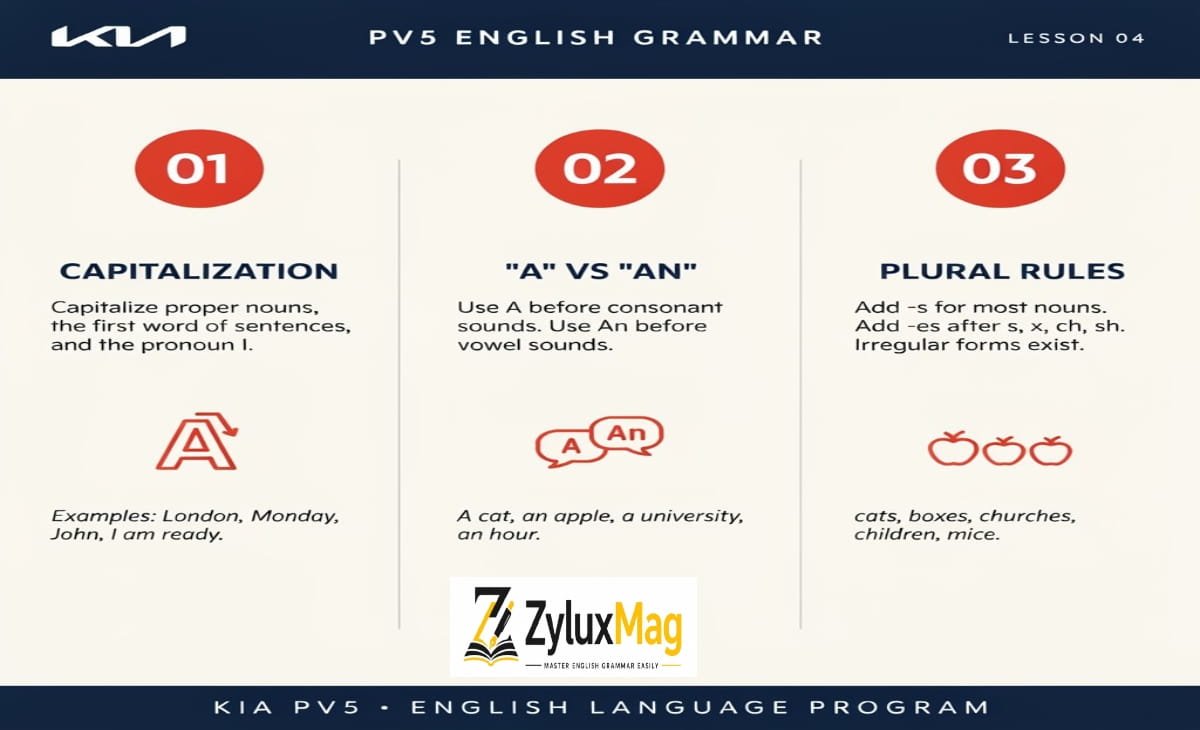
Short answer: Capitalize both parts — “Kia” and “PV5” — since it’s a proper noun followed by a model code. Use “a Kia PV5,” not “an,” because PV5 starts with a consonant sound. For more than one, write “PV5s,” never “PV5’s” — the apostrophe is only for possession.
Capitalizing Car Model Names
Car model names follow the same rule as any proper noun: capitalize every part that identifies the specific brand and model.
“Kia” is capitalized because it’s a company name. “PV5” is capitalized because it’s an alphanumeric model code — a mix of letters and numbers that functions like a name, not a regular word. This capitalization doesn’t change based on where the name sits in a sentence.
- Correct: The Kia PV5 comes in three configurations.
- Correct: Reviewers say the PV5 handles well in the city.
- Incorrect: The kia pv5 comes in three configurations.
Once a model name is established, you can drop the brand name and just use the model code (“the PV5”) if the context is already clear — but the capitalization stays the same either way.
“A Kia PV5” or “An Kia PV5”?
This is where most writers hesitate, because the rule for a vs. an is often misremembered.
The rule is based on sound, not spelling. Use an before a word that starts with a vowel sound, and a before a word that starts with a consonant sound — regardless of which letter it’s actually spelled with.
“PV5” is spoken as the letter names “P-V-Five.” The first sound is “pee,” which starts with a consonant sound (/p/). So the correct article is a, not an.
- Correct: A Kia PV5 was on display at the show.
- Incorrect: An Kia PV5 was on display at the show.
This is the same logic behind phrases like “a university” (starts with a “y” sound) or “an MBA” (starts with an “em” sound) — spelling doesn’t decide it, pronunciation does.
I learned this one the hard way, actually. Back in college, I was giving a presentation and confidently said “an PV5” out loud — my logic being, it starts with a letter, so it must need “an,” right? My professor didn’t even let me finish the sentence. He just said, “Say it again, slower.” I did, heard myself, and wanted to disappear into my chair. That was the moment I realized “a” and “an” aren’t about spelling at all — they’re about sound. I’ve silently sounded out words before saying them out loud ever since.
Making It Plural: “Kia PV5s,” Not “Kia PV5’s”
To make “PV5” plural, just add -s. No apostrophe a vs. an depends on sound, not spelling.
- Correct: Several Kia PV5s were parked outside the dealership.
- Incorrect: Several Kia PV5’s were parked outside the dealership.
The apostrophe version is a common mistake because it looks like it “needs” punctuation to separate the number from the added letter. But this is a regular plural, and regular plurals never take an apostrophe — the same rule that keeps “CDs” and “1990s” apostrophe-free applies here.
The apostrophe form (“PV5’s”) is only correct when you’re showing possession — something belonging to the PV5.
- Correct (possessive): The Kia PV5’s range increased this year.
- Correct (plural): Several Kia PV5s were tested.
- Incorrect: Several Kia PV5’s were tested. (this is a plural, not a possessive, so no apostrophe)
| Meaning | Form | Example |
| More than one PV5 | PV5s | Three PV5s arrived at the port. |
| Something belonging to the PV5 | PV5’s | The PV5’s battery charges in 30 minutes. |
Common Mistakes to Avoid
- Using “an” instead of “a.” Writers sometimes default to “an” because “PV5” starts with a letter that isn’t A, E, I, O, or U, and assume that settles it. It doesn’t — pronunciation decides the article, and “PV5” starts with a consonant sound.
- Adding an apostrophe to make it plural. “PV5’s” for “more than one” is one of the most common punctuation errors with model names and abbreviations in general. Save the apostrophe for possession only.
- Lowercasing the model code mid-sentence. “Kia pv5” is incorrect wherever it appears in a sentence — capitalization doesn’t reset partway through.
About the Author
Faizan Babar writes about English grammar and vocabulary, breaking down everyday writing mistakes into simple, practical rules. Drawing on years of hands-on writing experience — including the occasional real-life grammar slip-up — he focuses on making grammar feel less like a rulebook and more like common sense.