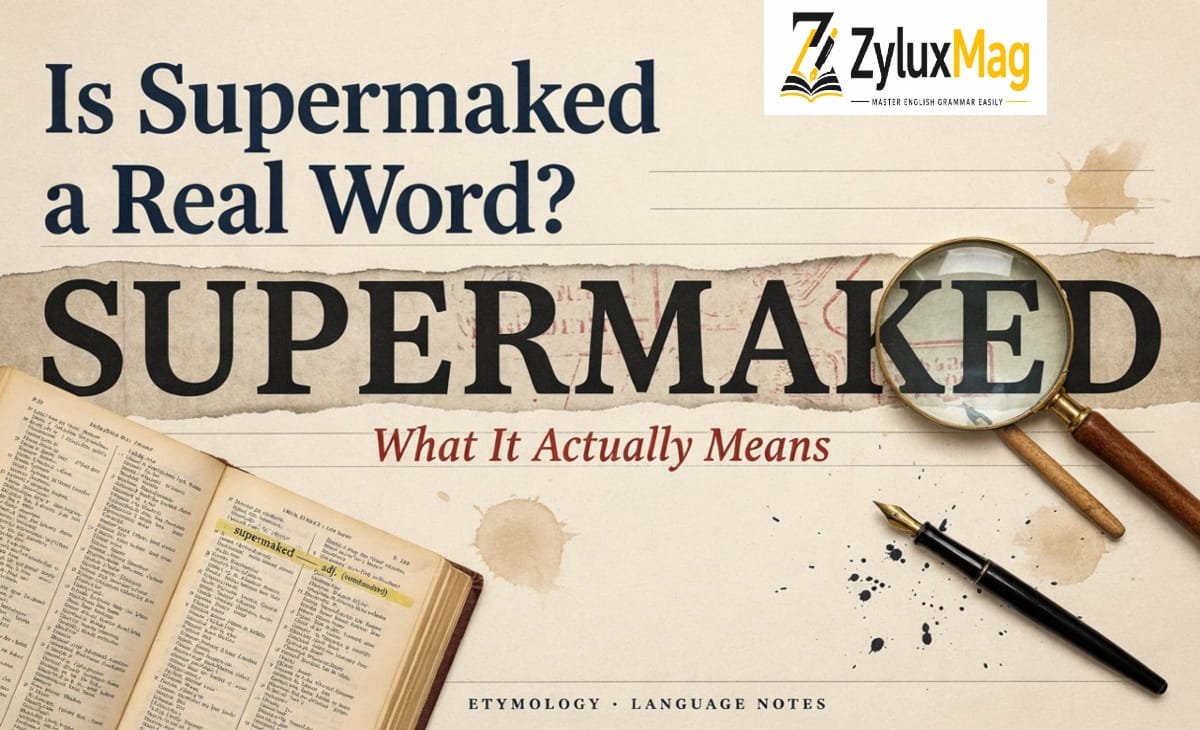
Quick answer: Supermaked is not a recognized English word. It doesn’t appear in any major dictionary and has no grammar rule or standard usage. You were most likely searching for “supermarket,” “unmasked,” or the motorcycle term “supernaked.” In a few cases, the word has spread because a website invented a definition for it that doesn’t actually exist in English.
Where “Supermaked” Actually Comes From
If you searched for “supermaked” and found an article confidently explaining what it means, that definition wasn’t pulled from a dictionary — it was made up.
There’s no dictionary entry for “supermaked” in Merriam-Webster, Oxford, Cambridge, or Collins. It has no etymology, no accepted spelling, and no grammar pattern that would explain how it’s formed. The handful of pages that do “define” it treat it as a shopping or lifestyle buzzword, built by mashing “super” onto a twisted version of “marketed.” That’s not how real English words are created, and it’s not backed by any linguistic source.
This kind of content usually comes from sites generating large volumes of articles around whatever terms show up in search data — including typos, autocomplete errors, and words that were never real to begin with. If a search term looks unfamiliar even though it sounds like English, it’s worth checking whether it’s an actual word before trusting an explanation of it.
A few years back, I was writing a shopping blog post on a tight deadline and needed one more “trendy” term to round out the piece. I found a site defining a word I’d never heard of, copied the definition almost word for word, and hit publish. Two days later, a reader commented asking where that word actually came from — because it didn’t exist anywhere else online. I’d trusted a source without checking it, and it taught me a lesson I never forgot: if a word only shows up in one random article, it’s probably not a word at all.
What You Were Probably Searching For
Supermarket
Supermarket (noun) is a large self-service store that sells food, household goods, and other everyday items.
- “We stopped at the supermarket to grab groceries on the way home.”
- “The new supermarket on Main Street has a much bigger produce section.”
This is the most likely match not a real English word. “Supermaked” and “supermarket” share the same first six letters, and it’s an easy typo to make, especially on a phone keyboard.
Unmasked
Unmasked (verb, past tense/past participle of “unmask”) means to have a mask, disguise, or hidden truth removed or revealed.
- “The performer finally stood unmasked in front of the crowd.”
- “The investigation unmasked years of financial fraud.”
If you added “super” in front of it for emphasis (“totally unmasked,” “completely unmasked”), that’s a natural way to intensify the word in casual speech — but “supermaked” isn’t a standard spelling or form of it.
Supernaked
Supernaked (also written “super naked”) is a real but niche term used in motorcycling. It describes a high-powered “naked” motorcycle — one with an exposed frame and engine, no fairings, built for speed and aggressive styling.
- “The Ducati Streetfighter is one of the most popular supernaked bikes on the market.”
- “Supernaked models trade wind protection for raw performance.”
This one is less common in everyday English, but if you came across “supermaked” in a motorsports context, this is likely the term you saw.
Quick Comparison
| Term | Real word? | Meaning | Example |
| Supermaked | ❌ No | Not a recognized English word | — |
| Supermarket | ✅ Yes | A large self-service grocery store | “I’ll pick up milk at the supermarket.” |
| Unmasked | ✅ Yes | Revealed; had a disguise or hidden truth exposed | “The scandal unmasked the truth.” |
| Supernaked | ✅ Yes (niche) | A high-powered, unfaired motorcycle | “He rides a supernaked bike.” |
How to Tell a Made-Up Word From a Real One
This isn’t the only invented term floating around online, so it’s a useful skill to check any unfamiliar word the same way:
- Check a real dictionary first. If a word isn’t in Merriam-Webster, Oxford, or Cambridge, treat that as a strong signal it isn’t standard English — not proof by itself, but a serious red flag.
- Look for an etymology. Real words have a traceable origin — a root, a borrowed language, a documented first use. Made-up words usually don’t, or the “explanation” is vague and made up on the spot.
- Be cautious of single-source definitions. If only one website defines a word and no dictionary or established publication uses it, that’s a sign the definition was invented rather than documented.
- Notice generic explainer language. Fabricated-word articles often describe a term as “gaining popularity” or “trending in [some] circles” without ever showing a real example of anyone actually using it that way.
If a search term fails more than one of these checks, it’s reasonable to assume it isn’t a real word — and to look for the real word it might be a typo or mishearing of, the way “supermaked” points back to “supermarket.”
About the Author
Admin writes about English grammar, vocabulary, and everyday language mistakes at ZyluxMag. With years of hands-on experience creating content across grammar and lifestyle topics, Admin focuses on clear, accurate, no-fluff explanations that help readers actually understand the language — not just memorize rules.