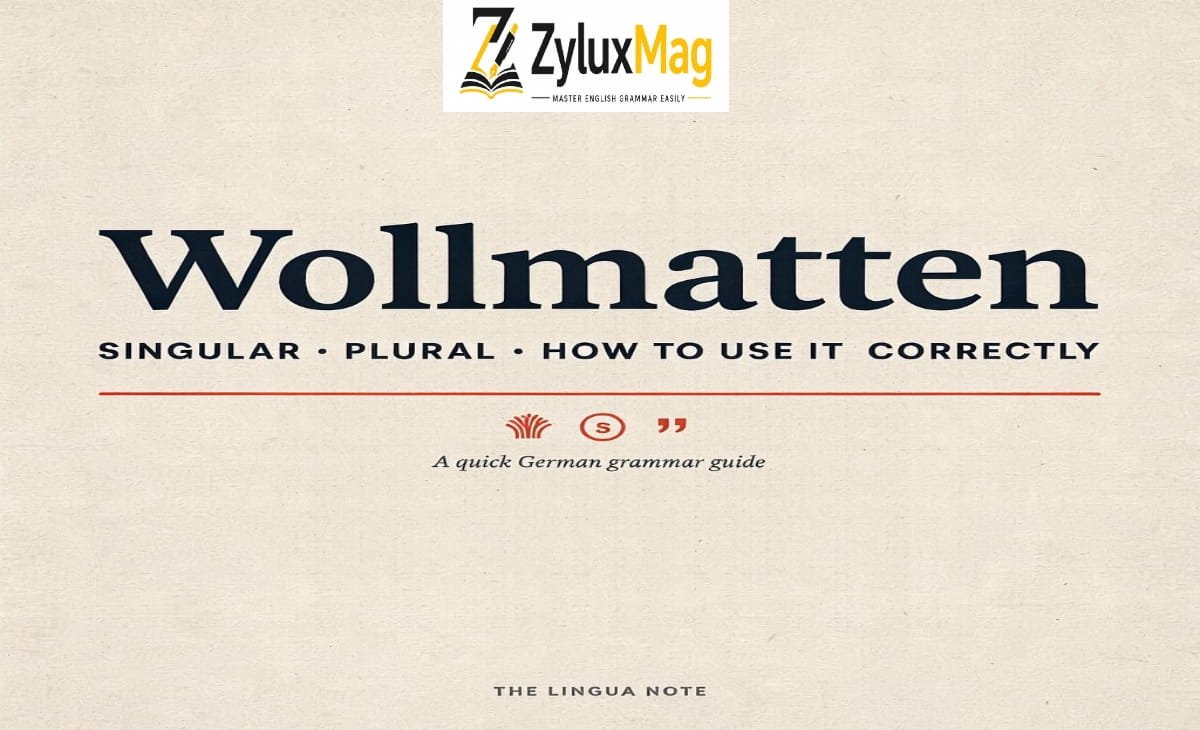
Wollmatten is a German word meaning wool mats (Wolle = wool, Matten = mats). It’s already plural in German — the singular form is Wollmatte. In English writing, don’t capitalize it mid-sentence, and don’t add an English “-s” to it (there’s no such thing as “wollmattens”).
What “Wollmatten” Means
“Wollmatten” is a compound of two German nouns: Wolle (“wool”) and Matten (“mats”). Put together, it simply means wool mats — mats made from sheep’s wool, most often used for insulation, flooring, or padding.
English doesn’t have one official, dictionary-standard word for this product, so the German term is sometimes borrowed directly into English text, especially in contexts related to natural building materials, sustainable home products, or wool crafts.
Is “Wollmatten” Singular or Plural?
“Wollmatten” is plural. The singular form is “Wollmatte.”
| Form | English meaning |
| Wollmatte | one wool mat |
| Wollmatten | wool mats (two or more) |
This trips people up because English speakers are used to adding “-s” to make a word plural, and “wollmatten” doesn’t look like a typical English plural. But the “-en” ending is a normal German plural pattern (similar to how English has irregular plurals like “child” → “children”). German simply pluralizes this word differently than English would.
Wollmatte vs. Wollmatten
- Wollmatte = a single wool mat
“I bought one Wollmatte for the hallway.” - Wollmatten = multiple wool mats
“I bought several wollmatten for the hallway.”
If you’re only talking about one mat, using “wollmatten” is incorrect — it already means more than one.
Do You Capitalize “Wollmatten” in English?
In German, all nouns are capitalized, which is why you’ll often see “Wollmatten” written with a capital W, even mid-sentence. That’s correct in German.
In English, this rule doesn’t apply. Nouns are only capitalized if they’re proper nouns (names, places, brands) or at the start of a sentence. So in an English sentence, “wollmatten” should generally be lowercase:
- ✅ “We used wollmatten to insulate the shed.”
- ❌ “We used Wollmatten to insulate the shed.” (unnecessary capitalization carried over from German)
The exception is simply when the word starts a sentence, the same as any other English noun how English handles comparative and word forms.
A Mistake I Made With This Word
I once took a freelance gig writing product copy for a company that sold natural home insulation, and half their reference materials were in German. I breezed past “Wollmatten” thinking it was just a fancy brand-ish word, capitalized it every single time like a proper noun, and sent the draft off feeling pretty confident. My editor sent it back with one line: “This isn’t a name, it’s just German grammar.” I felt my face go hot. That one comment taught me more about loanwords and capitalization than any style guide ever did.
Using “Wollmatten” Correctly in an English Sentence
| Sentence | Correct? | Why |
| “We insulated the attic with wollmatten.” | ✅ | Plural noun, lowercase, no extra ending |
| “We insulated the attic with a wollmatten.” | ❌ | “A” signals singular, but “wollmatten” is plural |
| “We insulated the attic with wollmattens.” | ❌ | Adds an English plural ending to a word that’s already plural |
| “Each wollmatte was cut to size before installation.” | ✅ | Correct singular form |
| “Each Wollmatten was cut to size before installation.” | ❌ | Wrong number (should be singular) and unnecessary capital |
The pattern to remember: treat “Wollmatte” the way you’d treat any singular English noun, and “wollmatten” the way you’d treat any plural English noun — just don’t add an extra “-s” to the plural form, since German has already done that job.
Common Mistakes to Avoid
- Using “wollmatten” as if it were singular — e.g., “a wollmatten,” “this wollmatten.” Since it’s already plural, pair it with plural verbs and quantifiers (“these wollmatten,” “several wollmatten”).
- Adding an English “-s” — “wollmattens” double-pluralizes a word that’s already plural in German.
- Capitalizing it out of habit — mid-sentence capitalization is correct German spelling but incorrect English spelling.
- Assuming it’s an established English dictionary word — it’s a borrowed German term, not standardized English vocabulary, so style guides and dictionaries won’t have a fixed “official” spelling rule for it in English.
Is There an English Word for It?
Not an official one. The closest natural English renderings are “wool mats” or “wool matting.” If you’re writing for an English-speaking audience and want to avoid the singular/plural confusion entirely, using “wool mats” instead of “wollmatten” is often the simpler choice — it behaves like a normal English noun and needs none of the rules above.
About the Author
Admin is the founder and lead writer at ZyluxMag, covering practical English grammar, vocabulary, and everyday writing mistakes for learners and professionals alike. Drawing on hands-on experience from freelance and editorial writing work, Admin focuses on the small language details that often get overlooked — but make a real difference in how clearly and confidently you communicate.