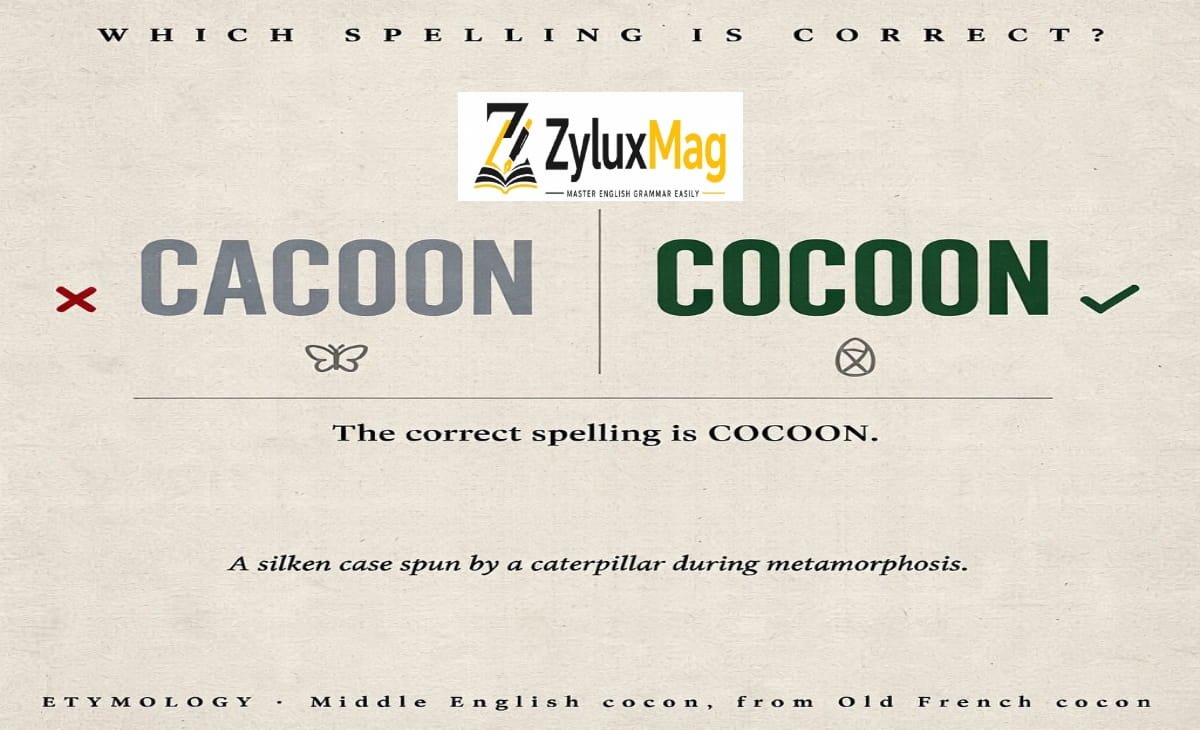
cacoon or cocoon is the correct spelling. “Cacoon” is not a standard English word for the silky casing an insect spins around itself — it’s simply a common misspelling caused by the way the word sounds when spoken.
What “Cocoon” Means
A cocoon is the protective silk casing that a caterpillar or other insect larva spins around itself before it transforms into its adult form. It’s the structure a caterpillar builds right before it becomes a moth.
The word isn’t limited to insects, though. In everyday English, “cocoon” is also used more broadly to describe anything that wraps someone in comfort, safety, or isolation — a blanket, a quiet room, even a mindset.
“Cocoon” can also work as a verb. To “cocoon” (or “cocoon yourself”) means to withdraw into a safe, comfortable space, shutting out the outside world for a while.
- The caterpillar formed a cocoon on the underside of the leaf. (noun)
- After a long week, she just wanted to cocoon on the couch with a blanket and a movie. (verb)
Why So Many People Write “Cacoon”
The mix-up isn’t really about carelessness — it’s about sound. When “cocoon” is spoken quickly, the first vowel can come out sounding closer to “ca” than “co,” especially in casual speech. That small gap between pronunciation and spelling is enough to make “cacoon” feel plausible, even though it isn’t a recognized word for this meaning.
English has several word pairs like this, where two spellings sound almost identical but only one is standard. “Cocoon” simply keeps its double “o” throughout — there’s no version of the word that swaps in an “a.”
“Cocoon” in a Sentence
| Correct | Incorrect |
| The caterpillar spun a cocoon on the branch. | The caterpillar spun a cacoon on the branch. |
| He wrapped himself in a blanket like he was in a cocoon. | He wrapped himself in a blanket like he was in a cacoon. |
| She cocooned herself at home for the weekend. | She cacooned herself at home for the weekend. |
How to Never Misspell It Again
A simple way to lock in the spelling: think of other everyday words with the same double “o” pattern, like balloon and raccoon. If you can spell those correctly, you already know the pattern “cocoon” follows — two o’s, no “a” anywhere in the word mistakes like naive vs nieve.
Is “Cacoon” Ever Correct?
In one narrow, unrelated context — yes. “Cacoon” (sometimes called the cacoon vine) is the name of a tropical climbing plant, Fevillea cordifolia, known for its large, hard, bean-like seeds. This is a botanical term with nothing to do with insects or metamorphosis.
So if you’re writing about a caterpillar, a moth, or the feeling of wrapping yourself up in comfort, the word you want is always cocoon — never “cacoon.”
A Mistake I Made With This Word
I once sent a pitch to a potential client describing my writing style as “helping brands cacoon their message in clarity.” I thought it sounded poetic. She wrote back one line: “Did you mean cocoon?” I stared at my screen for a full ten seconds, mortified. This was supposed to be proof I could write. Instead, I’d handed a stranger my one obvious typo, in a sentence I’d rewritten three times. I got the job anyway, but I never trusted spellcheck blindly again — now I read every pitch out loud before hitting send, slowly, letter by letter, especially the words I “just know” how to spell.
About Author
Written by Faizan Babar — a writer and editor at ZyluxMag who covers English grammar, spelling, and vocabulary with a focus on real, everyday writing mistakes. Faizan believes the best grammar lessons come from the errors people actually make, not just the rules in a textbook.