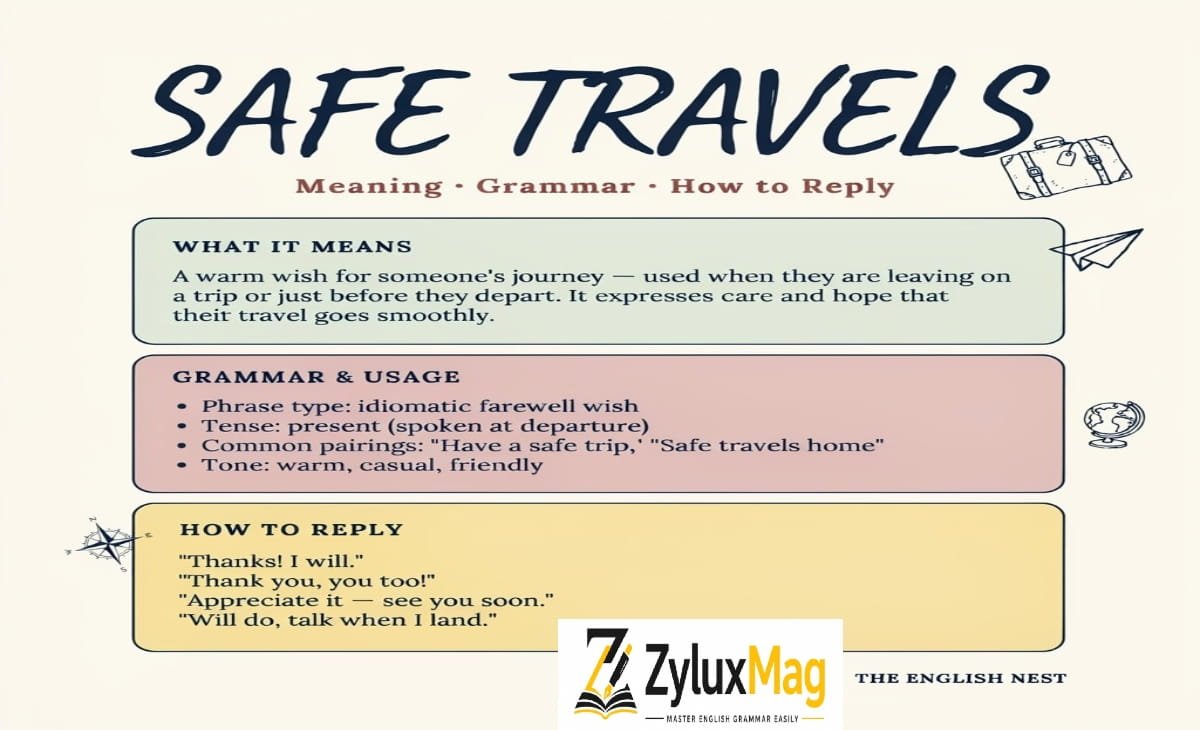
How to Use “Safe Travels” & Responses “Safe travels” is a standard, common idiomatic phrase which can mean “I hope you have a safe and enjoyable journey.” It is a phrase people say just before or just as someone is about to leave on a trip.
It isn’t an actual instruction, and it isn’t a full sentence in itself; it is a fixed phrase of well-wishes, similar in spirit to ‘take care’ or ‘have a good flight.’
“What does ‘Safe Travels’ mean?
Essentially, safe travels has 2 meanings rolled into one: you want the person to be safe, and you want the trip to be smooth. It is a shortened form of a much more formal expression: ‘I wish you safe travels’; the ‘I wish you’ part just gets dropped off, like in ‘good luck’ (dropping the ‘I wish you’). You usually hear or see this sort of phrase in moments like these: ‘Safe travels, Mom and Dad!
Text me when you land.’
‘It was nice to catch up!
Safe travels back to Chicago!’
‘Enjoy Bali!
Safe travels!’
Since ‘travels’ is plural, safe travels naturally refers to an entire trip, including all of its parts (the road trip, the airplane journey, the airport layover, the drive home) rather than just one single trip.
Is “Safe Travels” Grammatically Correct?
Yes. “Safe travels” is standard, widely accepted English. It just doesn’t follow the grammar of a normal sentence, because it isn’t one — it’s an interjection, a short expression used on its own to convey a feeling, the same way “congratulations” or “well done” are.
Here’s how the two words function:
| Word | Part of speech | Role in the phrase |
| Safe | Adjective | Describes the quality you’re wishing for the journey |
| Travels | Plural noun | Means “journeys” — the trip and everything involved in it |
Together, they form a fixed expression: adjective + plural noun, used as a stand-alone well-wish. There’s no verb, and none is needed — just like “nice weather” or “good luck” don’t need one either.
Why ‘Travels,’ Not ‘Travel’?
This is where the confusion is, so it is worth being precise: ‘Travels’ (plural noun) means journeys, trips, and everything involved in a person’s trip. This is the word you want to use with this phrase: ‘Safe travels!’ ‘Travel’ (count noun or verb) can refer to the general concept or act of traveling.
You will see it in things like ‘international travel’ or ‘talking about safe travel guidelines’ where it refers to travel as an overall activity instead of a specific person’s journey. So, when you’re wishing someone well before they set out, ‘safe travels’ (plural) is the right and natural choice. ‘Safe travel’ isn’t incorrect, but it is a different phrase, used to refer to travel as an overall activity instead of wishing someone well.
Safe Travels vs.
Also Safe Travel vs. Travel Safe(ly) These three phrases may look similar but don’t have the same meaning. Here’s how they compare: Phrase Word type In most contexts: …you want to say to a person before they leave on a trip… …you want to say about general (travel) activity …you want to say as an instruction or greeting… Safe travels Adjective + plural noun ‘Safe travels! See you when you get back from the trip.’
Safe travel Adjective + singular noun ‘We advise safe travel during the holidays.’
Travel safe(ly) Verb (imperative) + adverb ‘Have a safe trip.’ or, more formally, ‘Travel safely!’ A quick note on the last one: strictly speaking, the adverb ‘safely’ is the grammatically correct word here (as adjectives describe nouns, not verbs). ‘Travel safe’ is an example of a flat adverb, which is a bit more common in speech and informal writing, but ‘travel safely’ is the safer choice in more formal speech.
When Should You Say “Safe Travels”?
You should say ‘safe travels’ when someone is on their way out, genuinely about to leave on a trip (by plane, car, bus, or train, or perhaps even on foot). It applies whether the journey is a short one or a long one, whether the person is alone or with other people, and whether the journey involves many different stages or just the one.
You should not use ‘safe travels’ when the person isn’t really going anywhere.
The most common mistake with this phrase is using it as a kind of general farewell, for instance, to a co-worker who is simply leaving work at the end of the day, or to a neighbor who is heading out to do some errands around town. Since the phrase literally says ‘have a safe journey,’ using it outside of travel-related contexts sounds strange or confusing. In everyday life, ‘take care’ or ‘see you later’ are usually better choices.
I once yelled ‘safe travels!’
across an airport lounge as a friend prepared to embark on her two-week trip to Portugal, like I had planned on it being my new signature sign-off.
She just looked back at me with a small smile and said, ‘You’ve been saying that to me every time I leave for work too,’ and I realized I had actually been using the phrase to say goodbye for everyday occasions, not necessarily travel. ‘Safe travels’ is such a small phrase, but now that I know what it really means, I think it belongs to the occasions where it actually makes sense. Should You Say “Safe Travels” When Someone Is Not Going Somewhere?
If someone isn’t about to travel somewhere, then it doesn’t make sense to use this phrase. That rule is simply that you shouldn’t use it in situations where the person isn’t really about to travel somewhere. It does not hold, as in English, when the phrase is ‘about’ something else – for example, you don’t want to say ‘safe travels’ when you are talking about general life (‘doctors’ safe travels to you’- what exactly are they safe travels from?’), and that doesn’t mean you want to say ‘safe travels’ to anyone else, either.
When Should You Say “Safe Travels”?
You should say ‘safe travels’ when someone is actually about to leave on a trip (by car, plane, train, ship, or on foot). You should say it no matter how long or short the trip is, how many people are involved, or whether the trip involves a single destination or multiple stops along the way.
When Shouldn’t You Say “Safe Travels”?
You shouldn’t say ‘safe travels’ when someone isn’t actually going on a trip.
The most common time to use this phrase incorrectly is when you use it as a general farewell to someone who is simply leaving a place of employment or a social gathering, rather than someone who is actually leaving on a trip.
In those kinds of situations, ‘safe travels’ sounds unnatural and isn’t the appropriate way to say farewell. You instead want a phrase that conveys that you hope they have a good day or night, such as ‘bye’ or ‘see you later what “stay frosty” means and how it’s used.
Should You Say “Safe Travels” to a Colleague?
You should say ‘safe travels’ to a colleague who is traveling for business, especially if they have an important or lengthy trip. Since your colleague is traveling for business, ‘safe travels’ will convey the same sense of well-wishing as if you were wishing someone well who was going on a personal trip.
Is “Safe Travels” Formal?
While it’s a little casual compared to a formal declaration like ‘May you travel safely,’ in the context of business travel, ‘safe travels’ is perfectly acceptable.
If you want to make the phrase a little more formal, you can simply say ‘Have a safe trip.’
How to Reply to “Safe Travels”
A simple “thank you” is always a correct and sufficient response — there’s no obligation to say anything more elaborate. That said, here are a few natural options depending on the tone of the conversation:
- Casual: “Thanks! Will do.”
- Warm/personal: “Thank you — I’ll text you when I land.”
- Professional: “Thank you, I appreciate that.”
There’s no fixed “correct” reply — the goal is simply to acknowledge the kindness behind it.
Where the Phrase Comes From
Here’s a detail that surprises a lot of people: the word “travel” actually comes from the Old French word travail, meaning hard toil or suffering — which itself traces back to a Latin word for a torture device made of three stakes. In the 1300s, “travailen” meant “to make a difficult journey,” reflecting how genuinely arduous travel used to be. Over the following centuries, the word softened in meaning and eventually settled into the spelling “travel” by around the 1600s — losing its painful connotations along the way, even though “travail” (meaning hardship) still exists in English today as a separate word.
So in a sense, wishing someone “safe travels” carries a faint echo of a much older wish: that their journey wouldn’t be the ordeal it once so often was.
Other Ways to Say “Safe Travels”
- Have a safe trip — a straightforward, slightly more literal alternative.
- Have a safe journey — a good fit for slightly more formal contexts.
- Bon voyage — a French-derived phrase with a more elegant, formal tone.
- Fly safe — used specifically when someone is traveling by air.
- Godspeed — an older, more traditional expression wishing someone success and safety on their way.
About the Author
Faizan Babar is the founder and lead writer at ZyluxMag, where he writes about English grammar, vocabulary, and everyday language use. He’s passionate about breaking down confusing grammar rules into simple, practical explanations that people can actually use in real conversations, emails, and everyday writing.