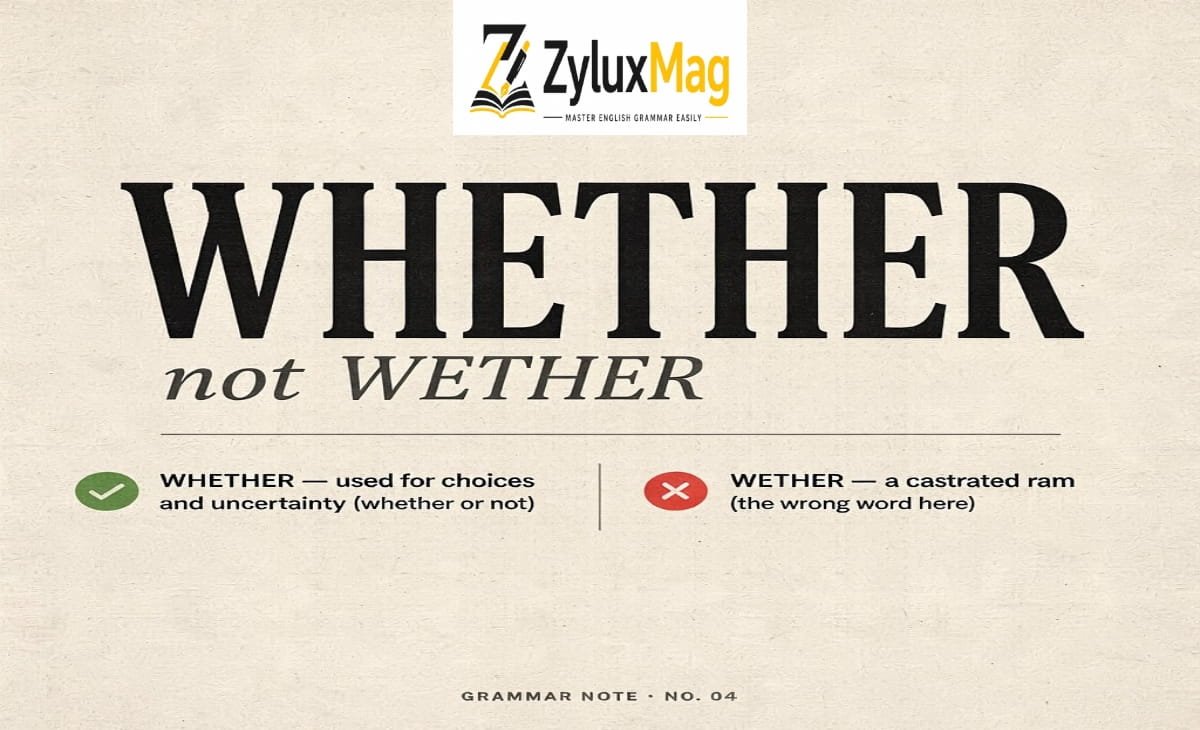
Actually, it’s “whether” in practically every sentence that can be. As a conjunction, it’s interchangeable with “if” and signals a choice or possibility, like: “I don’t know whether she’s coming. “Wether,” on the other hand, is a real word, but rarely relevant outside animal husbandry: it’s a castrated male sheep or goat.
In almost every context except farming and livestock, you’re meant to use “whether.“
If you’re unsure which one fits, chances are you need whether. Here’s a more in-depth breakdown and how to avoid confusion moving forward.
During a college seminar I had one of those moments where I accidentally wrote the wrong word on a slide – and made it prominent with big bold letters right at the top. What I wrote was ‘whether. When I presented the slides to the class.
My professor stopped mid-sentence, squinted at the screen, and then asked if anyone had an idea of what a “wether” was.
There was silence. Then, when I was sure I wouldn’t pass, he announced: “it’s a castrated sheep.” The class erupted in laughter. I was mortified and wished I could evaporate from my seat.
Even though the spell checker never highlighted a thing (because technically I’d typed a real word, just the wrong real word), the mistake was still etched forever into my memory and I never mixed those two up again frequently confused English spellings.
What “Whether” means
As a conjunction. “Whether”introduces doubt. It often looks exactly the same as “if,” and it truly can be an interchange between words. You’ll find “whether” most often under these conditions:
* When you need to refer to an indirect question; “I’m curious whether it’s going to rain.”
* When you’re trying to express a choice between two options or more; “Whether you drive, take a bus, or a plane, you’ll eventually get to their house.”
* When it immediately follows common verbs like: decide, ask. Know, wonder, and doubt. “She doesn’t know whether to eat there or order in.”
How to Use It in a Sentence
Here are few examples to bring “whether” into use:
“I don’t know whether that will be available by the time you arrive.”
“He called earlier whether or not you would take the meeting.”
“Have they agreed whether they can meet tomorrow?”
“It doesn’t make a difference to me whether you arrive by day or by night.”
Notice how with many of these, even when it seems like there are no alternatives presented, there are two present in context: you either have two opinions on whether an issue needs to be resolved or you either like one flavor or another.
What “Wether” Means (And Why It Will Almost Never Be Right)
As a noun, a wether (the other spelling) is a castrated male sheep or goat. For most English speakers who aren’t farmers and have never worked on a farm, this word likely won’t appear in any conversation they’ve ever had. A “wether” is mainly a livestock term.
“The farmer sheared a wether to prevent its fleece from becoming matted and unusable. “
“This lamb is still small but if it grows well, it will soon be fattened to become a wether to be sold at the market.”
Unless you’re writing an essay, article, or story about livestock, it’s safe to say that any time you’re staring at the word “wether”, you meant “whether”.
Whether vs. Wether vs. Weather — Don’t Let the Third One Trip You Up
There’s a third word that gets pulled into this confusion just as often: “weather,” meaning the state of the atmosphere (rain, temperature, wind, and so on). All three words sound alike or very close to alike, which is exactly why they get swapped by accident — especially with autocorrect.
| Word | Part of Speech | Meaning | Example |
| Whether | Conjunction | Introduces a choice or possibility (like “if”) | “I don’t know whether to stay or go.” |
| Weather | Noun / Verb | The state of the atmosphere; or to endure something | “The weather turned cold overnight.” |
| Wether | Noun | A castrated male sheep or goat | “The wether grazed near the barn.” |
A quick way to keep them straight: if you could swap in the word “if,” you want whether. If you’re talking about the sky, temperature, or storms, you want weather. If you’re talking about a sheep, you want wether — and that last one will rarely apply to you.
Use These “Whether” Rules to Your Advantage
Whether vs. If – Can I switch them?
They often can be switched, and in casual writing, they might be so often used interchangeably that people believe they are synonyms.
“She told me whether or not she was going to make it to the presentation. “
“She told me if or not she was going to make it to the presentation. “
For more formal writing or when dealing with sentences that directly pose an either/or choice, “whether” will often be read as the only truly acceptable way to phrase the sentence. For instance, here, “whether” is preferable:
“The board will discuss whether to invest their profits in expansion or buyback. “
Here, it isn’t ideal.
And remember, “if” cannot go before a preposition. “The issue of whether…” is correct, while “the issue of if…” is incorrect.
Is the phrase “whether or not” redundant?
In many contexts it might be redundant. However, when the words stand alone like this, they’re usually written as a unit. When you use “whether or not” for purposes that express “irrespective of the circumstances,” you generally need them together.
“We’re going to the concert whether or not he approves. “
Removing the “or not” here completely changes the tone of the sentence, suggesting you need approval and the issue of whether depends on it entirely.
Common Mistakes to Keep in Mind
* People make the error of mixing up either “weather,” “whether,” or “wether.”
* Autocorrect may save you and not spell-check it wrong.
* Assuming “whether” isn’t important to use correctly.
* Confusing “if” for “whether.”
* Forgetting that there are sometimes real-world differences between them.
Wether Today, bellwether in the future:
There is only one term where you may find “wether” being used in regular, everyday language even for most English speakers who have never lived on a farm, and that’s bellwether.A bellwether was the name given to the lead lamb that has a bell on it to let the herders know exactly where the herd is. In English today this figurative meaning allows for us to represent a person, place or thing that signals or indicates a broader trend, e.g: “He’s really become the bellwether for technology”. This is probably as much as you would ever need to worry about concerning the word ‘wether’ ever.
Quick Self-Check
Next time you’re unsure which word to use, ask yourself:
- Could I replace it with “if”? → Use whether.
- Am I talking about the sky, temperature, or a storm? → Use weather.
- Am I talking about a sheep or goat? → Use wether (this will almost never be the case).
One more note on pronunciation: some speakers pronounce the “wh” in “whether” with a slight puff of breath, making it sound just barely different from “weather” and “wether” — but for most English speakers today, all three sound identical, which is exactly why the spelling matters so much.
About the Author
Faizan Babar is the writer behind ZyluxMag’s English grammar and vocabulary section, where he breaks down commonly confused words and everyday writing mistakes into simple, practical explanations. His approach comes from years of hands-on writing experience — including the occasional embarrassing typo that taught him a lesson the hard way.